AI Infrastructure
Document Parsing for RAG: Evaluating Docling, PyMuPDF, and LlamaParse
Most RAG debugging effort goes into embeddings and vector databases. The bug is often three steps earlier, in whatever flattened your PDF into a string.
- Parsing is an information-preservation layer, not a formality. Parsing quality bounds chunking quality, which bounds retrieval precision, which bounds generation accuracy.
- PDFs have no native concept of "paragraph" or "table." Unless a PDF is explicitly tagged, a parser is reconstructing structure from raw glyph coordinates, not reading structure that was already there.
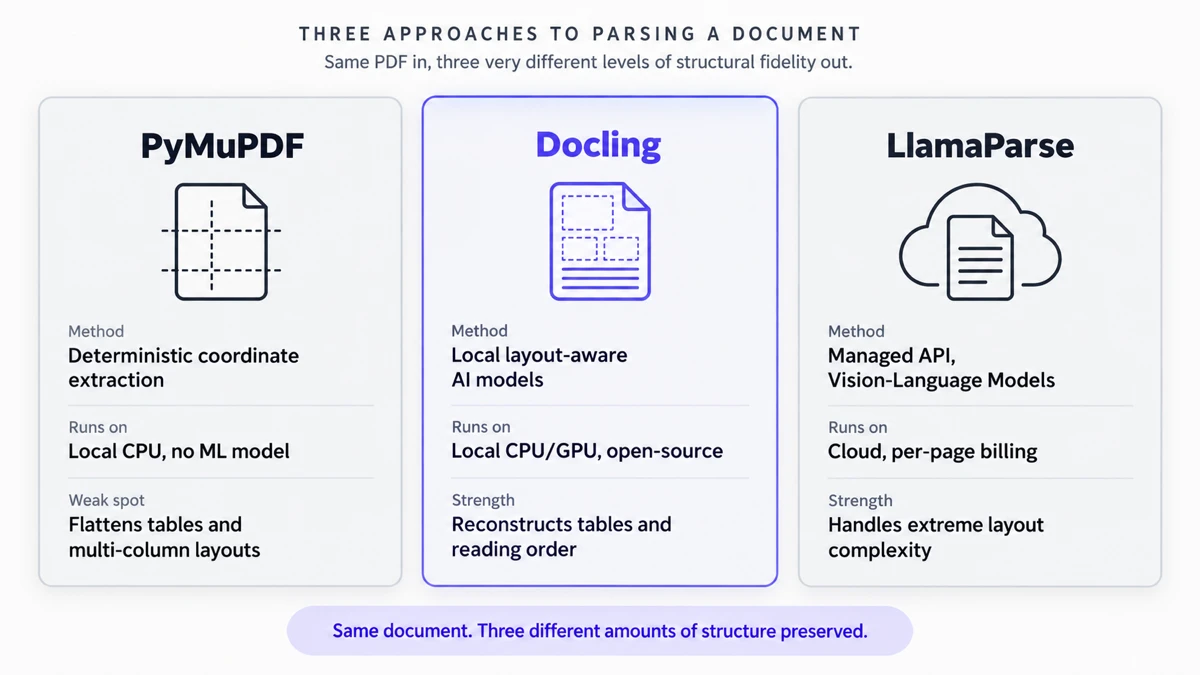
- PyMuPDF is fast and deterministic, but structure-blind. It's the right default for linear, digitally generated text, and the wrong choice for complex tables or multi-column layouts.
- Docling and LlamaParse solve the same problem differently. Docling runs layout-aware models locally; LlamaParse runs a managed API, in its higher tiers backed by Vision-Language Models.
- Better parsing doesn't guarantee better RAG accuracy. It removes a source of unrecoverable information loss, but retrieval and generation quality still depend on chunking strategy and everything downstream.
- Most production systems shouldn't pick one parser. A tiered router that escalates only the pages that need it keeps both compute cost and API spend under control.
- Why Document Parsing Is a RAG Problem
- OCR vs PDF Text Extraction vs Document Understanding
- The Table Problem: Preserving Relational Semantics
- PyMuPDF: Deterministic Extraction
- Docling: Open-Source Layout Understanding
- LlamaParse: Managed Multimodal Parsing
- Feature Comparison and Decision Matrix
- Cost Modeling the Parsing Layer
- A Tiered Document Parsing Architecture
- Benchmarking Methodology and Its Limitations
- Final Takeaways
- Frequently Asked Questions
Why Document Parsing Is a RAG Problem
When engineering a Retrieval-Augmented Generation system, architectural attention typically goes to embedding models, vector databases, and LLM orchestration. Production RAG systems frequently underperform anyway, because the text going into the vector database lacks structural integrity in the first place.
A document is a visual and structural hierarchy: headings, paragraphs, multi-column layouts, tables, headers, footers, figures, footnotes. Naive extraction flattens that hierarchy into a raw string, discarding the semantic relationships that existed in the original layout.
Document parsing has to be treated as an information-preservation layer. The causal chain runs: parsing dictates structural integrity, which dictates chunking quality, which bounds retrieval precision, which constrains generation accuracy. Better parsing doesn't automatically guarantee better RAG accuracy, since retrieval and generation depend on everything downstream, but poor parsing introduces information loss nothing downstream can recover.
The RAG Ingestion Pipeline
The ingestion side of RAG follows a strict sequence: Source Document → Parsing → Structural Representation → Cleaning → Chunking → Embedding → Vector Store. The parser's job is translating information from a visual layout domain (a PDF) into a machine-readable data domain (JSON, HTML, or Markdown).
Why Naive PDF Extraction Degrades Context
PDF prioritizes consistent visual rendering over logical data structure. Unless a document is authored as a "Tagged PDF," it typically has no embedded markers identifying a paragraph or a table, just drawing instructions for placing glyphs on a coordinate plane. A basic text parser reads those instructions and orders text using geometric heuristics, which causes predictable failures on complex documents:
- Column interleaving: in a two-column paper, reading linearly across page coordinates interleaves the left column's text with the right column's.
- Header/footer contamination: page numbers and footers get extracted as main text, splitting paragraphs across page boundaries and polluting semantic chunks.
- Table flattening: without border detection or row/column mapping, tabular data collapses into an unstructured sequence.
- Caption detachment: figure captions detach from their images and end up as isolated text blocks.
Structurally corrupted text produces embedding vectors that don't accurately represent the document's true meaning, no matter how good the embedding model is.
OCR vs PDF Text Extraction vs Document Understanding
Evaluating parsers requires the technical distinctions between extraction methodologies. They're a rough evolution of capability, though modern tools blend them.
1. PDF Text Extraction (coordinate-based)
Reads the internal text layer of a digital PDF, mapping character codes to Unicode values via deterministic, algorithmic parsing. Fails entirely on rasterized or scanned documents that lack a text layer, and relies on coordinate heuristics rather than semantic object classification.
2. Optical Character Recognition (OCR)
Extracts text from pixels using pattern recognition (CNNs or LSTMs, as in Tesseract or EasyOCR). Foundational OCR solves the "no text layer" problem but is largely structure-blind, though modern OCR engines increasingly bundle basic layout detection, blurring the line with Document AI.
3. Layout Analysis and Document AI
Reconstructs reading order and layout structure by detecting bounding boxes for page regions and classifying them (Title, Text, Table), using object detection models trained on document datasets like PubLayNet or DocBank. Meaningfully higher computational cost than deterministic extraction.
4. Multimodal / VLM Parsing
Uses Vision-Language Models to process a document page natively as an image, reasoning about text and layout simultaneously and often outputting structured schemas directly. Relies on large parameter models, which means GPU compute or a cloud API dependency.
The Table Problem: Preserving Relational Semantics
Tables expose the limits of basic parsers fastest. Consider a simple financial table:
| Product | Q1 | Q2 | Q3 |
|---|---|---|---|
| Alpha | 10 | 12 | 15 |
| Beta | 8 | 11 | 13 |
Parsed purely by Y-coordinate, a naive extractor outputs a single run: Product Q1 Q2 Q3 Alpha 10 12 15 Beta 8 11 13. Once that's chunked and embedded, the numerical relationships are severed. Ask "What were Beta's Q2 sales?" and the retrieval system may fail to find the relevant chunk, or the LLM may fail to align the entity with the correct column.
The structural solution: layout-aware parsers apply Table Structure Recognition (TSR). They locate the table's bounding box, detect rulings or whitespace alignment, resolve merged cells, and output a structured representation, typically HTML, JSON, or Markdown grids.
Markdown isn't universally sufficient, though. Complex tables spanning multiple pages, with hierarchical headers or merged cells, often degrade even in Markdown. In advanced pipelines, JSON or HTML intermediate representations are the more reliable choice, since they support row/column-aware chunking strategies instead of a standard recursive text splitter that has no concept of a grid.
PyMuPDF: Deterministic Extraction
PyMuPDF is a Python binding for MuPDF, a lightweight PDF, XPS, and e-book rendering engine written in C.
Architecture
PyMuPDF operates on the document's binary structure, parsing the PDF object tree and reading glyph coordinates without any machine learning model inferring layout. Calling page.get_text("blocks") returns text grouped by proximity and line-height calculations, which is a geometric heuristic, not a semantic one.
Characteristics
- Throughput: C-level algorithmic parsing gives it high throughput with minimal CPU utilization.
- Deterministic output: the same PDF always produces the same output, none of the variance inherent to generative models.
- Metadata extraction: extracts exact fonts, text colors, and bounding box coordinates.
Engineering Limitations
- Structure blindness: struggles with complex borderless tables and nested multi-column layouts, since its grouping heuristics are geometric, not semantic.
- No built-in OCR: extracts nothing from a scanned-image PDF unless explicitly paired with an external OCR library.
- Licensing: PyMuPDF is AGPL-3.0, not permissively licensed. Using it inside a closed-source product, an internal company tool, or a SaaS backend, even without redistributing the code, generally requires a paid commercial license from Artifex rather than the free AGPL terms.
When to Use It
PyMuPDF is the right architectural choice when the corpus is digitally generated PDFs with linear reading order (standard text contracts, for example), ingestion throughput or low compute cost is a primary constraint, and the licensing terms fit your product's distribution model.
import fitz  # PyMuPDF

doc = fitz.open("financial_report.pdf")
text_blocks = []

for page in doc:
    # "blocks" heuristic attempts to group paragraphs
    blocks = page.get_text("blocks")
    for b in blocks:
        text_blocks.append(b[4])  # index 4 contains the text

print("\n".join(text_blocks))
Docling: Open-Source Layout Understanding
Docling started as an IBM Research project, open-sourced under the MIT license in mid-2024, and has since been donated to the Linux Foundation's Agentic AI Foundation. It's a local, model-driven document parsing toolkit that treats parsing as a layout reconstruction problem rather than a text-extraction problem.
Architecture and Document Representation
Docling parses documents into an internal data model called the DoclingDocument, mapping elements like Text, SectionHeader, Table, and Figure. The pipeline typically involves:
- Format conversion: handles PDF, DOCX, PPTX, and HTML.
- Layout analysis: object detection models segment page bounding boxes; Docling's early-2026 release added Granite-Docling-258M, an Apache 2.0 vision-language model, as an alternative to the traditional layout-model pipeline.
- Table Structure Recognition: a dedicated model, TableFormer, deduces row/column spans, including merged cells and hierarchical headers.
- Reading order reconstruction: sorts bounding boxes into a logical narrative sequence.
- OCR integration: applies OCR (EasyOCR, Tesseract, or RapidOCR) when bitmap text is detected.
Characteristics
- Structural preservation: converts complex PDFs into structured Markdown or JSON, maintaining table grids for downstream processing.
- Data privacy: runs entirely locally; source documents never leave the host infrastructure.
- Unified output schema: standardizes diverse file formats into one predictable data structure.
Engineering Limitations
- Compute constraints: layout detection and TSR need meaningfully more compute than deterministic extraction. CPU processing works, but GPU acceleration (CUDA/MPS) is generally needed for throughput on large corpora.
- Environment footprint: requires managing a Python environment with PyTorch dependencies and model weights.
When to Use It
Docling fits when semantic structure, reading order, and table reconstruction matter for the RAG use case, and data privacy, air-gapped environment requirements, or avoiding recurring API costs push toward local execution.
from docling.document_converter import DocumentConverter

converter = DocumentConverter()
# Runs the layout analysis, TSR, and OCR pipeline as configured
result = converter.convert("research_paper.pdf")

# Export to Markdown for downstream chunking
markdown_output = result.document.export_to_markdown()
print(markdown_output)
LlamaParse: Managed Multimodal Parsing
LlamaParse is a commercial document parsing API from the creators of LlamaIndex, built specifically to generate context formatted for LLM consumption.
Architecture and Parsing Capabilities
LlamaParse runs as a managed cloud service with several parsing tiers. Its higher tiers incorporate Vision-Language Models alongside proprietary parsing heuristics, processing the visual representation of the page instead of relying solely on coordinate extraction or standard object detection. Based on its documented capabilities, this lets the service interpret complex or poorly bordered tables, transcribe mathematical formulas into LaTeX, and process scanned documents natively by reasoning about pixels, without a separate OCR step.
Characteristics
- Complex layout handling: designed for edge cases like highly stylized presentations, nested financial tables, and dense infographics.
- Operational simplicity: no ML environment, PyTorch dependencies, or local GPU provisioning to manage.
- Ecosystem integration: native integration with the LlamaIndex framework.
Engineering Limitations
- Network latency and API limits: uploading PDFs and waiting on cloud-side inference adds latency and subjects the pipeline to vendor rate limits.
- Data governance: documents are processed on external servers, which can conflict with strict data-residency or air-gapped requirements.
- Variable, tiered cost: billing is credit-based and tier-dependent. As of mid-2026, LlamaParse's four parse tiers (Fast, Cost-Effective, Agentic, Agentic Plus) consume roughly 1, 3, 10, and 45 credits per page respectively, at $1.25 per 1,000 credits, meaning the most capable tier costs on the order of 45x the cheapest one per page. At high ingestion volumes on the higher tiers, API spend can exceed the amortized infrastructure cost of hosting a local model.
When to Use It
LlamaParse fits architectures where document diversity is extreme, operational simplicity is prioritized over infrastructure management, and the organization accepts cloud processing plus a recurring, tier-dependent API bill.
from llama_parse import LlamaParse

parser = LlamaParse(
    api_key="llx-...",
    result_type="markdown"
)

# Uploads to API, parses, and returns LlamaIndex Document objects
documents = parser.load_data("invoice_scan.pdf")
print(documents[0].text)
Feature Comparison and Decision Matrix
Parser selection is conditional on document complexity, infrastructure ownership constraints, and performance requirements.
| Feature | PyMuPDF | Docling | LlamaParse |
|---|---|---|---|
| Architecture | Deterministic (C-based bindings) | Local AI models (layout/TSR) | Cloud API (heuristics + VLMs) |
| Table extraction | Text blocks only | Structured representation | Structured representation |
| Reading order | Geometric heuristics | Model-driven layout analysis | VLM / proprietary heuristics |
| OCR capability | External library required | Integrated pipeline options | Inherent to VLM modes |
| Compute location | Local | Local (GPU recommended) | Managed cloud |
| Document Type | PyMuPDF | Docling | LlamaParse |
|---|---|---|---|
| Digital text PDFs | High throughput, low cost | Capable, higher compute cost | Capable, higher API cost |
| Multi-column papers | Risk of interleaved columns | Reconstructs reading order | Reconstructs reading order |
| Complex tables | Flattens tabular relationships | Grid reconstruction | Grid reconstruction |
| Scanned documents | Fails without external OCR | Processes via integrated OCR | Processes via visual models |
Cost Modeling the Parsing Layer
The economic equation for a parsing layer is Total Cost = Compute + API Fees + Engineering/Ops + Storage + Reprocessing.
- Commercial APIs (LlamaParse): OPEX-driven. Monthly cost roughly equals documents per month times average pages times the tier's per-page fee.
- Local models (Docling): compute-driven. Cost per page is roughly the GPU or CPU instance's hourly cost divided by pages processed per hour, so real-world efficiency depends heavily on hardware utilization.
- Deterministic (PyMuPDF): compute cost is typically negligible thanks to high CPU efficiency, though a commercial license fee may apply depending on how the product is distributed.
The reprocessing factor: parsing technology evolves, and superior layout models eventually mean re-parsing historical corpora. API models charge per page again for reprocessing; local models consume compute time again; deterministic extractors re-run near-instantly, which is itself a point in their favor for corpora that get revisited often. This is also relevant to the broader question of cost-aware AI infrastructure scaling, since ingestion cost compounds with corpus size in a way inference cost usually doesn't.
A Tiered Document Parsing Architecture
Rather than picking a single parser for an entire diverse corpus, mature RAG ingestion systems often use a tiered document router that limits expensive ML compute or API calls to only the pages that actually need them, a pattern that mirrors the routing logic used in adaptive and corrective RAG more broadly.
- Low-cost signals: a lightweight script can check for a valid text layer, count image blocks, or measure text density before committing to anything expensive. High text density with no vector lines routes straight to PyMuPDF.
- High-cost signals: a lightweight layout classifier detects columns or tables before committing to full VLM extraction.
- Page-level escalation: a 100-page report might have 90 pages of standard text and 10 pages of financial tables. The pipeline runs PyMuPDF on the 90 text pages and escalates only the 10 table pages to a model-based parser.
Source documents flow through a complexity router (text density, lightweight classifiers, image presence) that splits into a simple/text-heavy path (PyMuPDF, tier 1) and a complex/scanned path (Docling or LlamaParse), both converging on a structured output format before semantic chunking and embedding.
Benchmarking Methodology and Its Limitations
Parser performance depends heavily on the corpus, hardware, and evaluation metrics. Don't rely entirely on generalized vendor benchmarks.
- Corpus distribution: curate a ground-truth dataset (50-100 documents is a reasonable start) split across complexity classes, text-only digital, multi-column scientific, dense tables, scanned/rasterized, that mirror your production data.
- Extraction metrics: measure text completeness, reading-order accuracy, and table structure preservation.
- RAG-level metrics: run the parsed output through your actual vector database and measure retrieval recall (did the system retrieve the correct chunk?) and answer accuracy (did the LLM synthesize the correct answer from it?).
- System metrics: measure latency, RAM, and GPU VRAM utilization.
Parser benchmarks are highly sensitive to configuration. A benchmark declaring one parser "faster" or "more accurate" can obscure that performance varies with OCR engine configuration, VLM version, or hardware (CPU vs CUDA vs Apple Silicon). Better extraction quality doesn't guarantee better end-to-end RAG performance either, if the downstream chunking strategy isn't configured to use the parser's specific output format, blindly text-splitting a JSON table representation throws away exactly the structure you paid for.
Final Takeaways
Document parsing has to be engineered as an information-preservation layer: moving data from a visual format into a vector database without severing the logical relationships retrieval depends on.
- Deterministic extraction (PyMuPDF) is highly efficient for linear, digitally generated text, high throughput and low compute cost, with a licensing model worth checking before shipping it in a closed-source product.
- Layout-aware parsing (Docling) gives a rigorous, locally deployable pipeline for reconstructing complex documents, tables, and reading order, assuming adequate compute is available.
- Managed multimodal parsing (LlamaParse) uses VLMs to interpret complex layouts, trading operational simplicity for API latency and a recurring, tier-dependent cost.
Benchmark candidate parsers against your own document complexity, not a vendor's demo corpus. Left unaddressed, a bad parsing layer looks exactly like a bad retrieval system or a bad LLM, right up until someone checks what actually went into the vector database and finds a flattened table where a table used to be. The diversity of your source documents, more than any other single factor, dictates the ingestion strategy that will actually hold up, and it's the difference between a system that retrieves the right chunk and one that quietly hallucinates an answer because the real data never made it into the index intact.
Frequently Asked Questions
What is document parsing in RAG?
Document parsing is the initial step in a RAG ingestion pipeline where visual documents, like PDFs and scans, are converted into machine-readable formats. It goes beyond simple character extraction by identifying document structure, including tables, columns, and headings.
Why is PDF parsing important for RAG?
Standard PDFs prioritize visual display over logical structure. If extracted poorly, multi-column layouts interleave and tables collapse into flat text. This structural degradation damages the context that embedding models rely on, leading to poor retrieval.
Is PyMuPDF suitable for RAG?
PyMuPDF is effective for RAG when ingesting digitally generated, text-heavy documents with linear layouts. It is highly efficient and deterministic. It relies on geometric heuristics, so it struggles with complex tables or multi-column formats, and its AGPL-3.0 license requires a commercial license from Artifex for most closed-source or SaaS use.
How do Docling and PyMuPDF differ?
They use different architectures. PyMuPDF is a deterministic text extractor optimized for throughput. Docling is an AI-driven toolkit optimized for structural accuracy, using machine learning models to preserve tables and complex layouts, though it requires meaningfully more compute.
What is Docling used for?
Docling is an open-source toolkit, originally from IBM Research and now hosted under the Linux Foundation, that converts documents (PDF, DOCX, PPTX) into structured formats like Markdown or JSON. It uses models for page segmentation, table structure recognition, and OCR, making it suitable for RAG ingestion pipelines.
What is LlamaParse?
LlamaParse is a managed document parsing API from the creators of LlamaIndex. Its higher-cost tiers use Vision-Language Models and proprietary heuristics to interpret complex layouts, formulas, and nested tables, returning structured output for RAG.
Can Docling extract tables?
Yes. Docling uses a dedicated Table Structure Recognition model called TableFormer to identify grid structures, map merged cells, and convert visual tables into structured Markdown or JSON grids.
What is the difference between text extraction and document understanding?
Text extraction identifies character locations and values, often by reading a PDF's internal text layer. Document understanding uses machine learning to classify regions of a page visually, distinguishing a title, a paragraph, and a table cell from one another.
Does better document parsing improve RAG accuracy?
Parsing sets the ceiling on structural integrity. Reconstructing tables and preserving reading order keeps chunking algorithms from severing logical relationships, giving the embedding model coherent context. That's a prerequisite for accurate retrieval, not a guarantee of it, since retrieval and generation still depend on everything downstream.
How should PDF parsers be benchmarked for RAG?
Evaluate parsers against a document distribution that reflects your production data. Measure extraction completeness, table structure accuracy, and compute cost, but also measure downstream RAG metrics like retrieval recall, since a parser's output format only helps if your chunking strategy is configured to use it.