The Enterprise AI Skills Maturity Model: The 5 Levels of AI Expertise
Most organizations don't have an AI problem. They have a Level 3 problem. Here's the framework that explains why, and what to do about it.
Enterprise AI investment is accelerating at an unprecedented rate. Billions of dollars are flowing into AI tools, training programs, and transformation initiatives. Yet the majority of enterprise AI projects (by most industry estimates, well over half) either stall in the pilot phase or fail to deliver meaningful returns in production.
The conventional diagnosis blames inadequate technology, insufficient data, or lack of executive buy-in. These are real factors. But they are rarely the root cause.
The actual bottleneck sits in the middle of the skills stack. Organizations invest heavily in teaching employees to use AI tools: prompting, copilots, chat interfaces. They hire strategists to define AI vision and roadmaps. But they consistently underinvest in the layer that actually makes AI work in the real world, specifically the engineers who can take AI systems all the way to production scale.
The Enterprise AI Skills Maturity Model (EAISM) is a way to map this problem clearly. It proposes five distinct levels of AI expertise, a way to reason about where organizations get stuck, and a concrete path forward for individuals, hiring managers, and enterprise leaders alike.
The Four EAISM Principles
Before mapping the five levels, it helps to understand the four principles that govern how expertise is defined and how progression should be evaluated.
Level progression only matters as long as it creates measurable business value. Someone who masters the vocabulary of Level 4 governance without actually reducing AI risk or improving reliability has not advanced. The model is outcome-oriented: expertise is demonstrated by what gets shipped, scaled, and sustained, not by credentials or titles.
Each level represents a real expansion in scope of influence. Level 1 people affect their own personal productivity. Level 3 engineers affect entire product teams. Level 5 leaders affect competitive positioning and industry structure. Advancement is not just about technical depth; it is about widening the radius of impact.
The jump from demo-grade AI to production-grade AI is the most consequential unlock in this framework. A prototype that works 80% of the time is not a business asset. A system that works 99.5% of the time in production, with proper evaluation, monitoring, fallback logic, and security, is. That reliability gap is what separates organizations that extract real value from AI from those sitting on a pile of expensive pilot projects.
The specific models, frameworks, and tools dominating AI today will keep changing. In the last two years alone, the leading model has turned over multiple times. Whatever is state-of-the-art today will be commoditized within 18 months. The underlying principles here (operationalization, evaluation, governance, strategic alignment) stay relevant across every technology generation. Building durable skills means building skills at the framework level, not just the tool level.
The Five Levels Explained
Each of the five levels answers a distinct question, operates at a different scope, and creates a different type of business impact.
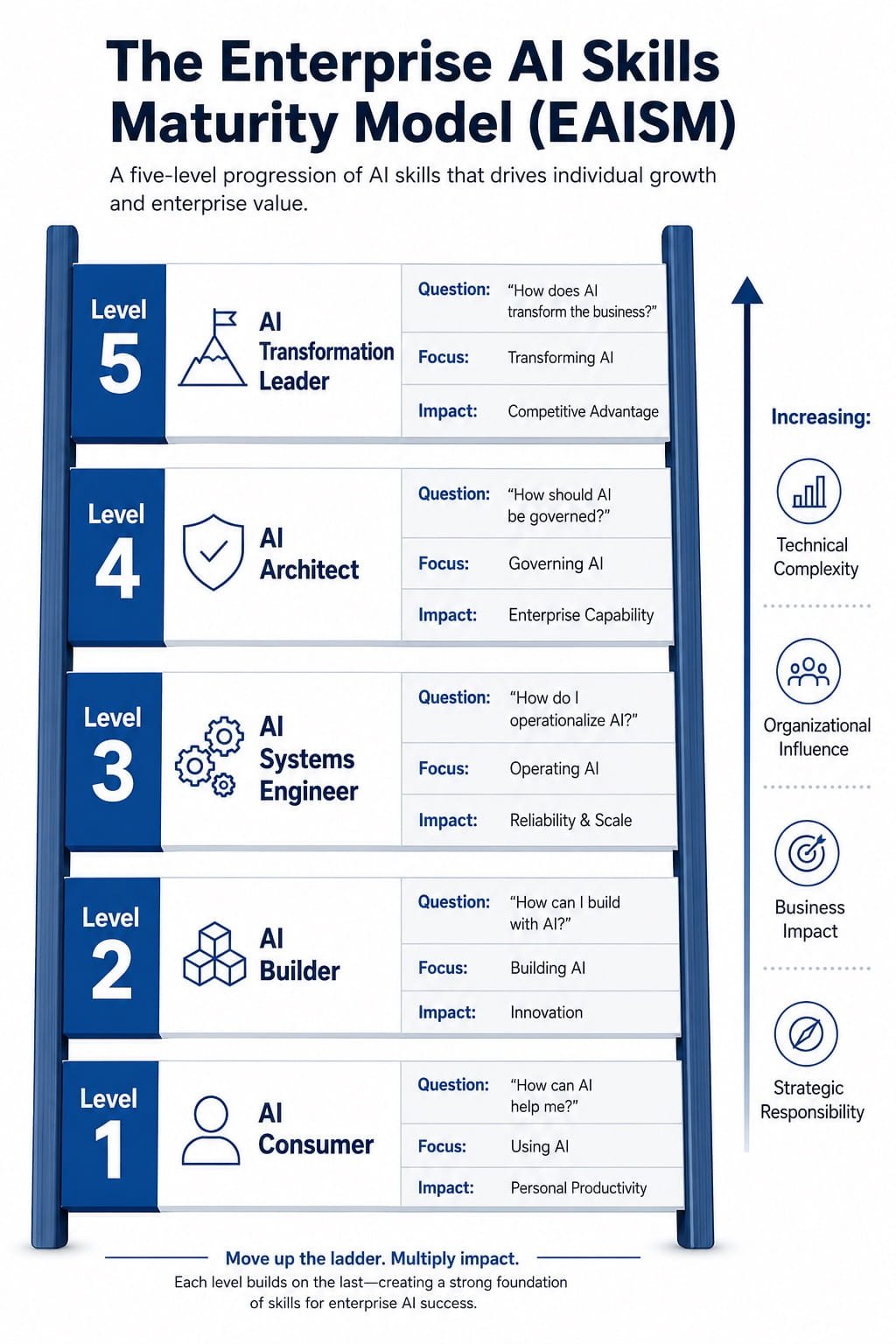
Question answered: "How do I use AI to do my existing job better?" At this level, people use AI assistants, copilots, and chat interfaces to improve personal productivity. Core skills are prompting, summarization, content generation, and using AI-powered tools within existing workflows. This is the most populous level by far. The business impact is real but narrow: individual productivity gains that do not compound at the organizational level.
Question answered: "How do I build applications and workflows using AI?" Level 2 people move from using AI tools to building with them. They integrate LLM APIs into applications, design function-calling workflows, build internal chatbots and automation pipelines, and ship MVPs. This is where most "AI-forward" teams currently sit: capable of building prototypes and pilots, but not yet able to sustain them reliably at scale.
Question answered: "How do I make this AI system work reliably in production, at scale, securely?" This is the critical level, and the one most organizations are missing. Level 3 engineers build the infrastructure that turns AI prototypes into production systems. Their work spans RAG architecture and retrieval optimization, LLM evaluation frameworks and benchmarking, observability and monitoring pipelines, LLMOps tooling and deployment, latency and cost optimization, and security hardening for AI endpoints. They are the bridge between "it works in a demo" and "it works for 100,000 users under real conditions."
Question answered: "How do we govern, standardize, and scale AI infrastructure across the entire organization?" Level 4 people design the enterprise AI platform: shared infrastructure, model registries, evaluation standards, security policies, and governance frameworks that let multiple product teams build reliably on top of AI. They translate organizational risk tolerance into technical guardrails, manage model versioning and drift at the platform level, and own the strategy for how AI capabilities are allocated across business units.
Question answered: "How does AI fundamentally change our business model and competitive position?" Level 5 leaders operate at the intersection of AI capability and business strategy. They identify which parts of the business can be reinvented, not just improved, by AI. They build the organizational structures, incentive systems, and talent pipelines that make transformation sustainable. True Level 5 leaders are only effective when the organization already has a functioning Level 3 and Level 4 foundation beneath them.
The Level 3 Bottleneck
The most important insight in the EAISM framework is identifying Level 3 as the critical bottleneck in enterprise AI progress. Understanding why requires looking at what actually happens when organizations try to move from pilot to production.
A Level 2 team can build an impressive AI demo in a matter of days. An LLM API call, a prompt template, a chat interface. These are genuinely accessible with modern tooling. The demo works. Executives are excited. Budget is allocated. And then the project stalls.
Organizations without Level 3 engineers accumulate what might be called AI prototype debt: a growing library of promising demos and pilots that never make it into production. The demos represent real investment and real potential, but they create zero business value sitting in a staging environment.
The pyramid visualization makes the population reality clear:
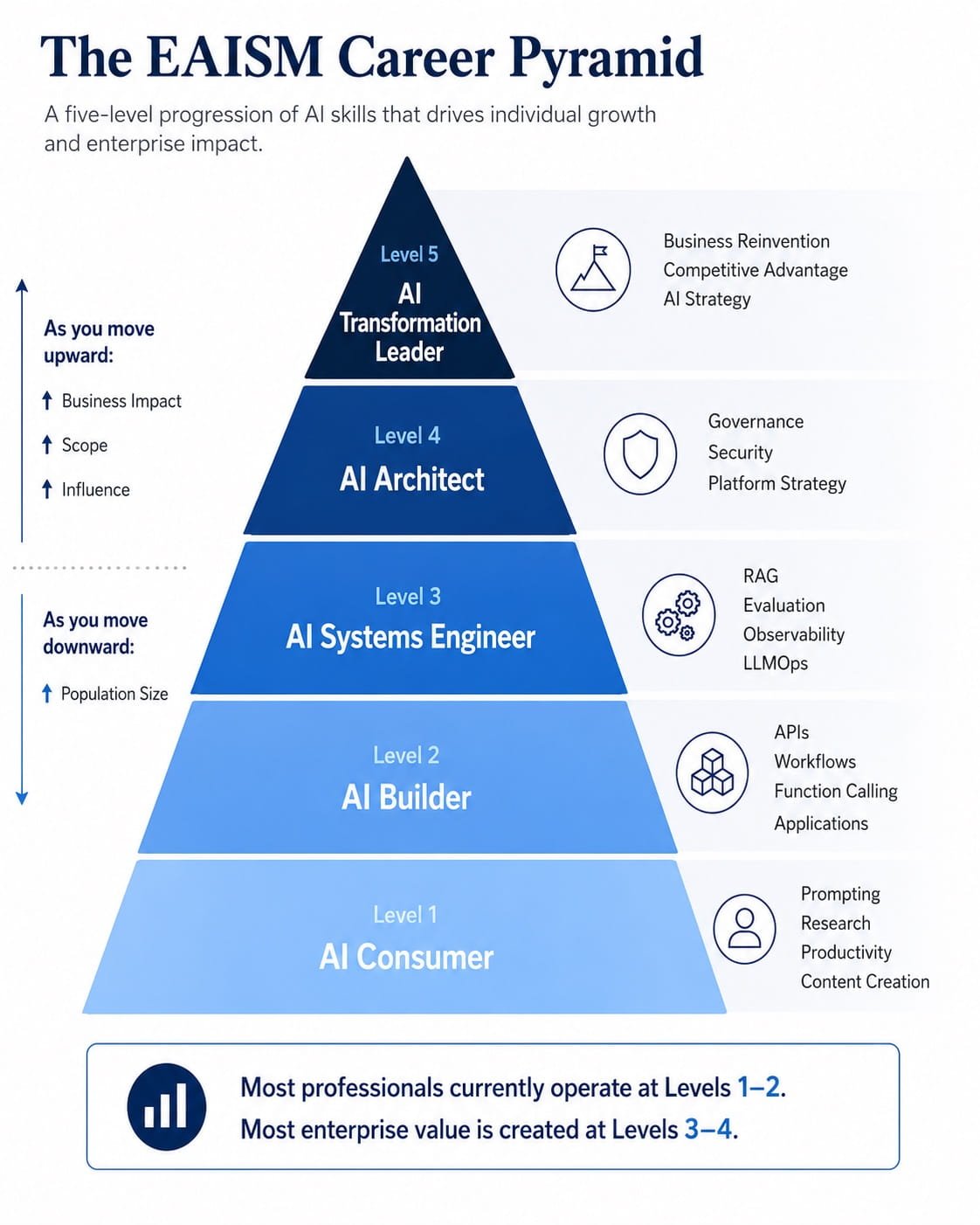
Most professionals currently operate at Levels 1 and 2. The pyramid narrows sharply at Level 3, not because the work is impossibly complex, but because it is a different discipline from what AI literacy programs, bootcamps, and prompt engineering courses actually teach. Most enterprise value is created at Levels 3 and 4. The supply-demand mismatch at Level 3 is severe, and it is not being closed quickly enough by existing training pipelines.
Skills Matrix Across Levels
The framework also produces a concrete skills matrix that maps specific capabilities to each level. Use it for self-assessment, hiring rubrics, or building a training roadmap.
| Skill Domain | L1 | L2 | L3 | L4 | L5 |
|---|---|---|---|---|---|
| Prompting | Basic prompting and chat | Prompt templates, few-shot | Evaluation-driven prompt optimization | Org-wide prompt standards | Strategic framing of AI tasks |
| APIs & Integration | Using AI-powered apps | LLM API calls, function calling | Async pipelines, retry logic, fallbacks | API governance, versioning policy | Vendor strategy, build vs. buy |
| RAG & Retrieval | n/a | Basic vector search integration | RAG architecture, chunking, reranking | Enterprise knowledge graph strategy | Data moat as competitive advantage |
| Evaluation | n/a | Manual spot-checking | Automated eval frameworks, benchmarks | Org-wide eval standards and tooling | AI quality as business KPI |
| Observability | n/a | Basic logging | Tracing, latency dashboards, cost monitoring | Platform-wide observability strategy | AI performance tied to business metrics |
| Security | Basic data hygiene | API key management | Prompt injection defense, PII handling | AI security policy, red-teaming | AI risk as board-level governance |
| Governance | n/a | n/a | Model versioning, change management | AI governance framework design | Regulatory strategy, responsible AI |
| Strategy | Personal productivity goals | Product feature scoping | Technical roadmap for AI systems | Platform and capability strategy | Business model reinvention |
A practical use of this matrix is identifying skill gaps at each level rather than trying to assess overall "AI maturity" as a single number. An organization might have strong Level 2 and Level 4 capabilities but a dangerous gap at Level 3, which is exactly the gap that prevents production deployments.
Organizational Maturity Stages
Individual skills aggregate into organizational capability. EAISM maps five organizational maturity stages that closely, though not perfectly, mirror the individual level distribution within the organization.
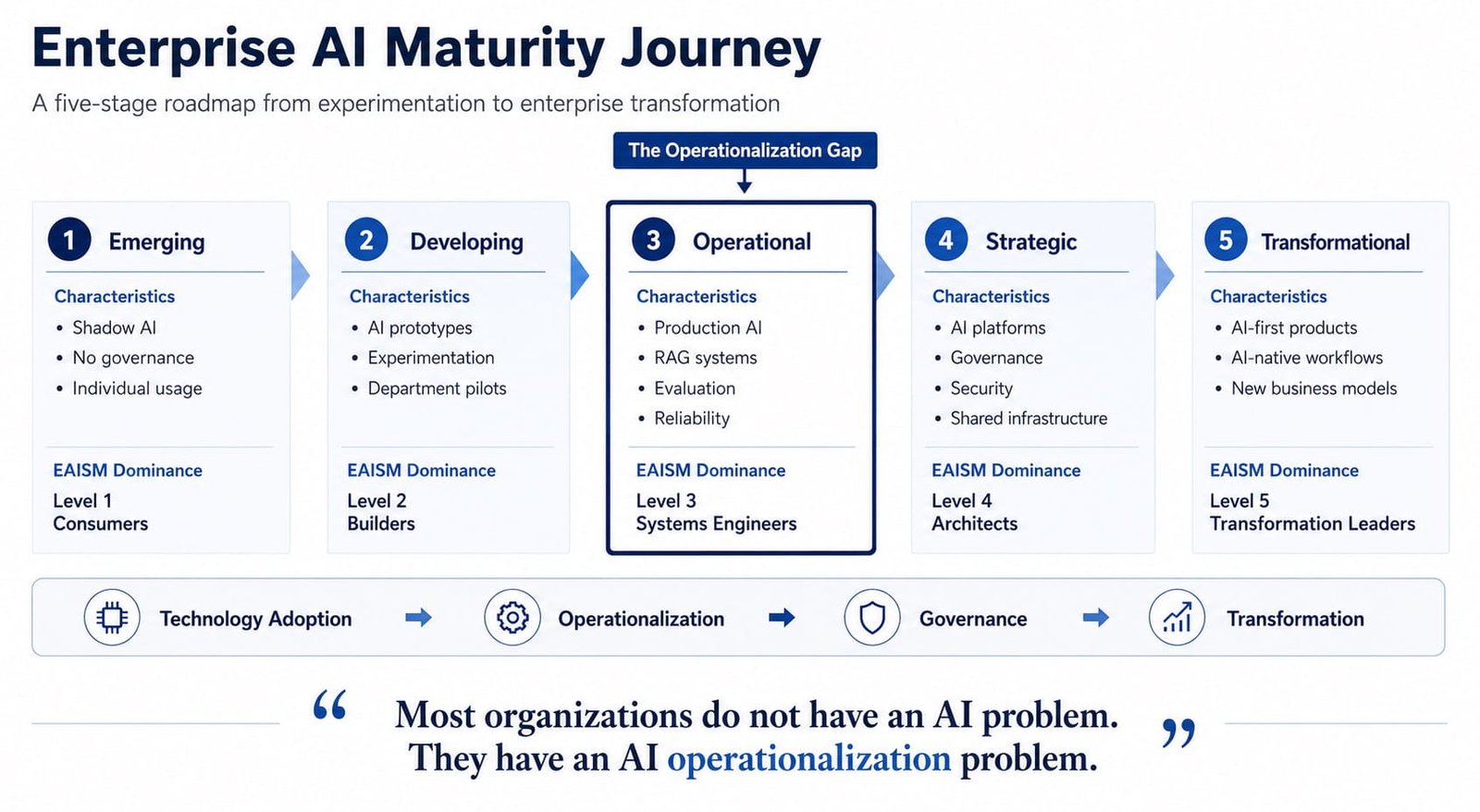
The organization has AI activity but no AI strategy. Individual employees use AI tools informally: ChatGPT for writing, Copilot for code, without organizational awareness or oversight. There is no governance, no data policy, no measurement. AI usage is dominated by Level 1 consumers. The primary risk is shadow AI and data leakage into public model APIs.
The organization has recognized AI as a strategic priority and is investing in pilots. Department-level AI projects are emerging. Level 2 builders are active. There are AI prototypes: chatbots, summarization tools, internal assistants being tested. But these pilots are isolated, inconsistently built, and not yet connected to shared infrastructure or a unified evaluation standard.
This is the most important and most difficult stage. Organizations that reach Stage 3 have AI systems in production that real users depend on. They have built evaluation pipelines, monitoring dashboards, and reliability standards. Level 3 Systems Engineers are the dominant workforce here. The Operationalization Gap must be crossed at this stage, and most organizations underestimate how different the skill requirements are from Stage 2. The organizations that successfully make this transition separate themselves decisively from those still stuck in pilot mode.
The organization has moved from running individual AI systems to governing an AI platform. Shared infrastructure: vector stores, model registries, evaluation tooling, security frameworks, is centralized and accessible to all product teams. Level 4 Architects lead this stage. AI investment decisions are made at the portfolio level, with clear cost accountability, performance benchmarks, and governance frameworks that span business units.
AI is not a feature added to existing products; it is the foundation of new ones. Business processes are redesigned around AI capabilities rather than being incrementally augmented by them. Competitive advantage comes from proprietary data, custom fine-tuned models, and AI-native product experiences that incumbents cannot replicate. Level 5 Transformation Leaders drive this stage, but they are only effective because the Level 3 and Level 4 infrastructure is already in place beneath them.
Career Roadmaps by Role
EAISM has direct, actionable implications for individual career development. The path forward differs meaningfully depending on where you start.
Software Engineers
Most software engineers already operate at Level 1 and can reach Level 2 quickly: integrating LLM APIs into applications is a short learning curve for anyone already familiar with REST APIs and async programming. The real career move is the Level 2 to Level 3 transition. Engineers who build expertise in evaluation, observability, RAG architecture, and LLMOps will be the most valuable technical practitioners in enterprise AI for the next decade. This transition requires deliberate investment; it is not covered by standard software engineering curricula or most AI courses.
Product Managers
PMs who understand Level 3 concepts, even without building the systems themselves, become dramatically more effective at scoping, prioritizing, and communicating AI product work. A PM who can articulate the difference between "the prototype works in a demo" and "the system needs evaluation, monitoring, and fallback logic before it ships" is worth far more to an engineering team than one who equates AI ability with chat fluency. The goal is not to become a Level 3 practitioner, but to develop enough Level 3 literacy to be a credible product owner for AI systems.
Data Professionals
Data scientists and ML engineers have a genuine head start on Level 3 entry. Experience with evaluation frameworks, statistical testing, model versioning, and production deployment pipelines transfers directly. The primary gap is typically on the infrastructure and API integration side: the LLMOps tooling ecosystem is different from classical MLOps. Data professionals who close that gap become rare Level 3 engineers who can bridge both the statistical and infrastructure dimensions of AI system design.
Non-Technical Business Roles
For business analysts, consultants, marketers, and operations professionals, the most valuable investment is building strong Level 1 fluency and developing an accurate mental model of what Levels 3 and 4 actually require. This lets you identify genuinely AI-automatable workflows, scope pilots that Level 2 teams can execute, and avoid the common mistake of promising AI-driven outcomes that require Level 3 infrastructure that doesn't yet exist in the organization.
Hiring for AI Maturity
EAISM has direct implications for how organizations should recruit. The most common and expensive hiring pattern in enterprise AI is front-loading senior strategy hires: Chief AI Officers, AI Transformation Directors, VP-level positions, without having Level 3 execution capacity to support them.
The EAISM-informed hiring sequence:
| Hiring Phase | Target Level | What This Builds |
|---|---|---|
| Phase 1 | L1 Consumers | Org-wide AI literacy; baseline productivity gains; identifies internal interest |
| Phase 2 | L2 Builders | Prototype capacity; internal tooling; pilot projects that demonstrate use cases |
| Phase 3 (critical) | L3 Systems Engineers | Production deployments; evaluation infrastructure; reliability at scale |
| Phase 4 | L4 Architects | Enterprise AI platform; shared infrastructure; governance and standardization |
| Phase 5 | L5 Transformation Leaders | Business model evolution; competitive AI strategy; organizational reinvention |
Hiring in this sequence is not about being conservative. It is about ensuring that each level of investment can actually produce returns. A Level 3 engineer hired into an organization with no Level 2 prototype capacity has no work to operationalize. A Level 5 leader without a Level 3 team has no reliable systems to transform the business with.
Three Persistent Myths Worth Pushing Back On
A few misconceptions keep circulating in the enterprise AI conversation. Mapping them against the five levels makes clear why they don't hold up.
Myth: Prompt engineering is a standalone career
Prompting is a Level 1 skill. It is necessary, learnable, and genuinely valuable, but it is not a technical specialization that creates durable career leverage on its own. Organizations paying "prompt engineers" as distinct roles are typically at Stage 2 maturity and will eventually need the work that prompting enables to be operationalized by Level 3 engineers. Advanced prompting techniques, like evaluation-driven prompt optimization and structured output design, are Level 3 sub-skills, but they are practiced in service of reliability engineering, not as a standalone discipline.
Myth: Adopting an AI platform solves the production problem
A lot of enterprises buy into Azure OpenAI, AWS Bedrock, or Google Vertex and assume they have closed the gap between prototype and production. The platform provides the model access, the APIs, and some guardrails. What it does not provide is the Level 3 engineering work: evaluation pipelines, RAG architecture, observability, fallback logic, cost controls, and the reliability standards that make a system actually trustworthy for real users. The platform is infrastructure. Someone still has to build and operate the AI system on top of it. Organizations that conflate vendor adoption with operational maturity end up surprised when their "production-ready" AI system quietly fails at scale.
Myth: Building a chatbot proves AI expertise
A chatbot wrapper over an LLM API is a Level 2 deliverable. It demonstrates that a team can integrate AI into a product. It does not demonstrate evaluation methodology, latency optimization, security hardening, or any of the skills required to run that chatbot reliably for real users over time. Organizations that confuse chatbot deployment with AI maturity consistently underestimate the work required and overestimate how far along the maturity journey they actually are.
The Agentic AI Future
The EAISM framework is not static. The rapid development of agentic AI, where LLMs take multi-step actions autonomously, use tools, browse the web, write and execute code, and interact with external APIs, will reshape the skill requirements at every level.
The clearest near-term trend is that Levels 1 and 2 are being partially automated by the very AI systems they describe. Basic prompting tasks are increasingly handled by AI assistants with built-in tool use. Simple API integrations that once required Level 2 skills can be scaffolded by coding agents. This does not mean Level 1 and Level 2 skills become worthless; it means the entry point for differentiated human value creation is shifting upward.
Level 4 expands to include multi-agent governance frameworks: policies for how agents interact, how tool access is scoped and audited, and how agent behavior is aligned with organizational risk tolerance. Level 5 practitioners in the agentic era are designing organizations where AI agents execute entire business processes, and where human judgment is reserved for the decisions that genuinely require it.
The human in the loop does not disappear in an agentic world. The human moves higher up the EAISM stack: from executing tasks, to building systems, to governing infrastructure, to setting strategy, to reinventing the business model. The framework shifts upward; the fundamental value of each level remains.
Conclusion
EAISM gives a precise vocabulary to a problem that has been hard to articulate: why organizations with significant AI investment, genuine executive commitment, and talented people still fail to produce AI systems that work reliably in production.
The answer is not a lack of AI ambition. It is a shortage of Level 3 engineers, people who can close the operationalization gap between a working prototype and a dependable production system.
For individuals, the most valuable career investment in AI right now is not prompt engineering certification or attending another AI strategy summit. It is building evaluation, observability, and reliability engineering skills that move AI from demo to production. That is where the work is, where the compensation reflects the scarcity, and where the durable impact is created.
For organizations, the most important strategic question is not "what is our AI vision?" but "how many Level 3 engineers do we have, and how fast can we build more?" Everything else, the strategy, the transformation roadmap, the competitive differentiation, depends on the answer.
Frequently Asked Questions
EAISM is a five-level framework that maps AI expertise from basic tool usage (Level 1: AI Consumer) to enterprise-wide transformation (Level 5: AI Transformation Leader). Each level represents expanding scope of impact, technical complexity, and strategic responsibility. The framework helps individuals assess their career position, organizations identify capability gaps, and hiring managers build the right team composition for AI maturity.
A Level 3 AI Systems Engineer operationalizes AI at production scale. Their work covers RAG system design, LLM evaluation frameworks, observability and monitoring pipelines, LLMOps tooling, security hardening, and reliability engineering. They are the critical bridge between a working prototype built by a Level 2 team and a system that reliably serves real users. Level 3 is the most in-demand and undersupplied role in enterprise AI today.
The skills required to move from a working prototype to a production-grade AI system are different from the skills required to build the prototype. Evaluation frameworks, latency optimization, security hardening, cost controls, and monitoring pipelines are not covered by basic AI literacy programs. Organizations without Level 3 engineers accumulate AI prototypes that never ship. Closing the Operationalization Gap requires deliberate investment in Level 3 talent and infrastructure.
The EAISM hiring sequence is: build Level 1 and Level 2 density first, then invest heavily in Level 3 Systems Engineers, develop Level 4 Architects from within, and only then bring in Level 5 Transformation Leaders. Hiring Level 5 strategy leaders without Level 3 execution capacity in place produces expensive AI strategy work that never ships. The most critical hire is Level 3; it is the constraint that determines whether every other AI investment delivers returns.
Agentic AI will automate increasing portions of Level 1 and Level 2 work, shifting the minimum meaningful entry point for human value creation toward Level 3. Level 3 itself evolves from LLM pipeline operationalization to agent orchestration engineering. Level 4 expands to include multi-agent governance. The framework shifts upward: human expertise moves from executing tasks to governing the systems that execute them autonomously.