The Real Villain of Ocarina of Time Was Time, And That's Why It Explains AI So Well
Most people remember it as a story about defeating Ganondorf. Replaying it as an adult reveals something stranger and truer.
When millions of people first played The Legend of Zelda: Ocarina of Time in the late 1990s, they believed they were participating in a classic hero's journey. Bathed in the static warmth of a CRT television, a generation of children guided a boy in a green tunic as he gathered magical stones to defeat a dark lord.
At the time, we thought we were learning how to conquer evil.
But returning to it years later shatters the illusion. The simple heroic quest fades, and the game's true nature emerges. We realize it was never really a story about defeating a dark lord.
It was a story about growing up.
Most players assume Ganondorf is the game's antagonist. But the older you get, the more you realize Ganondorf is merely an obstacle. The real villain of the game is Time.
Childhood disappears because of time. Friendships drift because of time. Skills become obsolete because of time. Entire worlds transform because of time. Ganondorf merely exploits change. Time creates it.
Today, the anxiety humming beneath our culture feels distinctly familiar. As artificial intelligence rewrites the global economy, human identity and technology are colliding in ways that leave millions experiencing an eerie sense of vertigo. We are confronting the exact emotions the game was quietly preparing us for nearly three decades ago.
AI is not frightening because it is evil. AI is frightening because it accelerates change. And change has always been humanity's oldest adversary.
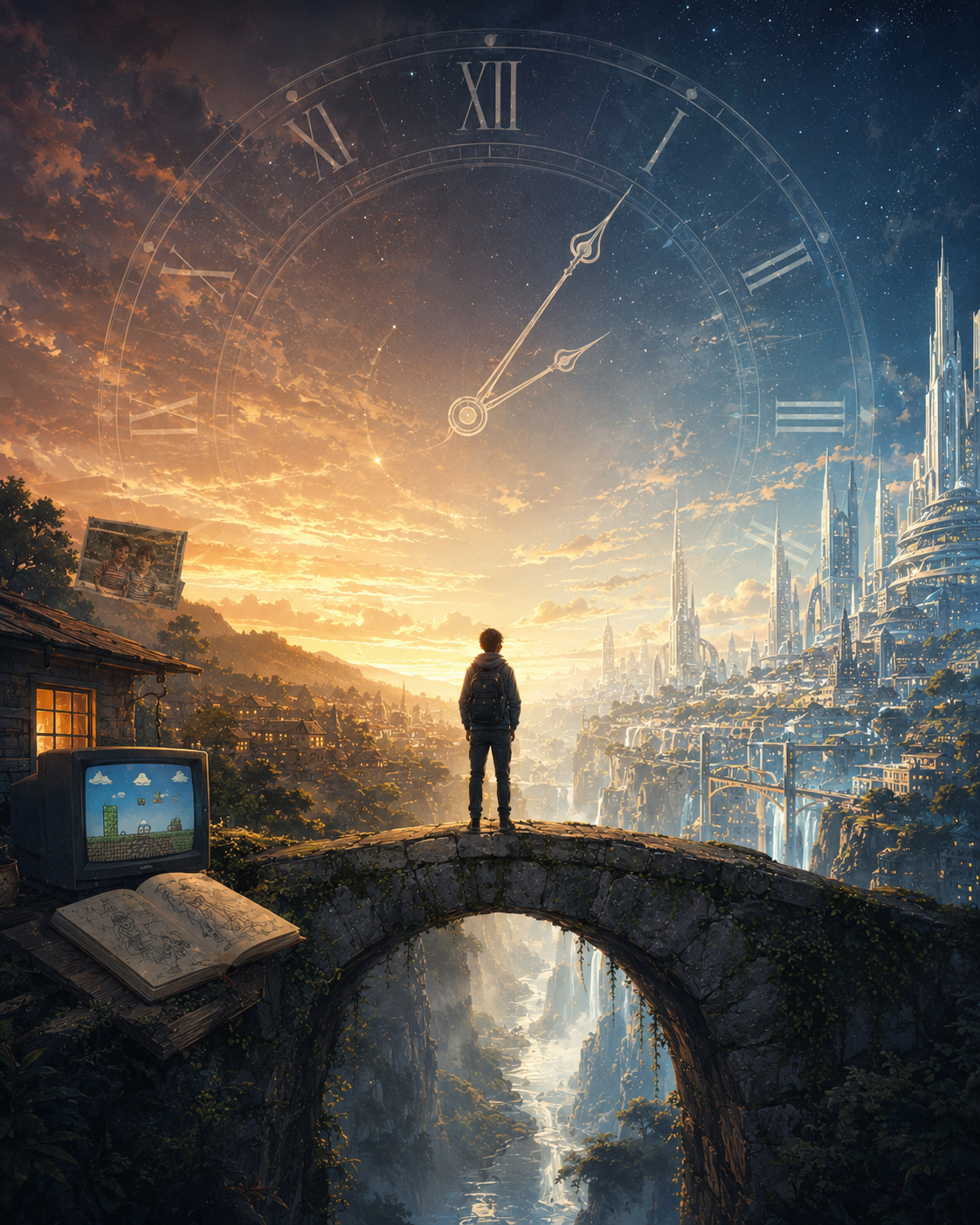
The bridge between what we remember and what has already arrived.
The enduring power of Ocarina of Time comes from a timeless truth: growing up means accepting that the world changes in ways you cannot reverse. As we stand on the edge of the AI era, society is being forced through a collective coming-of-age, one that is thrilling, terrifying, and profoundly irreversible.
The Seven-Year Time Skip
The defining philosophical moment in Ocarina of Time occurs when Link pulls the Master Sword from its pedestal. Instead of granting him the power to immediately save the world, the sword seals him away. He goes to sleep as a child and wakes up seven years later in an adult body, stepping out into a kingdom that has been radically, violently transformed.
For many knowledge workers, writers, and creatives, the arrival of generative AI has felt exactly like stepping out of the Temple of Time.
For decades, economists told us the transition to automation would be gradual. We expected a gentle slope. But when systems capable of reasoning, writing production-level code, and generating photorealistic art were unleashed, the timeline collapsed.
We went to sleep in one world and woke up in another.
Think of the first time you instinctively asked a machine a complex question instead of searching the web. Or the afternoon you watched an algorithm synthesize a sprawling dataset in three seconds, a task that previously would have consumed your entire week. Remember the distinct, hollow thrill of realizing a skill you spent a decade honing was now, suddenly, partially automated.
The future did not invite us in. It ambushed us.
The Need to Be Needed
In the game's opening hours, Link lives in the Kokiri Forest, a lush, insulated sanctuary where the inhabitants never grow up. It is a place of perpetual childhood, shielded from the complexities of the broader world. Leaving the forest requires abandoning that innocence forever.
Our Kokiri Forest was the deeply held assumption of human exceptionalism.
We believed that while machines might automate the physical world, the realms of creativity, strategy, and complex problem-solving were uniquely ours. We were told that learning to code, writing elegantly, or mastering graphic design were the ultimate moats against obsolescence.
AI has breached that sanctuary. And the loss feels intimately personal.
The deepest fear driving our cultural nostalgia is not merely economic. It is existential. We spent decades building our identities around being useful. We attached our self-worth to our expertise. Now, AI is forcing us to ask whether usefulness and human worth are actually the same thing.
The terror is not simply that a machine can do the work. It is the quiet, aching suspicion that nobody may need us to do it anymore.
Familiar Places Becoming Unfamiliar
When Link emerges from his seven-year slumber, he returns to the places of his youth only to find them unrecognizable. Castle Town, once a bustling hub of joy and commerce, is now a haunted wasteland. The architecture is intact, but the physics of reality have shifted.
We are watching our own familiar systems operate under alien rules. The software environments, creative industries, and digital rituals we spent decades mastering are suddenly behaving differently.
The modern office is no longer defined just by human collaboration, but by an uneasy alliance with machines. Autonomous agents haunt our documents, predicting our sentences and finishing our thoughts before we fully form them. The act of searching for information, a foundational human behavior for a quarter-century, is vanishing; we no longer sift through links to find answers, we ask an oracle to synthesize the truth for us. Even the essay, the primary unit of measuring student comprehension for centuries, was dismantled almost overnight.
We are walking through the digital equivalents of a transformed Hyrule. The spaces we built are still there, but they feel ghostly. We must learn to navigate environments we thought we knew perfectly, acutely aware that the old rules no longer apply.
The Burden of Knowledge
One of the great tragedies of Ocarina of Time is Link's isolation. By traversing time, he acquires knowledge that separates him from everyone else. He remembers a world that others have forgotten, and he sees a future that others cannot yet comprehend. He bears the psychological burden of holding two realities in his head at once.
This is the exact melancholy felt by today's researchers, engineers, and early adopters.
Those intimately involved in building or deploying artificial intelligence often describe a feeling of profound isolation. They see the exponential curve. They interact with frontier models that the public won't see for years. They bear the heavy, quiet loneliness of understanding what is coming before the rest of the world has caught up.
As this intelligence permeates society, it forces humanity to confront questions that do not yet have answers:
If intelligence becomes abundant, what becomes valuable? If creativity becomes cheap, what becomes meaningful? If productivity no longer defines us, what will?
We Are All Adult Link Now
Humanity has lived through massive technological shifts before. We survived the Industrial Revolution, the advent of electrification, the dawn of the Internet, and the ubiquity of mobile computing. So why does this feel so existentially heavy?
Because previous technologies were tools that amplified human intent. The loom amplified the weaver. The smartphone amplified connection.
AI is not a bicycle for the mind. It is a companion intellect.
It challenges us not because it is a better tool, but because it is the first technology that competes with us on the axis of cognition. The philosophy of AI forces humanity to ask the same question adulthood asks every person: who are you when the world no longer needs the version of you that once felt essential?
The Japanese have a concept called mono no aware, a gentle sadness at the transience of things. It is a recognition that the beauty of life is tied to its impermanence. The philosophy of Ocarina of Time is dripping with this sentiment. The game's music, its fading landscapes, its quiet moments of reflection all insist that moving forward requires leaving something beautiful behind.
The hardest part of a technological leap is not what arrives. It is what quietly disappears.
We are the bridge generation. We remember the internet before algorithmic feeds sculpted our desires. We remember search before generated answers. We remember creative work before generative models. We remember learning before instant synthesis.
We are not grieving technology. We are grieving a world that only exists in memory.
The tragedy is not that the world changed. The tragedy is that we remember what came before.
The Real Lesson of Ocarina of Time
Throughout the game, the mysterious character Sheik appears to teach Link melodies that allow him to traverse the world. Before teaching him the Minuet of Forest, Sheik offers a reflection on the passage of time:
The reason Ocarina of Time is timeless is found in how it concludes. Link defeats the darkness, but he cannot undo the fact that time has passed. The game does not offer a timeline where the trauma of change is erased. He is sent back to his youth, but he is fundamentally altered. He must live with the knowledge of what he has seen.
The true meaning of Ocarina of Time is not about defeating evil. It is about learning how to move forward despite irreversible change.
This is humanity's challenge today. The anxiety surrounding AI often manifests as a desire to pull the plug, to return to the Kokiri Forest. But the Master Sword has been drawn. The timeline has shifted. The future of art, work, and human identity is already irrevocably altered.
But every generation inherits a world it did not choose. Its responsibility is deciding what to build within it.
Ocarina of Time didn't predict AI. It predicted what it feels like to live through a world that changes faster than we are ready for.
When millions of children played the game in the late 1990s, they thought they were learning how to save a kingdom. What they were really learning was how to face a future they could not control.
Now, decades later, as the world transforms around them, they find themselves standing exactly where Link once stood.
Looking at a world transformed. Mourning what has been lost. Marveling at what has become possible. And discovering that courage is not the ability to stop change.
It is the willingness to move forward anyway.