AI Models
Jev by TypeSafe AI Explained: Decision Models, LLMs, and AI Architecture
It never writes a single sentence, only typed probabilities. That's either a genuine new AI primitive, or a well-marketed classifier.
- Jev doesn't generate text at all. It's a non-autoregressive "decision model" that takes application state and returns typed, bounded probabilities: booleans, categories, or scores, in a single parallel pass.
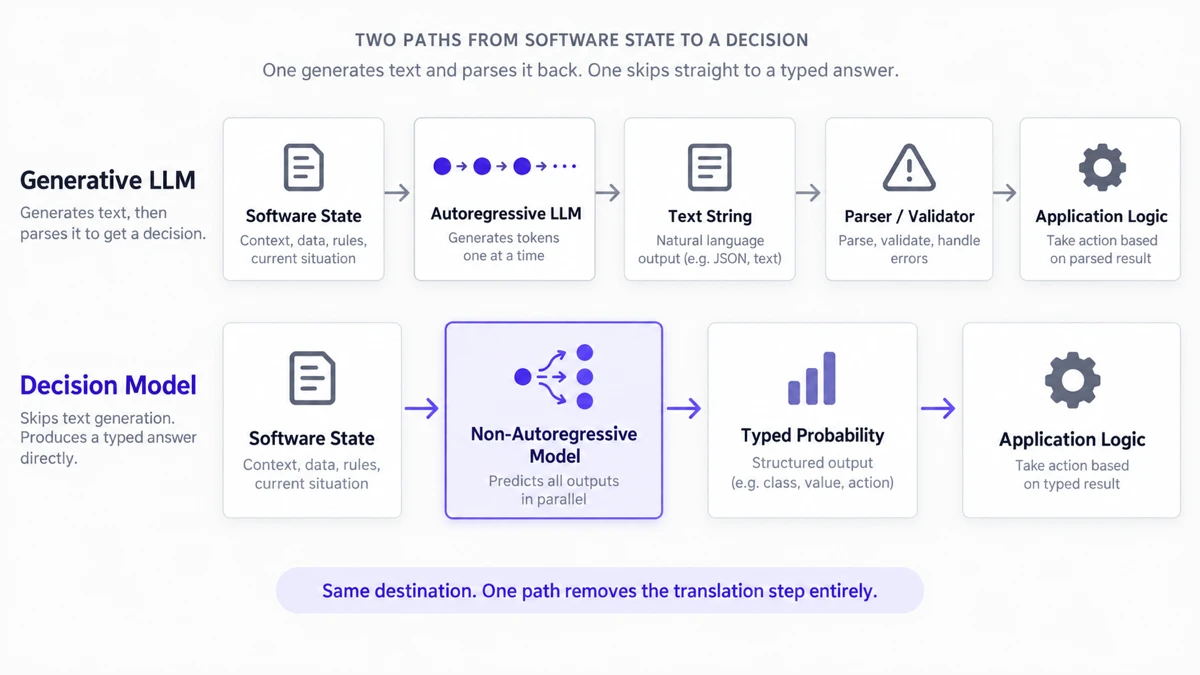
- It targets the "translation tax" of using LLMs for control flow. Asking a chatbot to output JSON and then parsing that JSON back into variables is exactly the workload Jev is built to replace.
- Structural safety is not the same as being right. Jev can't emit invalid JSON, but it can still confidently assign 0.95 probability to the wrong category. TypeSafe's own marketing distinguishes these less clearly than independent testing does.
- The economics are the real story. At $0.042 per million input tokens and $0 for output, evaluating a million decisions costs around $42, which changes which automation patterns are financially viable at all.
- The underlying idea is not new. Non-autoregressive parallel classification has academic roots going back years, and at least one independent open-source developer built a similar architecture before TypeSafe's commercial launch.
- "System One" is marketing, not a technical spec. It's a Kahneman-inspired analogy for a real architectural choice: parallel bounded evaluation instead of sequential token generation.
- What Is Jev?
- Why Would We Need a Model Like This?
- How Jev Differs From an LLM
- Why Isn't This Just JSON Mode?
- Jev vs Traditional Machine Learning
- What Does "System One" Mean?
- How Decision Models Fit Into AI Architecture
- Jev and AI Agents
- Probabilities, Confidence, and Calibration
- Performance and Economics: Claims vs Evidence
- Real-World Use Cases
- Where Jev May Not Be the Right Tool
- Failure Modes and Risks
- What Is Actually New About Jev?
- A Framework for Evaluating Decision Models
- Conclusion
- Frequently Asked Questions
What Is Jev?
Software communicates in typed, bounded structures. Humans communicate in open-ended prose. For the past several years, the standard way to bridge that gap has been to hand an LLM a system prompt, ask a question like "should this ticket be escalated?", and then parse the resulting text back into a boolean the application can actually branch on. Developers have taken to calling the retry logic, prompt engineering, and validation this requires a "translation tax."
Jev is TypeSafe AI's answer to that specific problem, and it takes an unusual position: it discards text generation entirely. TypeSafe AI is a San Francisco-based lab that exited a two-year stealth period on September 15, 2026. The company was founded by Diogo Almeida, a former OpenAI researcher and co-inventor of Reinforcement Learning from Human Feedback, alongside Erik Gafni and Sasha Sheng.
Jev accepts an input called "state," which can be raw text or structured JSON, and returns a JSON response scored against a developer-defined schema. According to TypeSafe's documentation, every query maps to one of three decision primitives:
| Primitive | Evaluates | Returns |
|---|---|---|
Noul | A binary (yes/no) condition | A single probability scalar from 0.0 to 1.0 |
Choice | A category from up to 255 predefined options | The winning option, a confidence metric, and a full probability distribution across all options |
Score | An ordered spectrum of 2 to 10 criteria levels | A numeric score and a probability distribution across the levels |
Because Jev is non-autoregressive, it evaluates the entire schema in one forward pass rather than generating tokens one at a time. Multiple questions can be attached to a single request against the same state, and TypeSafe says answering ten questions costs roughly the same latency as answering one, since the model is sampling probability distributions in parallel rather than writing anything sequentially.
What Jev Is Not
It helps to define the negative space. Jev is not a conversational chatbot and cannot participate in multi-turn dialogue. It is not a generative LLM: it cannot write code, summarize a document, or produce creative text. It is not a deterministic rules engine, since it uses semantic evaluation rather than hardcoded regular expressions. And it is not quite a traditional ML classifier either, because it claims to categorize dynamic, previously unseen text based on natural-language instructions, without a labeled training set.
Why Would We Need a Model Like This?
The case for a model like Jev comes from a mismatch between two audiences. Humans asking an AI assistant to "explain this concept" or "write an email" are well served by autoregressive text generation, it's a flexible medium for open-ended output. Software asking the same underlying question, "should this be escalated," doesn't want prose. It wants a boolean, an enum, or a float it can branch on immediately.
When a generative LLM is used as that logic gate, it has to semantically understand the prompt, predict a valid sequence of tokens, avoid conversational filler, and produce a string that survives a parsing layer, all before the actual if/else statement in the codebase can run. Removing the text-generation step in the middle is the entire pitch: let the application map a semantic evaluation directly to control flow, without a fragile string in between.
How Jev Differs From an LLM
The distinction between Jev and a standard autoregressive LLM is an architectural tradeoff between open-ended flexibility and programmatic constraint, not a claim that one is strictly superior to the other.
| Dimension | Generative LLMs (GPT, Claude) | Decision Models (Jev) |
|---|---|---|
| Primary output | Free-form natural language tokens | Typed probabilities and discrete values |
| Generation mechanics | Autoregressive (sequential token prediction) | Non-autoregressive (parallel probability mapping) |
| Latency profile | Scales with output sequence length | Not bottlenecked by output length |
| Cost model | Charges for input and output tokens | $0.042/M input tokens; $0 output tokens |
| Output-format failure | Possible, reduced by structured-output tooling | Constrained by typed API architecture |
| Semantic error | Possible | Possible; can be "confidently wrong" |
| Reasoning ability | Optimized for Chain-of-Thought reasoning | No sequential scratchpad; optimized for bounded evaluation |
Jev is not being pitched as a replacement for generative models. It highlights a distinction between workloads that need generative intelligence (creating new information) and workloads that need decision intelligence (evaluating existing information against a bounded schema).
Why Isn't This Just JSON Mode?
The obvious objection: frontier LLMs already offer structured outputs and constrained JSON generation. Why would a specialized model be necessary?
In most constrained-decoding frameworks, the underlying model is still an autoregressive LLM. As it generates, the framework uses a finite state machine (FSM, a system that tracks valid next-step states) or logit-masking to inspect the next candidate token and zero out the probability of anything that would violate the schema, forcing the model to pick a valid character. This reliably guarantees syntactically valid JSON, but TypeSafe's founders argue it has real costs: forcing a validator check at every token step can degrade the model's underlying semantic performance by interfering with its natural training distribution, and manipulating logits via an FSM tends to produce poorly calibrated confidence scores, since the raw probabilities have already been forced toward compliance.
Jev's schema evaluation is claimed to be native to its architecture instead of bolted on after the fact. It doesn't generate text and mask invalid strings, it scores the probabilities of the discrete schema options directly in one pass. TypeSafe asserts this produces mathematically unmasked probability distributions and lower latency. Independent testing across a wider range of production environments is still the open question for how reliable those unmasked probabilities actually are outside TypeSafe's own benchmarks.
Jev vs Traditional Machine Learning
If a model primarily categorizes and classifies data, the natural comparison is logistic regression, random forests, or gradient-boosted trees, not other LLMs.
Traditional ML classifiers remain excellent at stable, well-defined tasks, behave predictably within their trained domain, and can run locally at very low inference cost. Their weakness is infrastructure: they typically need hundreds or thousands of labeled examples to train, and they become brittle the moment the input schema changes or the underlying data distribution drifts.
Jev sits in the gap between traditional ML and heavy LLMs. It claims the zero-shot semantic flexibility of an LLM, categorizing dynamic documents from natural-language instructions with no labeled training set, while delivering the structured, typed output normally associated with a bespoke classifier. The tradeoff: developers gain zero-shot flexibility and skip a training pipeline, but they take on an API dependency, network latency, and ongoing inference cost for a task that a local classifier might otherwise run entirely offline.
Matching Models to Tasks
- Use a generative LLM when the output is natural-language prose, the task is open-ended or creative, or it requires multi-step Chain-of-Thought reasoning.
- Consider a decision model when the output is bounded (routing, booleans, enums), the application needs a typed value for direct control flow, and calibrated probability matters to the logic.
- Consider traditional ML when the task is stable and narrowly defined, abundant labeled data already exists, and local, offline inference is a requirement.
What Does "System One" Mean?
TypeSafe markets Jev heavily as a "System One" model, a term borrowed from Daniel Kahneman's dual-process theory of human cognition. "System 1" describes fast, automatic, parallel judgment; "System 2" describes slow, deliberate, sequential reasoning.
TypeSafe's analogy casts standard autoregressive LLMs as System Two, since they generate sequentially and often lean on Chain-of-Thought to reason step by step, and casts Jev as System One, since it maps inputs directly to output distributions in a single parallel pass. It's worth being precise here: "System One AI" is not an established academic model category. Non-autoregressive parallel decoding is a real, long-standing research area, but TypeSafe is using the Kahneman framing primarily as product positioning to differentiate Jev from conversational agents, not as a technical specification.
How Decision Models Fit Into AI Architecture
Because decision models return discrete logic instead of text, they suggest a different shape of application architecture.
- The LLM monolith:
User Request → Generative LLM → Tools/APIs → Result. A single LLM acts as router, planner, tool selector, and executor. This can incur high latency and is prone to failures when a generated tool call is malformed. - LLM + deterministic logic:
User Request → Generative LLM → Regex/Parsing → Application Logic. The application parses LLM-generated strings into variables, the translation-tax pattern this article opened with. Fragile by construction. - The decision orchestrator:
User Request → Decision Model → Business Logic → Tools/APIs. Jev evaluates state and returns a typed probability; the application branches deterministically on the returned variable. - Multi-agent specialization: an agent control loop where a decision model handles routing and tool selection, a generative LLM is invoked only for reasoning or content generation, deterministic APIs execute the result, and a decision model verifies the output before it's returned. In this conceptual pattern, a decision model acts as a fast control plane while the heavier generative model is reserved for work that genuinely needs it.
Jev and AI Agents
Stabilizing agent control loops, keeping an agent from crashing on a malformed tool call or looping indefinitely, has become a real engineering problem as autonomous agents take on longer workflows. Decision models are pitched as a way to handle the high-volume micro-decisions inside that loop without invoking a slower generative model for basic routing.
Consider an agent managing customer orders, with aggregated state like "identity verified," "order eligible for cancellation," and "customer context indicates frustration." An architecture could query Jev with typed primitives directly against that state: a Choice for next_action (search_db, refund_api, escalate, stop), and a Noul for requires_human. Using a non-generative model for this kind of routing is the intended way to reduce schema-related crashes inside agent tool-selection loops, with Jev functioning as tool selector, state evaluator, or safety gate alongside an LLM that handles the actual planning and reasoning.
Probabilities, Confidence, and Calibration
Robust automation depends on a model's confidence actually meaning something. Generative models are commonly trained via Reinforcement Learning from Human Feedback (RLHF), which optimizes for text that human raters prefer, and can inadvertently collapse probability distributions, producing overconfident, poorly calibrated scores even when the underlying answer is wrong.
TypeSafe says it trained Jev with a different objective, Reinforcement Learning for Calibrated Decisions (RLCD), whose loss function explicitly penalizes miscalibrated uncertainty. In a genuinely well-calibrated model, a prediction assigned roughly 0.90 probability should be correct roughly 90% of the time across a large population of similar predictions. TypeSafe claims Jev achieves this alignment, though independent, domain-specific verification of that claim in production is still limited.
If the calibration claim holds for a given domain, it enables a practical triage pattern:
- High confidence: automate the action directly (auto-issue a refund, route the ticket).
- Medium confidence: route to a generative LLM for deeper verification, or ask the user a clarifying question.
- Low confidence: halt automation and queue the state for human review.
Calibration varies across domains and data distributions. There is no universal confidence threshold that guarantees safety, thresholds have to be set from a team's own evaluation data, not copied from vendor documentation.
Performance and Economics: Claims vs Evidence
TypeSafe's documentation states Jev runs at 70 to 500 milliseconds end to end. Independent testing gives a more specific, and more useful, picture.
The technical publication Every ran two tests. In a writing-quality check across 12 synthetic passages (six clean, six with a defect deliberately planted), Jev returned a median 0.35 seconds per passage against 8.83 seconds for Claude Fable 5.1 running at high effort, about 25x faster and roughly 1/580th the cost. But Jev caught only 6 of the 7 planted defects, while Claude Fable 5.1 caught all 7. In a separate, larger batch test, Jev answered 21 questions across 37 documents simultaneously, 777 total judgments, in under 0.7 seconds for a total cost of roughly a quarter of a cent.
Economically, Jev is priced at $0.042 per million input tokens, with output tokens billed at $0 since the model never autoregressively generates strings. Evaluating one million decisions at roughly 1,000 input tokens each costs approximately $42 in API fees, several orders of magnitude below an equivalent volume of generative LLM calls once output-token and retry costs are included. Token price alone doesn't determine total system cost, orchestration, retrieval, preprocessing, and the human-review infrastructure needed for low-confidence outputs all add up, but the economic delta is large enough to make dense, per-request semantic evaluation financially viable in places it previously wasn't, such as request-level guardrails on high-volume API traffic.
Real-World Use Cases
| Use Case | Why a Decision Model Might Fit | What Could Go Wrong |
|---|---|---|
| Support ticket routing | Zero-shot mapping of complaints to discrete departments in ~200ms | May misclassify nuanced or multi-intent tickets |
| RAG verification | Scores document relevance to a query without generation overhead | Subtle semantic reasoning mismatches may be missed |
| Agent tool selection | Eliminates JSON-schema-failure crashes in agent control loops | Forced single-winner choices can collapse multi-intent states |
| Browser action selection | Instantly picks a DOM interaction from a finite schema | Large HTML DOM trees may exceed the ~32K token context limit |
| Content moderation / guardrails | Evaluates prompt injection or toxicity via boolean probabilities | Adversarial attacks can still bypass semantic boundaries |
Where Jev May Not Be the Right Tool
Generative LLMs remain preferable for complex reasoning: Jev has no sequential scratchpad, so it can't Chain-of-Thought its way through a logic puzzle or intermediate state. It's also the wrong tool for open-ended generation, writing code, summarizing documents, or synthesizing multiple sources into a report. And its ceiling on nuanced judgment is real, not hypothetical: in the Every defect-detection test, it caught 6 of 7 planted defects against Claude Fable 5.1's 7 of 7.
Traditional ML remains preferable for stable, high-volume classification against a genuinely static schema with abundant labeled data. A well-tuned local model will usually be more predictable and cheaper than a semantic cloud API call for that specific case.
Failure Modes and Risks
TypeSafe has marketed Jev as having a "0% hallucination rate." That claim needs to be split into two separate things: structural validity and semantic correctness. It's accurate that Jev cannot output a JSON key or option outside the developer's schema, that's a real, mathematically guaranteed property. It does not follow that Jev's judgments are correct.
- Confidently wrong judgments: Jev can evaluate a complex billing dispute and assign "technical support" a 0.95 probability. The failure isn't structural, it's a judgment error.
- Context exhaustion: the architecture enforces a maximum context window of roughly 32,000 tokens (about 150,000 characters). Extensive server logs or large codebases will get truncated or rejected outright.
- Adversarial vulnerabilities: typed constraints reduce structural injection, but Jev remains vulnerable to semantic prompt injection. Malicious state data can skew a probability distribution and force a false positive on a
Noulcondition. - Multi-intent collapse: because
Choiceforces a single winner, an input that legitimately belongs to more than one category collapses into one, unless the developer designs a multi-question pipeline around it. - No auditability: Jev returns a decision, not an explanation. If a high-confidence error reaches production, there's no reasoning trace to debug, only the number.
What Is Actually New About Jev?
Separating genuine architectural novelty from product packaging matters here. Jev's interface is a real developer-facing abstraction: it lets developers invoke booleans, enums, and scales directly against a model, without writing prompt-engineering scaffolding to coax structure out of a chatbot. Its task specialization, abandoning generation entirely to focus on evaluation, is a real design choice, and its calibration focus via RLCD is a concentrated effort at making confidence scores trustworthy for automation, something generative models trained on RLHF have historically struggled with.
None of that means the underlying mathematics is new. Parallel sampling and non-autoregressive classification have existed in acoustic modeling and translation research for years. More directly, an open-source version of essentially the same idea already existed roughly a year before TypeSafe's commercial launch.
TypeSafe's actual contribution looks less like inventing new mathematics and more like a specific, polished combination: model behavior, developer interface, and calibration objective, aimed at a real, well-understood software engineering pain point.
A Framework for Evaluating Decision Models
Before adopting a decision model in a production architecture, it's worth working through a short checklist:
- Is the task fundamentally a bounded decision? Routing, categorization, or scoring, not content generation.
- Does the application need typed output? Is the result feeding directly into deterministic code?
- Is semantic generalization actually required? Does the input vary enough that traditional ML can't easily handle it?
- Is training a task-specific classifier practical instead? Could this be solved locally, with no API dependency at all?
- Does latency matter at this call frequency? Is autoregressive generation delay actually degrading the experience?
- Does probability or calibration drive application logic? Will different confidence bands trigger different code paths?
- Is the workload large enough for the token economics to matter?
- Is a generative LLM still needed elsewhere in the pipeline?
- What happens when the decision is wrong? Is there a fallback for a confidently-wrong semantic error?
- How will calibration actually be evaluated in production? Against what ground truth, and on what cadence?
Conclusion
Today's standard AI interface assumes a human-centric pipeline: Human → Natural Language → Model → Natural Language → Human. Software backends increasingly want a different one: Software State → Model → Typed Decision → Software Logic. Jev is a genuine, early attempt to build for the second pipeline rather than retrofitting the first one.
A generative model can generate. A reasoning model can reason. A classifier can classify. A decision model can, at least in principle, provide bounded, typed judgments without the overhead of text generation in between. The interesting question isn't whether Jev replaces LLMs, TypeSafe itself doesn't claim that. It's whether software architecture increasingly assembles itself from specialized model primitives instead of routing every decision through one generalist chatbot.
Whether decision models become a durable, independent category rather than a well-timed commercial packaging of an existing technique depends on evidence that doesn't exist yet: real-world accuracy against actual ground truth (not against other LLMs' averaged answers), calibration stability across genuinely novel domains, and production economics once the early-access pricing settles. Jev is worth tracking closely. It is not, yet, proven.
Frequently Asked Questions
What is Jev by TypeSafe?
Jev is a specialized evaluation model designed to process application state and output typed probabilities and discrete decisions, without generating conversational text.
Is Jev an LLM?
Jev is a non-autoregressive decision model, meaning it does not generate text sequentially like a standard Large Language Model. It maps input state directly to a bounded probability distribution in a single parallel pass.
What does System One mean in this context?
System One is a product analogy used by TypeSafe, inspired by Daniel Kahneman's dual-process theory of cognition. It describes a model that evaluates data quickly and in parallel, contrasted with generative models that reason sequentially. It is not an established academic model category.
Is Jev just structured JSON output?
No. Most structured-output frameworks constrain a generative LLM with a Finite State Machine at each token step. TypeSafe says Jev differs because decision-making is its native task: it scores schema options in a single parallel pass rather than generating text and masking invalid tokens.
Can Jev work with AI agents?
An architecture could use Jev as a fast control plane for AI agents, handling tool selection, routing, and safety gating in under 500ms, while a generative LLM is only invoked for the reasoning or content-generation sub-tasks that actually require it.
Does Jev eliminate hallucinations?
Jev's API structurally prevents output-format failures, it cannot emit invalid JSON or an option outside its schema. It does not eliminate semantic errors: it can still confidently assign a high probability to the wrong answer.
How accurate is Jev compared to frontier LLMs?
On TypeSafe's own published evaluation across four business workflows, Jev scored 67.8% against a 74.1% comparator average. That score measures agreement with the averaged answers of GPT-6 Astra and Claude Fable 5.1, not agreement with independently verified ground truth, since no ground-truth labels were used.
What does Jev cost, and where can developers access it?
As of late 2026, TypeSafe prices Jev at $0.042 per million input tokens, with output tokens billed at $0. It is accessible via TypeSafe's own API and SDKs, and through integrations including Vercel AI SDK, Pydantic AI, OpenRouter, and Cloudflare Workers AI.