AI Engineering
Brain-Inspired AI Engineering: From Biological Principles to System Design
The brain runs on 20 watts and never stops learning. Modern AI consumes gigawatts and forgets everything when retrained. The gap is not computational. It is architectural.
- Intelligence is substrate-independent. Strip away the biology and the brain becomes a well-defined information pipeline, fully describable with math and engineering principles.
- Dense embeddings are a reasoning trap. They work for similarity search but break down under logical operations. Vector Symbolic Architectures (VSAs) offer a more structured alternative.
- Backpropagation works at scale but is biologically implausible and energy-intensive. Local learning rules are the necessary alternative for edge and neuromorphic hardware.
- LLMs are sophisticated pattern matchers, not reasoners. Chain-of-thought output resembles reasoning but lacks a symbolic layer to verify it. Neuro-symbolic integration closes this gap.
- Transformer attention covers only one of three biological attention systems. The missing piece is Executive Control, the system responsible for focused reasoning and ignoring distractors.
- RAG is document retrieval, not memory. Biological memory reconstructs context from partial cues. Agent memory systems need to do the same, not just find the most similar text chunk.
The Cognitive Compute Cycle: A Unified Mental Model
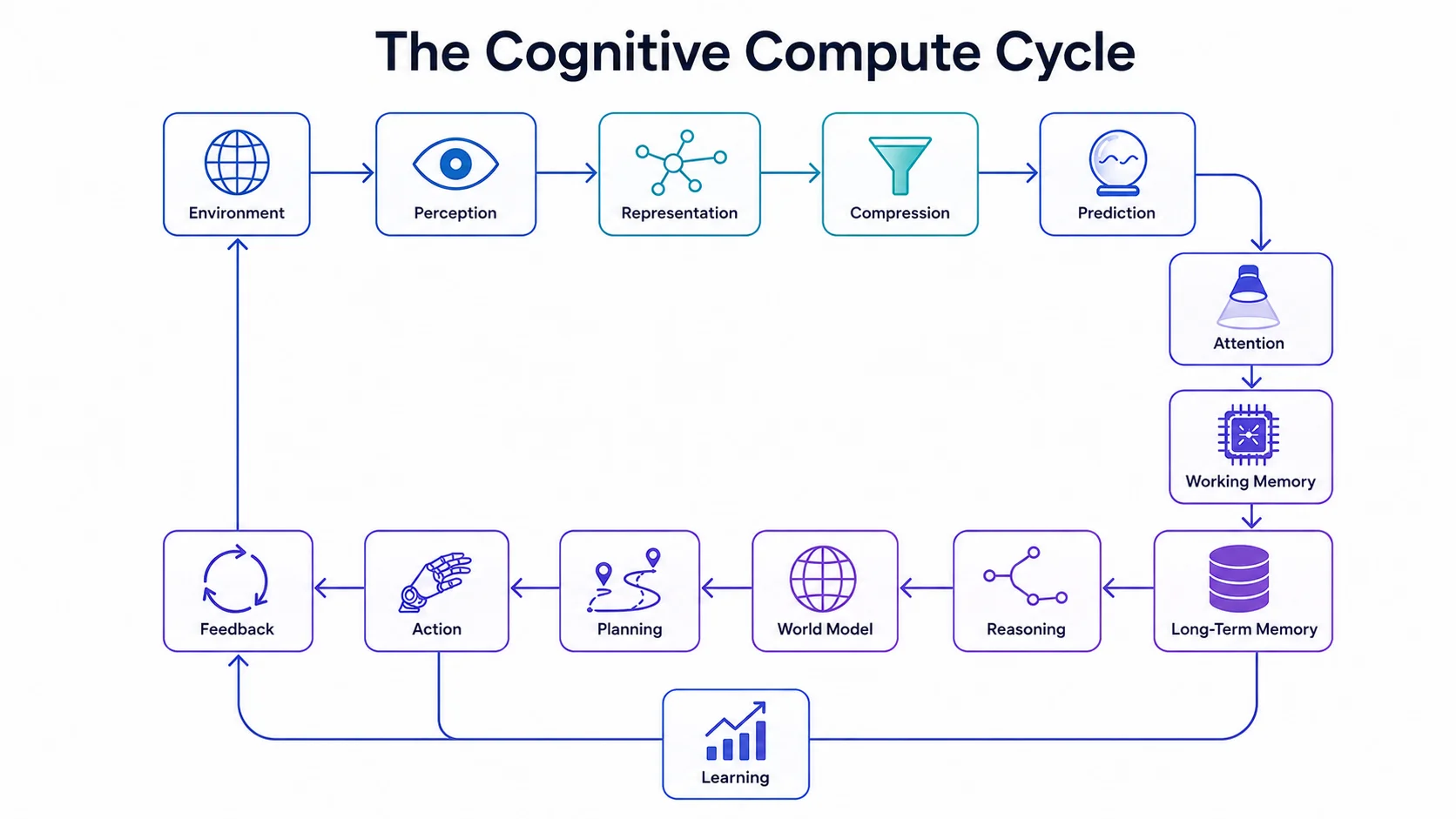
Most discussions about the brain focus on neurons; most AI discussions focus on parameters. Neither framing explains intelligence. A more useful lens is the Cognitive Compute Cycle: a unified view of biological intelligence as a continuous information-processing pipeline. Each section of this article examines one stage of the cycle, how biology solved it, and where current AI has yet to catch up.
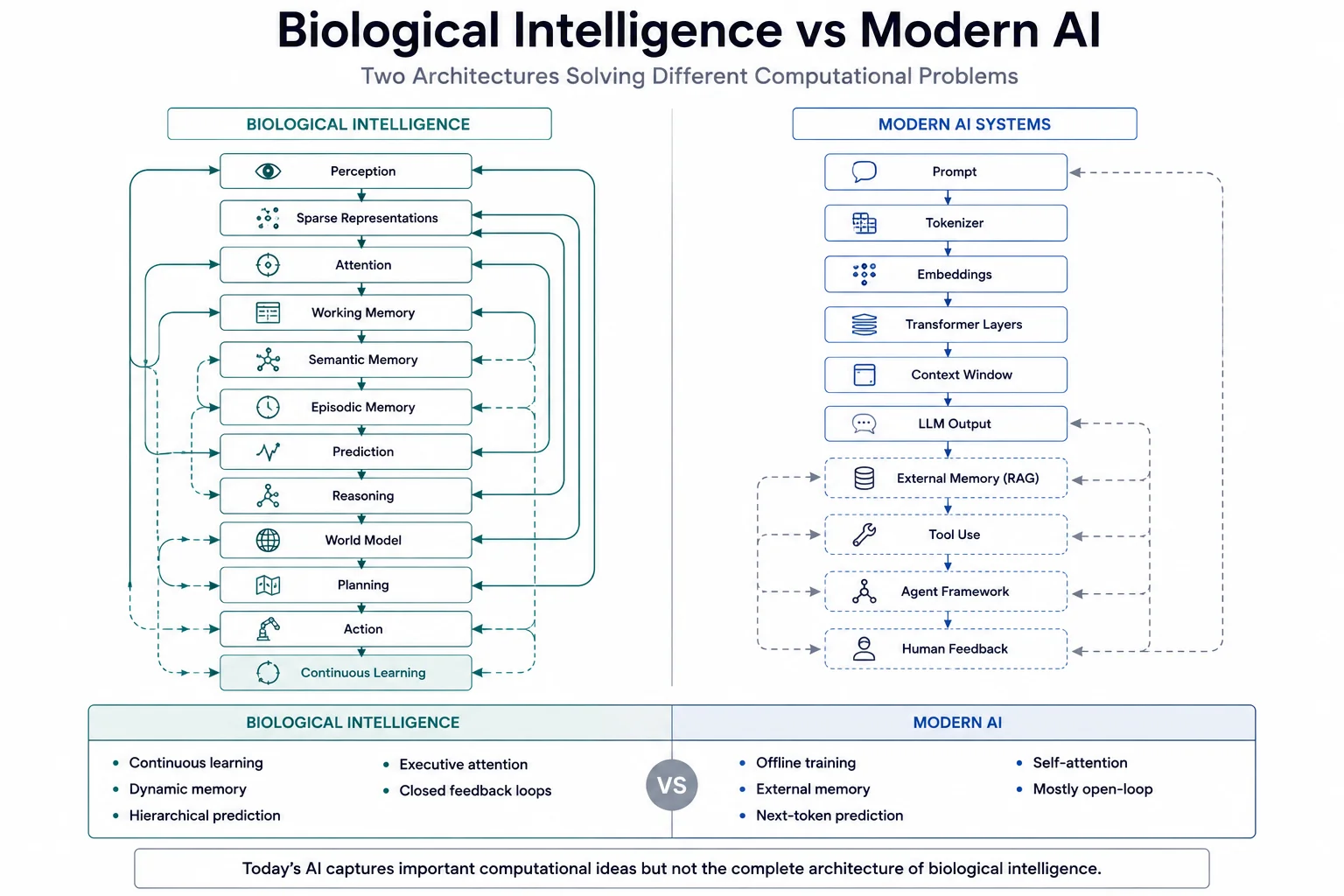
Biological intelligence and modern AI both process information, but they optimize for fundamentally different objectives under fundamentally different constraints. The sections below examine each principle in detail.
1. Intelligence as Information Processing
The Computational Principle
A dominant view in computational cognitive science holds that to survive and operate efficiently, an intelligent system must act as an optimal controller under conditions of severe computational and metabolic constraints. Treating intelligence as pure information processing allows us to formalize cognition using information theory, control theory, and thermodynamics.
The Free Energy Principle (FEP), developed by Karl Friston (Nature Reviews Neuroscience, 2010), provides a unified mathematical objective. It proposes that self-organizing systems work to minimize "free energy": a measure of how surprised they are by their sensory inputs. Less surprise means a better internal model of the world. In this framework, the brain is not a passive filter but an active, generative inference engine that continuously updates its internal model using incoming sensory signals.
Where this differs radically from modern deep learning: biological processing optimizes for survival in non-stationary environments by unifying learning and inference into a single continuous, asynchronous, event-driven process. Deep learning separates training phases from inference phases to maximize throughput and static accuracy. These are not minor implementation differences; they represent fundamentally different objectives.
- Massive distributed architectures extract meaningful hierarchical representations from raw data
- Stacking non-linear transformations uncovers latent causal factors, analogous to mammalian cortical hierarchy
- Self-supervised learning demonstrates that prediction forces rich internal representations
- No unified integration of perception, learning, memory, and action in a single continuous process
- Training and inference are separate phases; biology never stops learning during operation
- AI largely ignores the thermodynamic constraints that force biological sparsity and efficiency
2. Information Representation
The Computational Principle
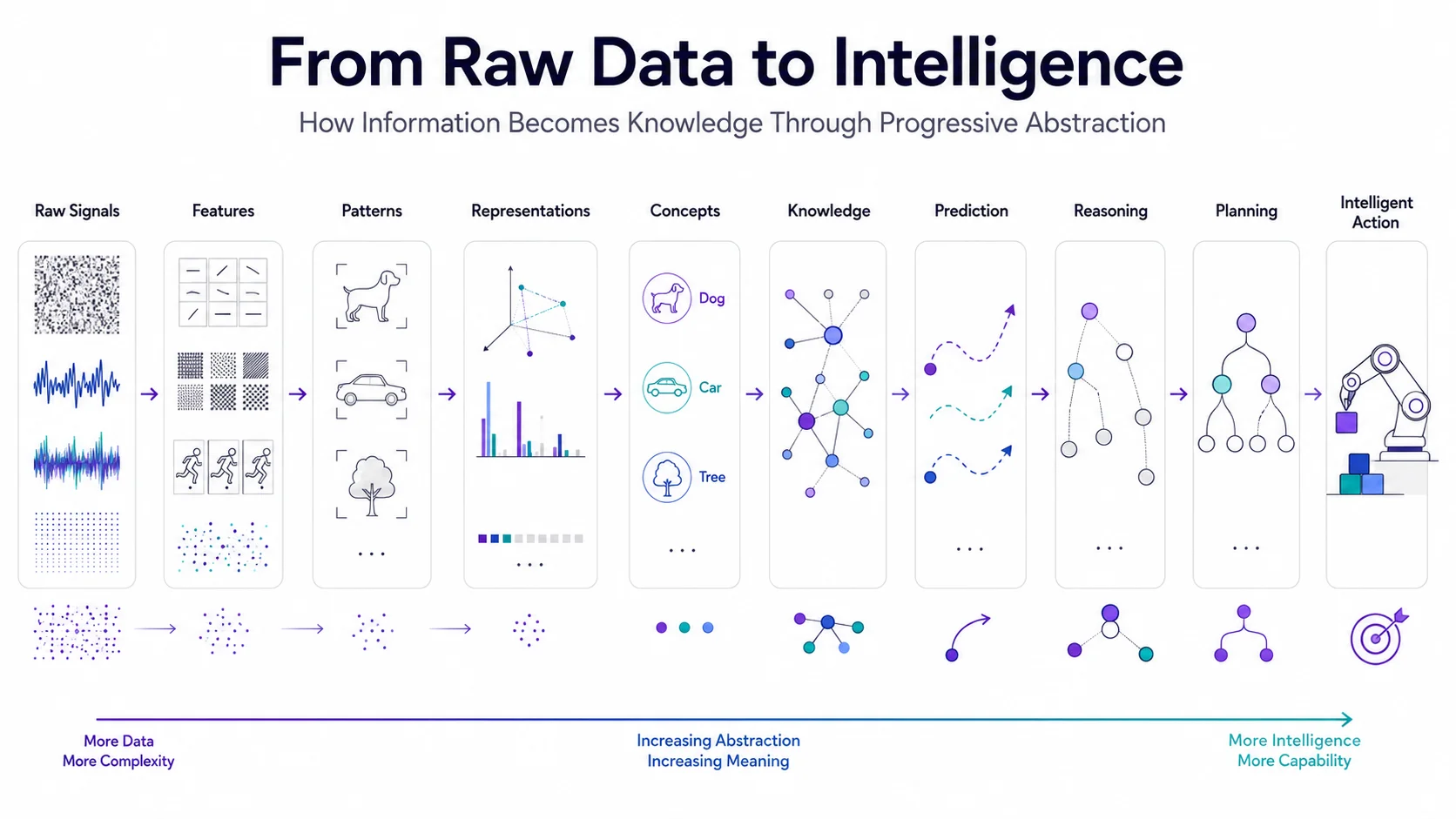
Representation is how high-dimensional signals are transformed into manipulable symbols. To be useful for high-level reasoning, a representation must be highly separable (avoiding interference between concepts) and strictly compositional (building complex thoughts from atomic components).
Neuroscience demonstrates that the brain uses Sparse Distributed Representations (SDRs) and population coding: a concept is represented by a specific, small subset of active neurons within a larger population. Computational cognitive science formalizes this through Vector Symbolic Architectures (VSAs), or Hyperdimensional Computing (Kanerva, 2009), where concepts are represented by extremely high-dimensional vectors (e.g., 10,000 dimensions) with specific algebraic operations:
| Operation | Symbol | What It Does | Biological Analogue |
|---|---|---|---|
| Binding | ⊗ |
Invertible operation (element-wise XOR or multiplication) that links a variable to a value, producing a nearly orthogonal combined concept | Conjunctive coding: a neuron that fires only when feature A and feature B are co-present |
| Bundling | ⊕ |
Similarity-preserving operation (element-wise addition) that superimposes vectors to create a set or associative memory | Population summation across a cortical column |
| Permutation | Π |
Cyclic shift of vector elements to encode sequence, order, or structural position | Phase-of-firing encoding of temporal sequence in hippocampal place cells |
The Superposition Catastrophe
Standard AI embeddings are dense: almost every dimension has a non-zero value. When too many concepts are bundled into a dense vector space, the original components cannot be cleanly extracted. The vectors entangle. This is the superposition catastrophe: dense embeddings suffer from relational ambiguity that makes strict logical operations (like distinguishing "A causes B" from "B causes A") fundamentally unreliable.
VSA and sparse biological representations avoid this through high dimensionality combined with extreme sparsity or algebraic constraints, ensuring that even after bundling dozens of concepts together, individual components remain recoverable through the inverse binding operation.
- Excellent at continuous optimization and capturing semantic gradients
- GPU-efficient and easy to train at scale
- Rich topological relationships between concepts
- Fail at strict compositionality and explicit symbol manipulation
- Vulnerable to superposition catastrophe under heavy concept load
- Highly robust to noise and adversarial perturbation
- Supports explicit symbol manipulation and algebraic binding
- Infinite compositionality from a finite set of atomic concepts
- Optimization difficulties on dense GPU accelerators
- Higher dimensional requirements increase memory footprint
3. Compression
The Computational Principle
Sensory environments present an overwhelming bandwidth of data: millions of photoreceptors, thousands of skin receptors, constant auditory input. Transmitting and storing all of this requires massive metabolic and computational energy. Horace Barlow's Efficient Coding Hypothesis posits that biological sensory systems are optimized to reduce the statistical redundancy of natural stimuli, not to store everything, but to compress to the essential.
Naftali Tishby's Information Bottleneck (IB) theory formalizes this as a mathematical optimization objective. The goal is to find a compressed representation Z of an input X that retains maximal mutual information with a target variable Y:
Where β controls the trade-off between compression of the input and predictive relevance for the output. Deep networks naturally exhibit this: an initial "fitting" phase where information about the input increases, followed by a "compression" phase where redundant information is actively discarded. This compression phase correlates directly with generalization performance.
- Deep learning implicitly performs IB-style compression layer by layer
- Latent diffusion models exploit this by operating entirely within a compressed latent space
- Autoencoders and VAEs explicitly enforce bottleneck representations
- Biological systems dynamically adapt their β at runtime based on task demands and cognitive load
- AI compression often yields entangled, opaque representations; features do not map cleanly to interpretable concepts
- No native mechanism to widen or narrow the bottleneck based on uncertainty
4. Prediction
The Computational Principle
Predictive Coding and the broader Active Inference framework assert that the brain's primary objective is to minimize variational free energy. The brain is arranged hierarchically: higher cortical levels send predictions down to lower levels, and lower levels send prediction errors up to update the higher models. This bidirectional, multi-timescale process is radically different from standard feedforward neural networks.
In Active Inference, an agent minimizes prediction error in two ways: updating its internal model to match reality (perception), or acting on the world to change reality to match its predictions (action). Actions are chosen to minimize Expected Free Energy, elegantly balancing goal-directed behavior (instrumental value) with information-gathering behavior (epistemic value). The agent actively seeks data that reduces its uncertainty.
- Next-token prediction is the most powerful self-supervised learning paradigm, forcing rich world representations without labeling
- Contrastive Predictive Coding and other predictive objectives bootstrap useful representations
- LLMs demonstrate that predicting the future forces the emergence of syntactic and semantic structure
- LLM prediction is flat and autoregressive; biology predicts across hierarchies and timescales simultaneously
- No Active Inference: models passively observe sequences, they do not probe the environment to test hypotheses
- No top-down prediction signals propagating back through the network during inference
5. Attention
The Computational Principle
Attention solves the combinatorial binding problem and the resource bottleneck. In a world of infinite data and severely limited processing capacity, an intelligent system must dynamically route computational resources to the most salient information while actively inhibiting the rest.
Cognitive science categorizes biological attention into three integrated networks via the Attention Network Theory (ANT):
| Network | Type | Function | AI Equivalent |
|---|---|---|---|
| Alerting | Tonic | Maintaining physiological and cognitive readiness; phasic response to unexpected signals | No direct equivalent in current architectures |
| Orienting | Bottom-Up | Rapid, stimulus-driven allocation based on perceptual saliency. Computes topographic saliency maps early in sensory processing. | Transformer self-attention (QKV mechanism) |
| Executive Control | Top-Down | Goal-directed, volitional biasing that suppresses highly associative but logically irrelevant distractors. Critical for conflict resolution (e.g., Stroop task). | Missing entirely from current LLMs |
Why This Gap Matters
Research published in PNAS Nexus (2025) demonstrates that LLMs fail on tasks requiring sustained conflict resolution, analogous to extended Stroop-test variants, because self-attention cannot suppress semantically strong but logically irrelevant tokens. When strong semantic priors conflict with the current logical goal, the Orienting mechanism actively works against the model.
Increasing context window size does not fix this. The problem is not window length; it is the absence of an inhibitory top-down pathway.
- QKV self-attention brilliantly implements dynamic, content-based routing across all sequence elements
- Sparse Attention and Mixture-of-Experts achieve dynamic compute allocation based on input
- Long-range dependency tracking and coreference resolution are now reliable
- No Executive Control module, no volitional top-down suppression of irrelevant tokens
- No lateral inhibition or true bidirectional recurrent gating
- Fails on sustained conflict resolution tasks where semantic priors oppose the logical goal
6. Memory
The Computational Principle
Storing complete, uncompressed logs of sensory experience would rapidly overwhelm physical capacity and be mathematically useless for generalization. Instead, biological memory operates on the Complementary Learning Systems (CLS) theory, with two distinct structures that serve different roles:
| Structure | Speed | Role | Mechanism | AI Analogue |
|---|---|---|---|---|
| Hippocampus | Fast | Episodic, singular event encoding | Pattern separation: rapidly encodes highly dimensional details of a unique event as a sparse "Key" (index pointer, not the memory itself) | Vector database / RAG index |
| Neocortex | Slow | Semantic, statistical generalization | Pattern completion: extracts deep statistical regularities over extended time via offline consolidation ("Values") | LLM parametric weights |
During retrieval, a partial environmental cue activates the hippocampal index (Key), which then reconstructs the full memory by activating distributed cortical representations (Values). This is ecphory: memory as reconstruction from a cue, not retrieval of a stored file.
- The separation of parametric memory (LLM weights ≈ neocortex) from non-parametric memory (vector DB ≈ hippocampus) maps correctly to CLS theory
- RAG successfully extends the effective "memory" of a model beyond its context window
- RAG retrieves static text via passive semantic similarity, with no relational context, temporal progression, or causality
- Cannot update embeddings based on new contradictory information without full re-indexing
- No offline memory consolidation: no mechanism to transfer episodic vector DB knowledge into parametric weights
- No multi-hop associative reconstruction; RAG fails on complex relational queries
7. Learning
The Computational Principle
Learning requires solving the credit assignment problem: in a highly distributed system, determining exactly how much each individual parameter contributed to a global error, then adjusting it accordingly. Backpropagation solves this problem perfectly in a deterministic, synchronous, differentiable software environment.
Biological organisms solve credit assignment very differently. Synaptic plasticity is governed by local learning rules: Hebbian learning ("neurons that fire together, wire together") modulated by global reward signals like dopamine. Crucially, biology uses no backward pass through the network, requires no frozen forward processing to wait for global errors, and performs no symmetrical weight transport. Algorithms like predictive coding, target propagation, and energy-based equilibrium propagation are biologically plausible alternatives being actively researched.
- Backpropagation calculates exact gradients with exceptional mathematical efficiency
- Solves credit assignment perfectly in synchronous, static environments
- Enables scaling of foundation models to hundreds of billions of parameters
- Backprop is energy-intensive and impossible to scale to asynchronous neuromorphic hardware
- Demands massive memory to store intermediate activations; "update locking" prevents continuous processing
- Catastrophic forgetting: gradient descent overwrites old representations when trained on new distributions
- Cannot perform continuous, online learning at inference time
8. Reasoning
The Computational Principle
Reasoning is the deliberate, sequential manipulation of abstract representations to simulate outcomes, deduce novel relationships, or solve problems outside the bounds of immediate pattern recognition. It involves causal, logical, spatial, and analogical frameworks operating together.
Human reasoning is a hybrid neuro-symbolic process: neural networks handle perception and intuition (System 1), while symbolic systems handle strict logic and relational mapping (System 2). Analogical reasoning, the ability to transfer structural knowledge from a familiar domain to an alien one, requires retrieving a source analog, mapping its causal structure to a target, and evaluating the fit.
Research shows that Chain-of-Thought length in Large Reasoning Models correlates closely with human reaction times and cognitive effort on comparable tasks, suggesting these models are discovering a functionally similar algorithm for sequential reasoning. But functional similarity is not structural equivalence. LLMs demonstrate near-perfect recall for finding analogies but terrible precision; they frequently mismatch causal structures, producing internally coherent but logically flawed conclusions.
- Chain-of-Thought forces LLMs to decompose problems, mirroring sequential working memory
- CoT length correlates with human cognitive effort; a functionally similar algorithm is emerging
- Strong performance on analogical recall tasks
- No grounded symbolic engine to verify that a generated logical chain is actually valid
- Poor causal structure precision; analogies are found but causal mappings are frequently wrong
- Fails on tasks requiring strict formal combinatorial generalization
9. World Models
The Computational Principle
An intelligent agent maintains an internal, dynamic simulation of its environment, a World Model that captures spatiotemporal and causal mechanics, allowing the agent to project the consequences of its actions into the future without testing them physically.
Learning strictly by trial and error in the real world is unacceptably slow and often dangerous. A world model transforms model-free reinforcement learning (requiring millions of iterations) into model-based learning that can solve problems in zero or few shots by hallucinating trajectories and selecting the optimal path. In machine learning, formal world models use Variational Autoencoders (VAEs) to compress spatial environments into latent vectors and Recurrent Neural Networks (RNNs) to predict future states given an action.
- Agents can learn complex control policies entirely inside a "hallucinated" latent space and successfully transfer to the real environment
- Generative video simulators demonstrate that neural networks can implicitly learn physical world mechanics from video prediction alone
- Current AI world models are rigid and fail at long-horizon, high-fidelity planning in stochastic environments
- No JIT abstraction: AI attempts to simulate the entire state vector simultaneously, wasting massive compute on irrelevant details
- World models embedded in LLMs are implicit and statistical, not grounded in physical causal laws
10. Feedback Loops
The Computational Principle
Intelligence is not a static input-output pipeline; it is a closed, continuous feedback system. Every action an agent takes alters the environment, generates new sensory information, causes prediction errors, updates internal representations, and refines future predictions, leading to new actions. This is not optional. It is the definition of adaptive intelligence.
In the Free Energy Principle, this loop is formalized via the concept of a Markov Blanket: the agent's internal states are separated from external environmental states by a boundary of sensory states (inputs) and active states (outputs). Intelligence is the continuous mathematical coupling of these states to maintain equilibrium and minimize expected free energy.
- Reinforcement Learning inherently relies on feedback loops (Environment → State → Reward → Policy Update)
- RLHF proved that feedback is the crucial alignment link for base statistical models
- Agentic frameworks (ReAct, AutoGPT-style loops) demonstrate the value of iteration
- Foundation models do not update parametric weights during inference; the feedback loop only operates transiently within the context window
- No continuous, native, real-time adaptation of the internal world model based on environmental interaction
- The agent cannot permanently learn from its mistakes without a separate, massive fine-tuning run
11. Efficiency
The Computational Principle
Biological intelligence is heavily constrained by physics; it must balance computational capacity, speed, and adaptability against strict metabolic energy budgets and thermal limits. The architecture is optimized not just for accuracy but for maximal intelligence per joule. It achieves this through three mechanisms unavailable to modern deep learning:
| Mechanism | How Biology Implements It | Current AI Equivalent |
|---|---|---|
| Extreme Sparsity | Only a tiny fraction of neurons fire at any given moment (~1-5% in cortex). Inactive neurons consume negligible energy. | Mixture of Experts (MoE), weight quantization, structured pruning (approximate sparsity, not native) |
| Co-located Memory and Processing | Synapses store weights and perform computation in the same physical location, eliminating data movement | No direct commercial equivalent. Research neuromorphic chips such as Intel Loihi (2018) and IBM TrueNorth (2014) approximate this |
| Event-Driven Signaling | Spiking Neural Networks (SNNs): neurons only fire and consume energy when their input signal changes meaningfully | None. GPU/TPU perform dense, synchronous matrix multiplications regardless of signal change |
Modern AI is tethered to the von Neumann bottleneck: memory and processing are physically separated, meaning the vast majority of energy is spent moving data between RAM and the processor, not performing the computation itself. Training frontier LLMs consumes tens of gigawatt-hours. Single inference queries consume significantly more energy than human cognition over the same timeframe.
What Current AI Is Missing
Modern AI has matched or exceeded human performance in pattern recognition and text generation, but five architectural gaps separate it from genuine machine intelligence. It cannot learn continuously without forgetting (catastrophic forgetting). It has no executive attention for goal-directed conflict resolution. Its world models are statistically grounded rather than causally grounded. It fails at strict compositional reasoning beyond pattern matching. And it is a passive responder rather than an active uncertainty-seeker. A sixth meta-gap underlies all of them: thermodynamic inefficiency from the von Neumann architecture, which forces a physical separation between memory and computation that biology never accepted. The reference architecture below is one engineering sketch of what it would look like to close all six at once.
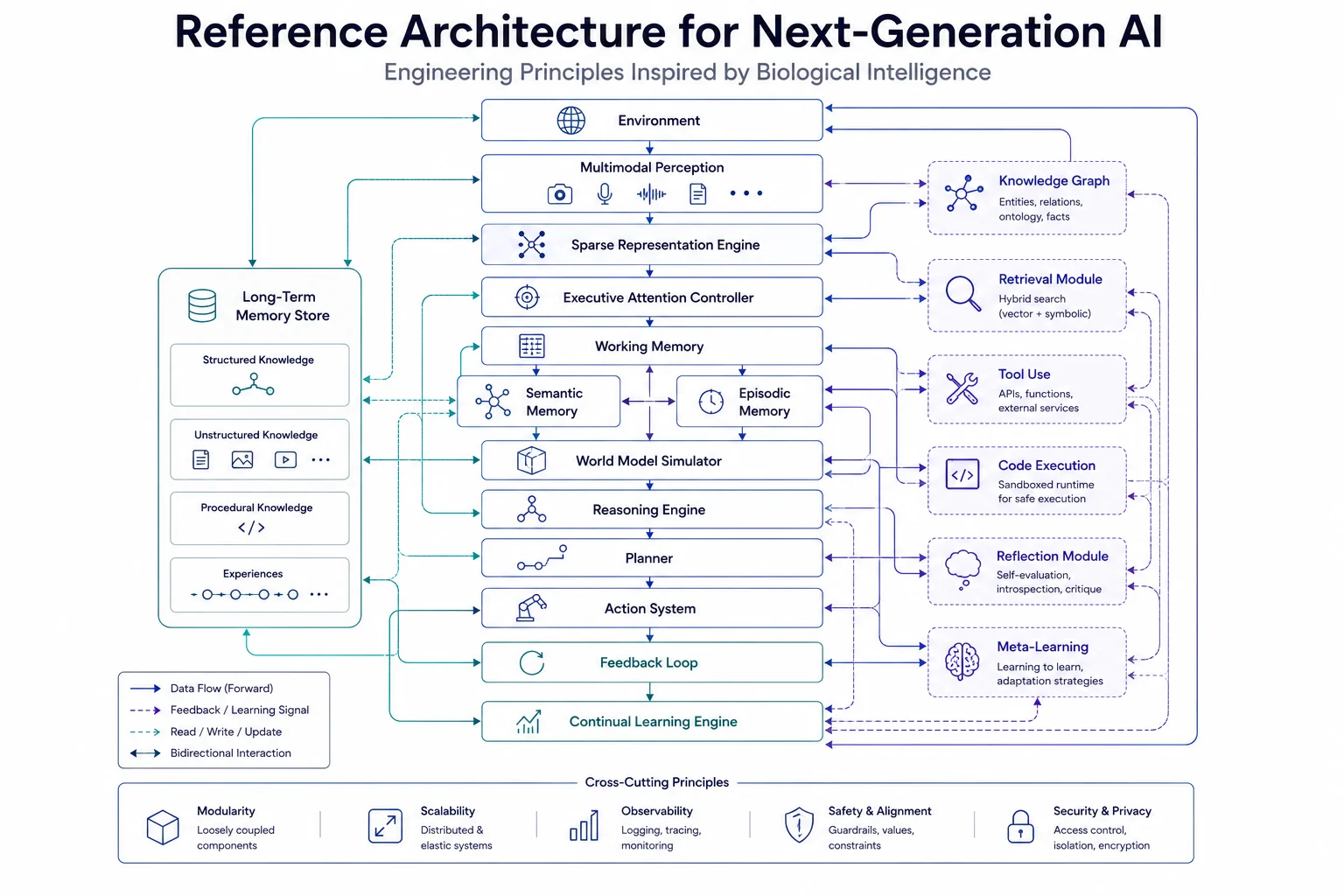
Engineering Principles
The ten principles below summarize what the preceding sections imply for engineering. Each has implementable starting points today.
| Principle | Engineering Implication | Starting Point |
|---|---|---|
| Representations enable logic | Dense embeddings are insufficient for compositional reasoning. Hybrid sparse-dense or VSA representations are required for variable binding without superposition collapse. | Hyperdimensional Computing libraries (torchhd), neuro-symbolic frameworks |
| Compression enables abstraction | Treat neural networks as Information Bottlenecks. Optimize explicitly for redundancy reduction to force task-invariant concept emergence. | IB regularization, VIB (Variational IB), noise injection during training |
| Prediction reduces uncertainty | Move beyond flat autoregression. Architectures must predict across hierarchical levels of abstraction and use prediction errors as the primary driver for local weight updates. | Hierarchical predictive coding models, Expected Free Energy objectives |
| Attention allocates computation | Self-attention is only the Orienting phase. AI agents need an explicit top-down Executive Control module to maintain goal adherence and suppress irrelevant tokens. | Dual-process architectures, goal-conditioned attention masks |
| Memory is reconstructive | RAG is a stopgap. Agent memory must evolve into a Key-Value architecture where sparse indices actively reconstruct relational states, mimicking hippocampus-neocortex interplay. | Graph-Augmented RAG, EcphoryRAG, entity-centric memory graphs |
| Learning requires locality | The future of edge AI and neuromorphic hardware requires local credit assignment algorithms, not global backprop, to enable continuous, energy-efficient learning. | Dendritic Localized Learning, Feedback Alignment, Difference Target Propagation |
| Reasoning requires symbolic grounding | LLMs are powerful pattern matchers, not reasoners. Reliable intelligence requires Neuro-Symbolic integration, where neural perception feeds into deterministic symbolic engines. | Code interpreters, formal verification, Prolog-style symbolic engines wired to LLMs |
| Planning requires simulation | Agents must maintain world models to hallucinate action trajectories before acting, abstracting irrelevant details dynamically rather than simulating the full environment. | RSSM-based world models, Dreamer architecture, latent imagination |
| Intelligence is a closed loop | Static inference is not intelligence. AI must be embedded in continuous Perception-Action-Evaluation loops using Active Inference to explore and minimize surprise. | Active Inference frameworks, persistent episodic memory, online RL integration |
| Efficiency scales intelligence | The brain proves that cognitive capability does not require gigawatts. Sparsity, event-driven processing, and in-memory computing are mandatory for embodied AI at scale. | SNNs, Intel Loihi 2, analog in-memory computing, aggressive quantization |
Conclusion: The Gap Is Architectural
The distance between biological intelligence and modern AI is not primarily a data problem, a compute problem, or even a parameter-count problem. It is an architectural gap, a mismatch between what the two systems optimize for.
Biological intelligence optimizes for survival in non-stationary, partially observable environments with severe energy constraints. It achieves this by unifying perception, learning, memory, prediction, and action into a single closed loop that runs continuously, updates locally, compresses aggressively, and never stops adapting. Modern AI optimizes for static benchmark performance on fixed datasets with effectively unlimited compute. These objectives produce fundamentally different architectures.
The good news: every one of the eleven principles described here is already being researched. Predictive coding architectures are being integrated into Transformers. VSAs are being combined with deep learning for neuro-symbolic reasoning. Graph memory is replacing flat RAG for agent memory. Local learning rules are being demonstrated on neuromorphic hardware. The pieces exist.
What is missing is synthesis, treating these not as independent research threads but as stages of a single, unified Cognitive Compute Cycle that all AI systems will eventually need to implement to move from capable tools to genuinely adaptive intelligence.
Frequently Asked Questions
What is the Cognitive Compute Cycle?
The Cognitive Compute Cycle is a unified model of biological intelligence as a single continuous pipeline: raw information is structured into a Representation, compressed into Abstractions, used to generate Predictions, filtered by Attention, indexed in Memory, consolidated via Learning into weights, enabling Reasoning within World Models, which drives Actions, creating Feedback Loops, all while maximizing thermodynamic Efficiency. Every step feeds the next, making biological intelligence a closed, self-correcting system rather than a static input-output function.
What is the Information Bottleneck theory?
The Information Bottleneck (IB) theory, formulated by Naftali Tishby, states that the optimal learning objective is to find a compressed representation Z of an input X that retains maximal mutual information with a target Y. Formally: minimize I(X;Z) − β·I(Y;Z), where β controls the compression-prediction trade-off. Deep networks naturally undergo this: a fitting phase followed by a compression phase. The IB lens explains overfitting (bottleneck too wide), and why noise injection and architectural bottlenecks improve generalization.
How does biological attention differ from Transformer self-attention?
Biological attention operates via three integrated networks: Alerting (maintaining readiness), Orienting (rapid bottom-up, stimulus-driven allocation), and Executive Control (top-down suppression of distractors for conflict resolution). Transformer self-attention is mathematically analogous to the Orienting network only. It has no Executive Control, which is why LLMs fail on sustained conflict-resolution tasks where highly associative but logically irrelevant tokens dominate the context. Scaling context windows does not fix this; only an explicit top-down inhibitory pathway does.
What is Active Inference?
Active Inference, from Karl Friston's Free Energy Principle, holds that an intelligent agent minimizes prediction error by either updating its model to match reality (perception) or acting on the world to change reality to match its predictions (action). Actions are chosen to minimize Expected Free Energy, balancing goal-directed behavior with information-gathering behavior. An Active Inference agent actively seeks data that disproves its own hypotheses. Current AI agents are largely passive responders, not active uncertainty-reducers.
What is the superposition catastrophe in AI embeddings?
In dense vector embeddings, the superposition catastrophe occurs when too many concepts are bundled into the same high-dimensional space. Because every dimension has a non-zero value in dense embeddings, superimposed concepts entangle and cannot be cleanly extracted. This makes strict logical operations (like distinguishing "A causes B" from "B causes A") fundamentally unreliable. Vector Symbolic Architectures (VSAs) address this through explicit binding operations that maintain mathematical separability even after multiple concepts are composed together.