Vibe Coding Is Not Magic. It's Workflow Engineering.
How disciplined AI-assisted development actually works, and what separates production software from fragile prototypes
In early 2025, the software development ecosystem experienced a profound methodological shift. We all watched the same narrative take hold across developer communities: the mainstream arrival of "vibe coding." Coined to describe a highly exploratory, forgiving mode of software creation, the phrase captured a tantalizing promise, a world where developers could shift their focus away from wrestling with syntax line by line, and instead guide a large language model through a fluid, conversational build process.
In its purest, idealized form, vibe coding felt like a space where a creator could fully surrender to the momentum of their ideas, effectively forgetting that the underlying code even existed.
However, as the concept permeated the broader technology sector, it became deeply misunderstood. Driven by aggressive tooling marketing and a surge of internet hyperbole, vibe coding was falsely equated with the complete obsolescence of traditional software engineering. A pervasive narrative emerged: anyone, regardless of technical background, could instantaneously generate production-ready enterprise applications simply by typing abstract desires into a text box.
This illusion led to a brief but intense period of organizational misalignment, an era some called "tokenmaxxing," where tech organizations began equating raw AI token consumption with actual productivity. Engineers were ranked by how much AI output they generated, while compounding technical debt accumulated silently underneath.
Spend enough time actually building and shipping software, and a fundamentally different reality emerges. Modern AI-assisted development, when implemented without rigorous engineering discipline, reliably produces fragile, unmaintainable, and insecure systems. The resulting software inevitably collapses under the unforgiving pressures of a production environment.
- Vibe Coding Is Workflow Engineering
- Systems Thinking Matters More Than Ever
- Product Thinking and UX Empathy
- A Multi-Model Orchestration Workflow
- AI Did Not Remove Engineering Discipline
- The Hidden Superpower: Rigorous Testing
- Beginner Guidance: Learning Workflows, Not Just Prompts
- Conclusion: The Human Orchestrator
- FAQ
Vibe Coding Is Workflow Engineering
The transition from manual typing to AI-assisted generation represents a macro-level paradigm shift. We are moving from syntax execution to intent orchestration.
In traditional software development, a massive portion of daily labor involves translating business logic into highly specific programmatic commands, including endless boilerplate, fighting with language-specific idiosyncrasies, and manually wiring up data structures. In the AI engineering era, this low-level execution is increasingly commoditized. An LLM can write a sorting algorithm or a basic API fetch request in milliseconds. But the commoditization of syntax must never be conflated with the commoditization of software engineering itself.
To understand why AI developer workflows must be approached as a structured discipline, we have to distinguish between two very different goals.
Answering that second question requires shifting away from casual, free-flowing chats with an AI and moving toward what is fundamentally agentic engineering: the disciplined, deliberate practice of coordinating and orchestrating AI coding agents within a structured pipeline.
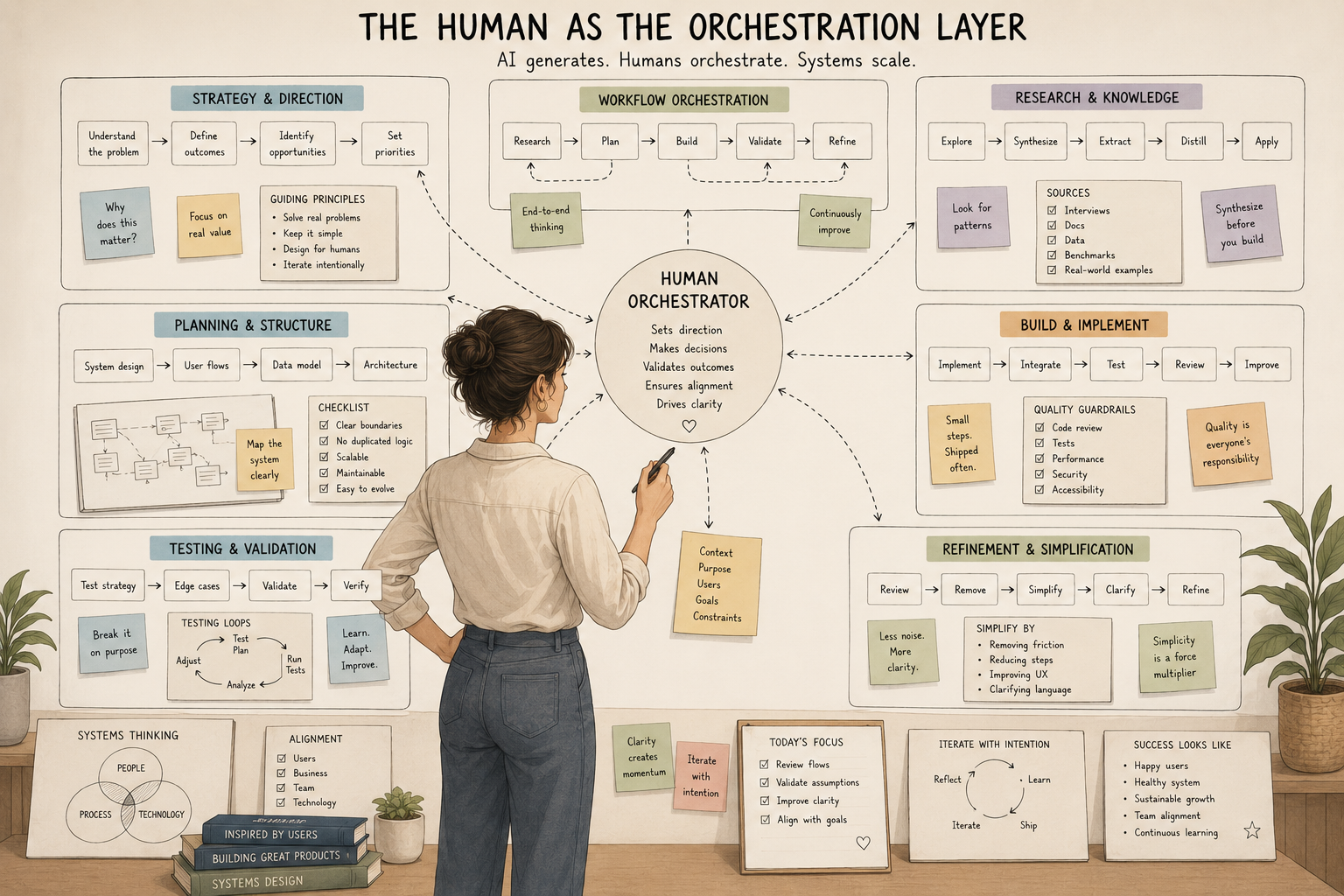
When you engage in workflow engineering, you are not merely opening a chat window and asking an AI to "build an application." You are designing a multi-step system. You determine exactly how architectural context is fed to the model, how the model's output is verified against business requirements, how regressions are systematically prevented, and how the user experience is prioritized.
You will find yourself reviewing generated code far more often than writing raw syntax. You act less like a bricklayer placing syntax block by block, and more like a systems architect and quality assurance director combined. You are the conductor. The AI is the orchestra. The final output is only as robust as the human-designed system engineered to produce it.
Systems Thinking Matters More Than Ever
Historically, the most celebrated software engineers were often those with encyclopedic knowledge of memory management and obscure language-specific syntax. While those technical fundamentals remain valuable, highly capable AI coding tools have democratized the implementation phase. Because generating raw code is no longer the primary bottleneck, the defining constraint of a technical project is no longer how to build it, but what exactly to build and why it matters to the end user.
This shift has moved the primary locus of value creation directly toward systems thinking, business process design, and user experience awareness. AI accelerates implementation, but systems thinking becomes exponentially more important.
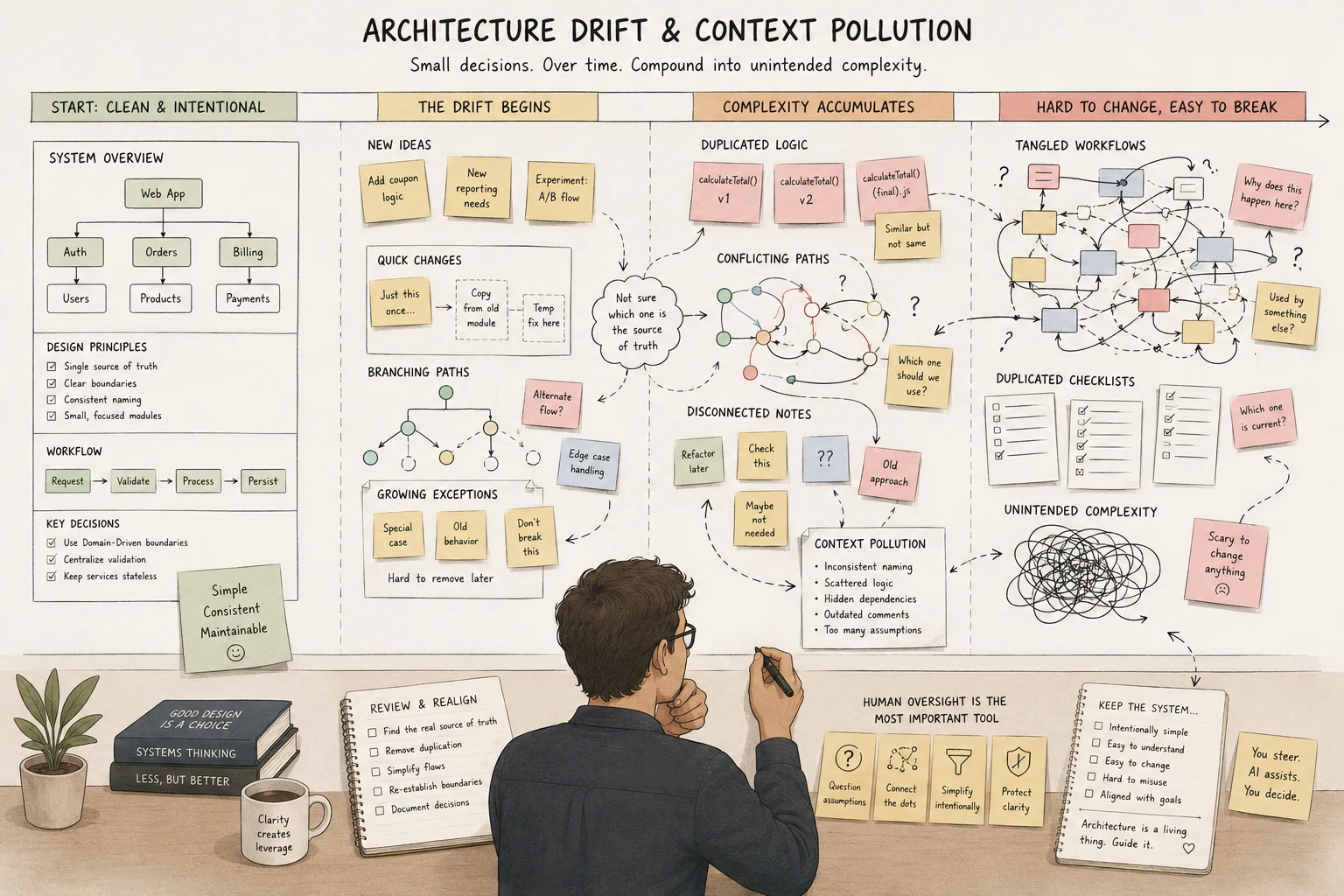
Systems thinking is the ability to understand how discrete, isolated components interact within a larger, cohesive whole. In AI coding workflows, this perspective is not a nice-to-have; it is a survival requirement. Large language models are notorious for losing overarching architectural context when they get hyper-focused on micro-level implementations, a frustrating phenomenon often called "goldfishing."
A practitioner functioning as a systems thinker anticipates this architectural drift during iterative prompting. They don't merely ask the AI to write an isolated function. They design the broader data flow, anticipate system degradation, and meticulously structure the application state.
For many builders, the operational reality of development doesn't rely on sprawling cloud version control. The app is built, managed, and verified entirely locally before a finalized bundle is uploaded to a distribution console. In this localized reality, maintaining a pristine mental model of your codebase is paramount. You cannot rely on an AI to perfectly hold the entire system architecture in its context window without eventually corrupting it.
Product Thinking and UX Empathy
Great software is fundamentally defined by its usability, its simplicity, and its ability to reduce cognitive overload for the end user. AI models, if left completely unguided by human empathy, default to generating complex, feature-bloated, or highly generic interfaces. They tend to overengineer simple features because they lack an intrinsic intuition for human behavior.
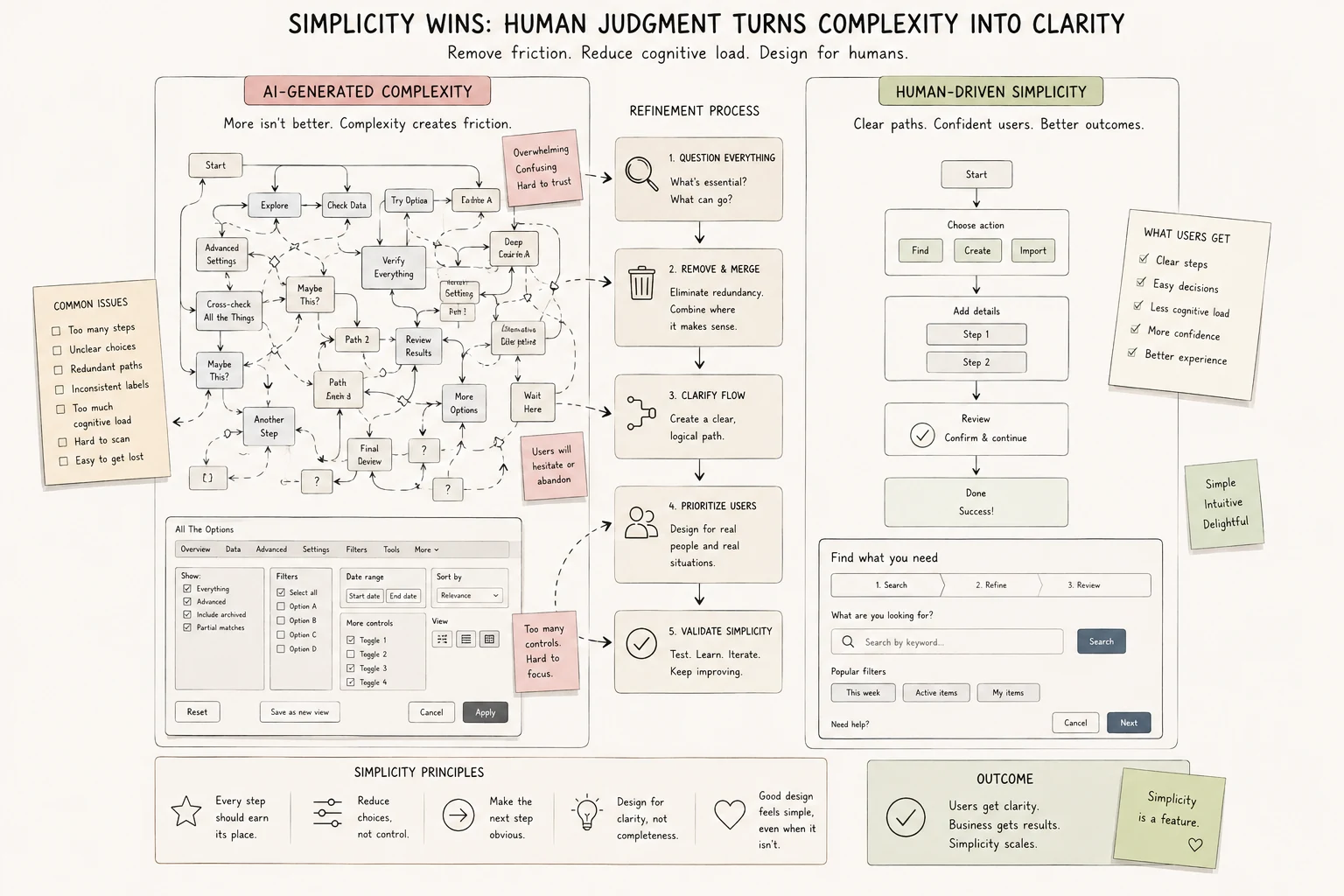
A practitioner with a strong product background brings essential human-centered design principles to the orchestration process. They focus relentlessly on iterative refinement, often improving UX by removing complexity rather than adding features.
This means making hard architectural choices early. It means actively fighting the AI's naive instinct to wire up an unnecessary cloud database simply because it's a standard pattern in its training data. You have to design a privacy-first application that functions on-device without relying on external cloud synchronization or forced account creation.
A Multi-Model Orchestration Workflow
A defining characteristic of mature AI developer workflows is the absolute abandonment of single-tool reliance. Different large language models possess distinctly different architectural designs, training data distributions, and internal optimization priorities. No single AI tool is perfectly suited for every stage of the software engineering lifecycle.
Expert practitioners do not exhibit blind loyalty to a single provider. Switching tools depending on task complexity is not a luxury; it is an operational necessity.
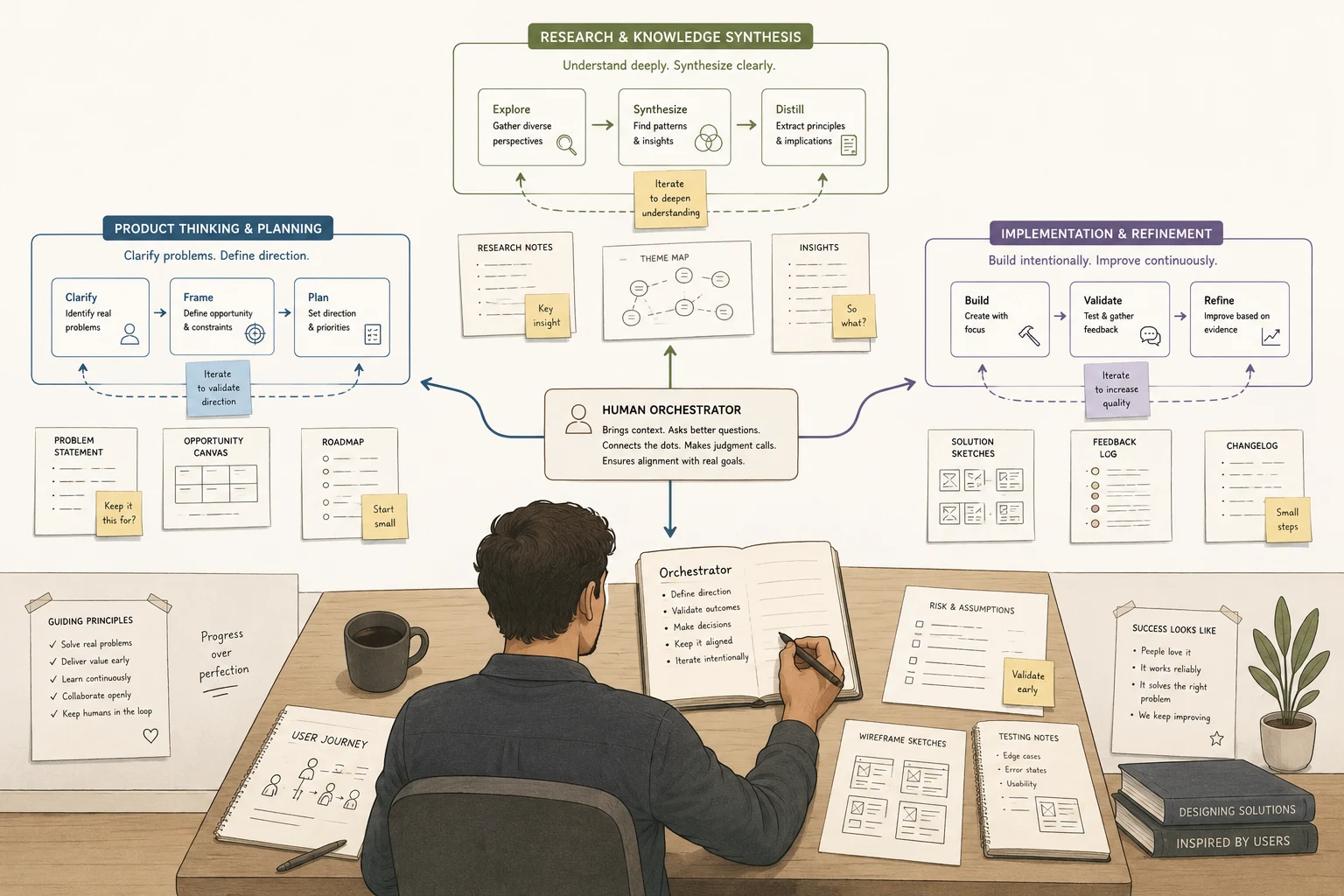
The inception phase requires broad, divergent thinking, market context analysis, and the synthesis of abstract user needs. You do not use this phase to write production code. You use the AI as a strategic sounding board to establish product-market fit, draft feature requirements, and stress-test the initial idea. The output of this phase is not an app; it is a human-readable product specification that will serve as the unyielding constraint for all subsequent engineering phases.
Once broad product requirements are established, the workflow shifts to technical research. When the engineering task requires understanding complex, frequently updated third-party APIs, analyzing vast datasets, or synthesizing extensive compliance documentation, you need a model optimized for massive context windows and rapid factual synthesis. Models like Gemini allow you to feed entire PDFs of documentation, extract specific data structures, and bridge the gap between abstract requirements and concrete technical realities.
For the actual implementation phase, the industry relies on models uniquely tuned for complex logic, surgical file editing, and strict adherence to formatting instructions. When integrated into modern AI-enabled IDEs like Cursor, these models dynamically read your actual files, dependencies, and directory structures. You feed the AI the product specification, the technical constraints, and a highly structured master prompt that dictates specific coding standards. Operational reality dictates that you will spend significant time managing the AI's memory; restarting sessions before context pollution causes hallucinations is a daily routine.
AI Did Not Remove Engineering Discipline
Perhaps the most dangerous misconception to survive the initial hype cycle was the notion that AI had somehow rendered software engineering discipline obsolete. On the contrary, the proliferation of AI-generated code has made rigorous engineering discipline more critical than ever before.
AI tools produce the safest, most reliable outcomes only when high-functioning engineering standards already exist within the practitioner's methodology. When developers adopt a high-risk tolerance, minimize procedural oversight, and blindly trust large volumes of AI-generated code, the project inevitably collapses. The speed at which an AI can generate syntax is matched only by the speed at which it can generate compounding technical debt.
The Necessity of Architecture
Before a line of code is generated, disciplined engineering requires meticulous planning. Because AI models lack true situational awareness, the human operator must establish the architectural boundaries: defining data schemas, selecting appropriate design patterns, establishing explicit API contracts, and determining how the system handles offline states.
Security, State, and Maintainability
Unstructured vibe coding frequently introduces unseen vulnerabilities. Code generated by AI is often excluded from thorough human code reviews. The model might achieve the immediate visual goal while utilizing deprecated libraries, ignoring input sanitization, or completely failing to separate concerns.
Consider the reality of monetization. When an LLM generates a payment screen, its first instinct is often to hardcode a specific price tag directly into the user interface components. A disciplined systems thinker knows this is a recipe for disaster. The UI must remain entirely agnostic, with price labeling dynamically fetched from a dedicated, secure billing library. If the AI merges presentation with core business logic, you are setting a trap for yourself in production.
Engineering discipline also mandates modular design and clear documentation. These practices ensure you are balancing the speed of AI generation with the uncompromising demands of long-term maintainability.
The Hidden Superpower: Rigorous Testing
If multi-model orchestration is the engine of modern AI software development, rigorous testing is the steering wheel and the emergency brake. The most critical differentiator between amateur vibe coding and professional agentic engineering is the presence of an uncompromising, almost obsessive testing discipline.
The Operational Reality of Validation
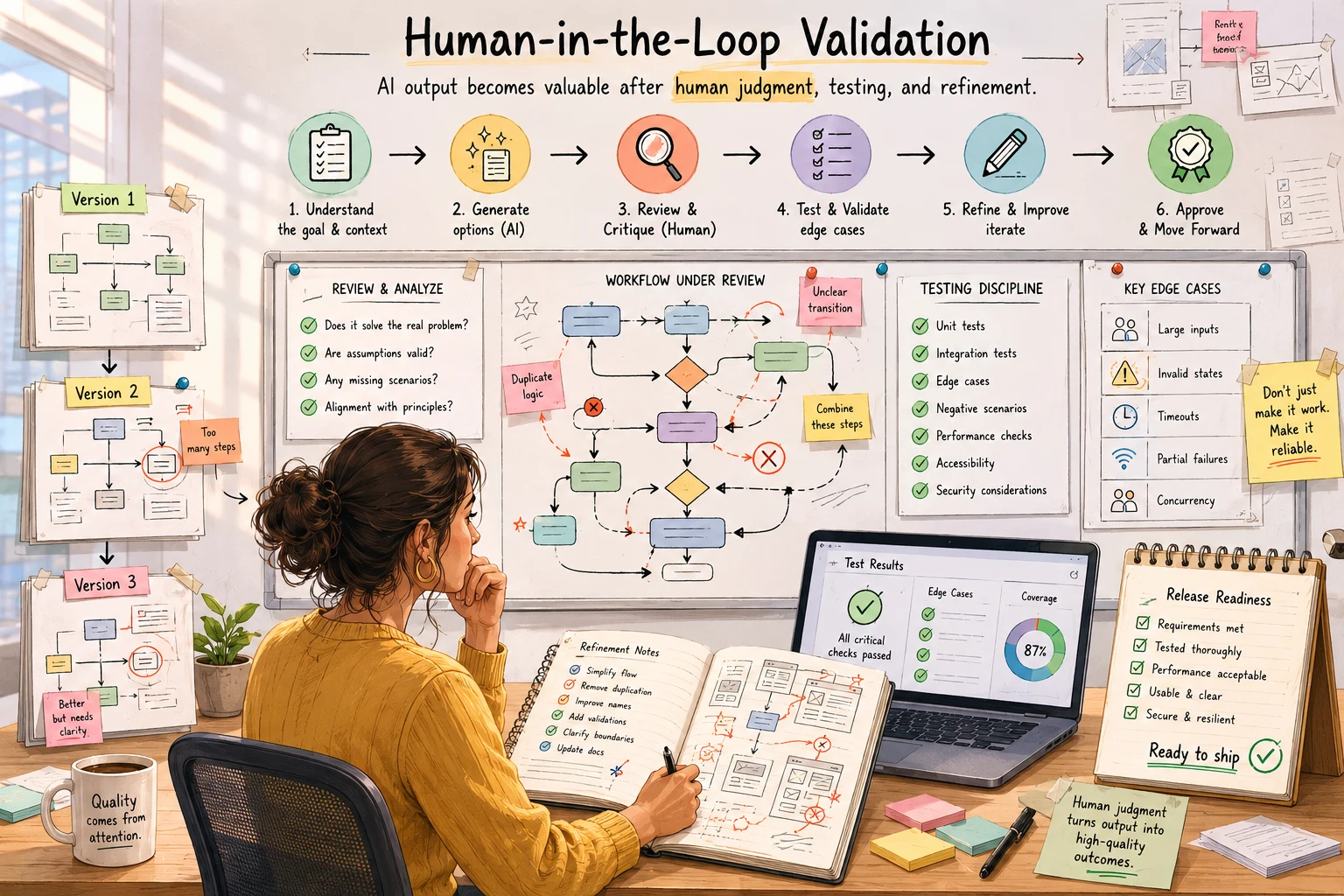
Validation is not just about asking the AI to write a unit test script. It is deeply operational, requiring a safety-first workflow where code generation is tightly coupled with immediate, aggressive validation.
- Scope ruthlessly. Keep context tight. Request one specific, isolated unit of functionality at a time.
- Generate and test concurrently. The moment the AI produces isolated logic, immediately validate the expected input and output.
- Anticipate the regression. Explicitly command the AI to check for known constraints or side-effects it is prone to forgetting.
- The human sanity check. Automated tests are necessary but insufficient. You must manually run the build, click the buttons, and force the edge cases.
In practice, validating an AI-generated feature goes far beyond terminal scripts. It involves putting a build into the hands of real people, running mandatory internal testing cycles with real testers, meticulously watching how the AI's logic holds up when an actual user taps the wrong sequence of buttons on an older device.
Mitigating Edge Cases
LLMs inherently default to the path of least resistance. When prompted to build a feature, they will almost always assume optimal conditions: high-speed network connectivity, perfectly formatted user input, and absolute API uptime.
Software engineering, however, is the science of managing failure states. A sophisticated workflow forces the AI to confront edge cases. What occurs when the local database read fails? How does the UI gracefully degrade if an uninitialized setup occurs? You must actively collaborate with the AI to map the dark corners of the application, transforming volatile statistical output into a trusted, resilient digital product.
Beginner Guidance: Learning Workflows, Not Just Prompts
The democratization of software development via natural language prompting represents a massive, unprecedented opportunity. However, the onboarding process is fraught with peril. When novices attempt to build production systems instantly by relying on the "pure vibes" promised by marketing campaigns, they quickly smash into a wall of technical complexity.
If you are just entering the AI coding space, your goal should not be to immediately build a sprawling enterprise architecture. Your focus must be on learning the fundamentals of workflow engineering incrementally.
Navigating the Wall of Jargon
The initial experience of using a modern AI coding tool often feels less like magic and more like an abrasive crash course in systems administration. Before the AI ecosystem reaches a point where the underlying machinery disappears behind a perfect interface, beginners have to navigate a wall of terms like environment variables, explicit dependencies, PATH configurations, and lifecycle methods. Because the AI generates code assuming these structures already exist in your environment, you will be stranded when the app fails to compile.
Start Small, Validate Relentlessly
The most effective way to learn agentic engineering is to start with exceptionally small, highly constrained projects. Build a single-page local utility. Build a simple data parser. By keeping the initial scope small, you practice the fundamental iterative loop: state the requirement clearly, read the generated code line by line to understand the logical structure, validate the output relentlessly by running it, and iterate based on error messages.
You are not just learning how to prompt. You are learning how to think like a systems engineer. You are learning to anticipate unpredictable behavior and understand the flow of state within an application.
Conclusion: The Human Orchestrator
The current era of software development is not defined by the obsolescence of the human engineer. It is defined by the incredible amplification of human capability through artificial intelligence.
Generative AI is neither a magical replacement for human skill nor a trivial toy. It is an extraordinarily powerful statistical instrument that yields its highest value only when subjected to rigorous, disciplined orchestration.
As we move firmly away from casual, high-risk exploration and settle into mature agentic engineering, the mandate is clear. You must prioritize sustainable outcomes over hype. There is no universal, perfect AI tool that will do the thinking for you. The quality of your final software product is entirely, unequivocally dependent on the quality of the workflow you design to produce it.
Software engineering discipline has not been erased by the LLM. It has been elevated by it. Writing code line by line is no longer the hard part. Designing the system, managing AI context, and making sure the output actually works — that is where the real engineering happens now.
Frequently Asked Questions
Vibe coding is an AI-assisted approach to software development where developers guide large language models through a conversational, iterative build process rather than writing syntax manually. At its best, it represents a shift from syntax execution to intent orchestration. At its worst, it becomes undisciplined code generation that produces fragile, unmaintainable systems that collapse under production conditions.
Yes, but only when paired with rigorous engineering discipline. Unstructured vibe coding reliably produces fragile systems with compounding technical debt, architectural drift, and security vulnerabilities. Production-grade AI-assisted development requires a structured multi-step workflow: a product specification, architectural planning, context-managed implementation sessions, and exhaustive validation including manual testing on real devices.
Agentic engineering is the disciplined practice of coordinating and orchestrating AI coding agents within a structured workflow. Rather than issuing a single prompt and trusting the output, practitioners design multi-step pipelines that define how architectural context is fed to models, how output is validated against requirements, and how regressions are prevented. The human acts as the architect and quality director; the AI handles implementation.
Keep prompts tightly scoped to isolated units of functionality, validate output immediately after generation, restart AI sessions before context degradation causes hallucinations, use modular architecture so the AI cannot silently overwrite unrelated logic, and apply a strict human review layer before any generated code reaches production. Treating every AI output as probabilistic rather than deterministic is the foundational mindset shift.
Advanced reasoning models work well for product strategy and architectural planning. Models with massive context windows like Gemini suit deep research and synthesizing documentation. IDE-integrated tools like Cursor are optimal for implementation and codebase-aware code generation. No single tool covers every phase effectively. The discipline lies in knowing when to switch and how to transfer context cleanly between them.