AI Infrastructure
Late Chunking and Contextual Retrieval: Solving the RAG Context Boundary
The chunk has the exact answer. The retrieval system still can't find it, because the text was severed before anything ever read it in context.
- Standard RAG chunks first, embeds second. That ordering severs context before the embedding model ever sees the full document, and no amount of chunk overlap reliably fixes it.
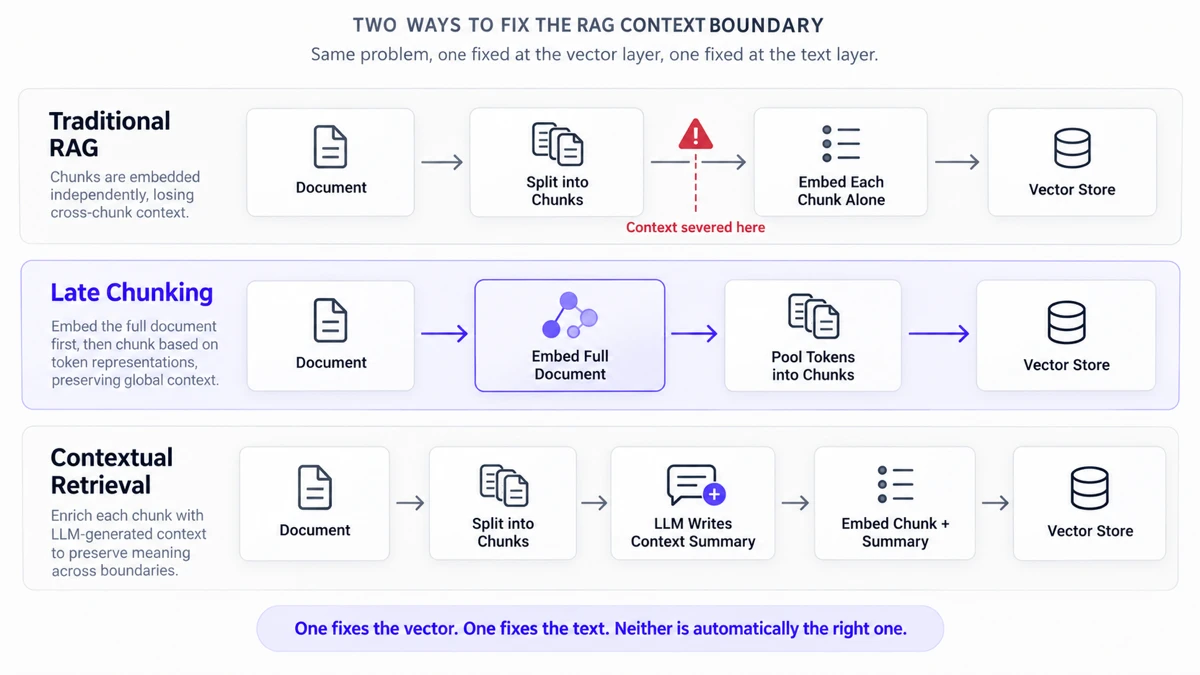
- Late Chunking flips the order: encode first, pool later. A long-context embedding model processes the whole document, then chunk boundaries are applied to the already-contextualized token vectors.
- Contextual Retrieval fixes the same problem at the text layer instead. An LLM writes a short explanation of where each chunk fits in the document, and that gets prepended before embedding and BM25 indexing.
- They aren't interchangeable. Late Chunking needs a long-context embedding model and produces an inspectable-nothing dense vector. Contextual Retrieval needs LLM inference per chunk and produces auditable text, plus a real lexical-search benefit.
- Late Chunking moves the context boundary, it doesn't remove it. A document longer than the embedding model's context window still needs to be segmented, and that segmentation can still lose context.
- Neither is a universal fix. Short, self-contained documents like error logs or support tickets get little benefit from either.
- The RAG Context Boundary
- Why Traditional Chunking Loses Context
- What Is Late Chunking?
- How Late Chunking Works
- Late Chunking vs Contextual Retrieval
- How It Compares With Other RAG Strategies
- Infrastructure and Computational Trade-offs
- Implementing Late Chunking
- Evaluating Retrieval Quality
- Failure Modes and Limitations
- When Should You Use Late Chunking?
- Conclusion
- Frequently Asked Questions
The RAG Context Boundary
Retrieval-Augmented Generation fundamentally relies on segmenting large documents into smaller, searchable units. The standard ingestion pipeline dictates an established sequence: a document is chunked first, and vector embeddings are generated for those isolated chunks second.
That architecture makes large corpora searchable, but it introduces a severe structural flaw known as context boundary loss. Consider a technical design document with this sequence across a paragraph break:
"The company introduced the Falcon architecture in 2024. [Paragraph break] It reduced inference latency by 37% while maintaining fp16 precision."
If a conventional chunking algorithm splits at the paragraph boundary, the resulting vector for the second chunk is generated strictly from the isolated string "It reduced inference latency by 37% while maintaining fp16 precision." When a user queries "What impact did the Falcon architecture have on latency?", retrieval failure is highly probable. The query vector heavily encodes the entity "Falcon architecture." The chunk vector only encodes "latency reduction" and "fp16." Because the embedding model processed the second chunk in isolation, it never had the opportunity to map the pronoun "It" to "Falcon architecture."
The context was severed before the embedding model ever evaluated the text. The isolated chunk contains the exact answer the LLM needs, but the dense retrieval system can't find it.
Traditional RAG determines chunk boundaries before the embedding model contextualizes the text. Important document-level context disappears right at that boundary. Late Chunking and Contextual Retrieval address this by making sure the representations used for retrieval retain information from the surrounding sequence, each in a different way.
Why Traditional Chunking Loses Context
A common engineering heuristic is to try solving context loss by increasing chunk size or implementing a chunk overlap strategy, a 15% token overlap window between consecutive chunks, for example.
Chunk overlap improves textual continuity. If an important sentence spans an arbitrary character limit, a token overlap ensures at least one chunk captures the complete sentence without bisecting it. But overlap does not guarantee the preservation of semantic context. Those are functionally different things. Semantic context covers the long-range dependencies that give a text span its complete meaning:
- Document-wide terminology: an acronym or domain-specific term defined in the introduction but used heavily in the conclusion.
- Entity relationships: pronouns, relative references ("the proposed framework"), or comparative statements relying on subjects established in previous sections.
- Table and section context: a row reading
"Q3 | $4.2M"that belongs to a table physically located 20 chunks prior, specifying currency, region, and reporting standard. - Hierarchical dependencies: a technical spec stating "Defaults to 512" in an API reference, relying on the preceding H2 header to define which endpoint and parameter it's even talking about.
If a metric's definition is on page 1 of a report and the chunk using it is on page 10, a 200-token overlap gives zero access to that definition. The traditional embedding model processes page 10 in a vacuum, mapping the literal text into vector space without the broader situational awareness needed to match highly specific user queries.
What Is Late Chunking?
Late Chunking is a retrieval architecture that reorganizes the standard ingestion sequence. Instead of chunking the text and then encoding the isolated spans, it encodes the broader document sequence first and applies chunk boundaries later.
In a traditional pipeline, text is sliced into independent strings and each string is passed to the embedding model separately. In a Late Chunking pipeline, the document is passed to a long-context embedding model as one continuous sequence. The model generates highly contextualized token-level representations for the input. Only after that contextualization happens are the predetermined boundaries applied to aggregate tokens into searchable chunk vectors.
Late Chunking does not mean "do not chunk." It means "encode first, pool later."
The core architectural distinction comes down to the non-commutativity of transformer and pooling operations. For a given document and a defined chunk within it, the resulting vectors are unequal:
Pool(Transformer(document)[chunk]) ≠ Pool(Transformer(chunk))
Applying a transformer to an isolated chunk restricts the attention mechanism exclusively to the tokens within that boundary. Applying a transformer to the whole document lets the tokens within a specific chunk span incorporate information from the surrounding sequence, subject to the model's architecture, positional encoding, and attention mechanism.
The resulting chunk representation can therefore retain contextual information that would be unavailable if the exact same chunk were encoded in isolation. You still produce one vector per chunk, and you still store the original chunk text to pass to the generation model, but the vector itself is enriched by the available document context. Late Chunking moves the context boundary, it does not remove it.
How Late Chunking Works
The mechanics require an embedding model capable of processing long sequences natively (8,192 tokens or more, for example) and exposing token-level outputs before pooling occurs. The pipeline runs through these stages:
- Global tokenization: the document, or a segment of it that fits within the model's context window, is tokenized as a single continuous sequence.
- Long-context forward pass: the tokenized sequence goes through the embedding model. During this pass, multi-head self-attention layers compute relationships between tokens. A token for "It" in the latter half of the sequence can pull attention weights from tokens for "Falcon architecture" in the earlier half.
- Token representation output: instead of a global pooling operation producing a single document-level vector, the model outputs a dense vector for every individual token (an N × d matrix, where N is sequence length and d is embedding dimension).
- Boundary mapping: parallel to or preceding the forward pass, a standard chunking algorithm (recursive character splitting, semantic chunking, regex) determines where the text should logically divide. Those text-level boundaries get mapped to their corresponding token indices.
- Segment pooling: for each chunk boundary, the system extracts the contextualized token vectors within that span and aggregates them into a single chunk-level vector, typically via mean pooling:
v_chunk = MeanPool(h_i ... h_j), where h_i through h_j are the contextualized token representations for that span. - Normalization and storage: the resulting pooled vectors are typically L2 normalized and inserted into the vector database alongside the raw chunk text.
Because the underlying token representations were generated while the model evaluated the broader sequence, the final aggregated chunk vector carries mathematical traces of semantic information from outside its immediate textual boundary.
Late Chunking vs Contextual Retrieval
Contextual Retrieval, popularized by Anthropic's engineering team, is a separate architectural philosophy for the same problem. Where Late Chunking operates implicitly at the dense representation layer, Contextual Retrieval operates explicitly at the text layer.
In Contextual Retrieval, the document is chunked first. Before the chunks are embedded, each chunk, alongside the full document or a relevant subset, is passed to a generative model. That model produces additional context, typically a short 50-100 token explanation of how the chunk fits into the broader document. This generated context is concatenated to the original chunk text, and the combined string is embedded and indexed, feeding both the dense embedding and the BM25 lexical index. Anthropic's own benchmarks found this combination (Contextual Embeddings plus Contextual BM25) cut top-20 retrieval failures by about 49%, and adding a reranking stage on top pushed the total reduction to roughly 67%.
Where Context Enters
| Approach | Where context enters |
|---|---|
| Late Chunking | Implicitly at representation time. The long-context embedding model processes the surrounding sequence, producing contextualized token representations. Chunk boundaries are applied afterward. |
| Contextual Retrieval | Explicitly in text. A generative model produces additional context associated with each chunk before embedding and/or lexical indexing. |
Engineering Trade-offs
| Dimension | Late Chunking | Contextual Retrieval |
|---|---|---|
| Model requirements | Requires an embedding model with long context and token-level output access. | Agnostic to the embedding model, works fine with legacy 512-token models, but requires a generative LLM for preprocessing. |
| Ingestion compute | Shifts compute toward longer-context embedding passes, mathematically heavier than isolated short-context passes. | Incurs LLM inference cost and latency (prompt processing plus generation) for every chunk in the corpus, substantial at scale. |
| Storage and payload | Modifies the dense vector values, not the underlying text. | Increases raw text storage and payload token count, since the generated context is permanently appended in the database. |
| Debugging and interpretability | A black-box dense representation, context is distributed across vector dimensions and hard to audit. | Explicit and inspectable, an engineer can read the exact context text the LLM generated. |
| Hybrid / BM25 retrieval | Operates entirely in dense vector space, no direct benefit to pure lexical search. | Typically improves sparse/lexical retrieval directly, since missing entities get written into the indexed text. |
How It Compares With Other RAG Strategies
Semantic Chunking
Semantic chunking addresses a structural question: where should the document be split? It typically uses sentence-level embeddings to detect shifts in meaning, placing boundaries at topical transitions instead of arbitrary character limits. Late Chunking addresses a representational question instead: how should the resulting spans be represented? These techniques are entirely orthogonal and frequently combined, an optimized pipeline can use semantic chunking to determine boundary indices, then Late Chunking to generate the contextualized vectors for those specific spans.
Parent-Child Retrieval (Auto-Merging)
Parent-child retrieval is an assembly-time strategy. Documents split into large parent chunks, which split further into smaller child chunks. Only the child chunks get embedded and indexed. At query time, the system retrieves the relevant child chunk but returns the encompassing parent chunk to the generative LLM.
This restores context at generation time, giving the LLM a wider text window to formulate an answer. It doesn't alter the representation used for the initial vector search, though. If the child chunk lacks the contextual keywords to trigger a similarity match, the parent document never gets retrieved in the first place. Late Chunking attempts to solve the search bottleneck directly instead of downstream of it.
Late Interaction (ColBERT)
Late Interaction architectures, ColBERT being the best-known example, get conflated with Late Chunking often, but the mechanics differ fundamentally. Late Chunking produces one pooled vector per chunk, once the contextualized tokens are pooled, the system runs a standard single-vector retrieval paradigm. Late Interaction retains multiple token-level vectors and never pools them into a single chunk representation. At query time it performs fine-grained, token-level matching (a MaxSim operation) between every token in the query and every token in the document. That yields exceptionally high retrieval accuracy but requires specialized vector database support and introduces very different storage and query-time compute constraints.
Infrastructure and Computational Trade-offs
Adopting Late Chunking means evaluating its impact on storage, query latency, and ingestion compute specifically.
Storage Footprint
Late Chunking doesn't inherently increase the number of vectors in a database. A corpus with one million chunks produces one million vectors under conventional chunking, and still produces one million vectors under Late Chunking. Actual storage depends on vector dimension, numerical datatype (float32 vs int8 quantization), the specific ANN index structure, metadata, and replication overhead. Because Late Chunking outputs a standard dense vector, it doesn't multiply storage costs the way multi-vector approaches like ColBERT do.
Query Latency
Late Chunking doesn't inherently add a retrieval stage or change query-time search complexity. The resulting vectors search using conventional single-vector ANN infrastructure. Actual system latency depends on the surrounding implementation, the query embedding model's speed, database size, ANN parameters, but Late Chunking itself doesn't degrade query speed.
Ingestion Compute
Late Chunking intentionally shifts more computation into ingestion and indexing. In a conventional setup, a 4,000-token document might process as ten isolated 400-token forward passes. In Late Chunking, the embedding model processes the sequence as a single 4,000-token pass.
The practical cost depends heavily on the embedding model's architecture. Standard full self-attention has quadratic pairwise attention complexity (O(N²)) with sequence length, making longer sequences disproportionately expensive. Optimized attention kernels improve memory efficiency and practical throughput, and sparse, linear, or specialized attention architectures can change the theoretical scaling entirely, but regardless of the optimization, processing long sequences requires sufficient GPU VRAM and careful batching during indexing.
Implementing Late Chunking
Implementing Late Chunking requires access to the intermediate token-level representations before the model applies its default pooling layer. Certain embedding providers expose Late Chunking directly through their APIs, letting developers pass a document and an array of boundary indices to get chunked vectors back automatically.
For custom implementations on open-weights models, the logic requires tokenizing the long input, running the forward pass, and manually slicing the output tensor. The following illustrative pseudocode shows the conceptual requirements, exact APIs vary by embedding model and library:
import torch

def generate_late_chunk_vectors(document_text, chunk_boundaries, tokenizer, model):
    """
    Illustrative pseudocode.
    chunk_boundaries: List of character spans [(start_char, end_char), ...]
    """

    # 1. Tokenize the long input sequence
    # return_offsets_mapping is necessary to map character boundaries back to tokens
    inputs = tokenizer(
        document_text,
        return_tensors="pt",
        truncation=True,
        max_length=8192,
        return_offsets_mapping=True
    )

    offset_mapping = inputs.pop("offset_mapping")[0]

    # 2. Run the long-context embedding model
    with torch.no_grad():
        outputs = model(**inputs)

    # 3. Obtain contextualized token-level representations
    # Shape typically [batch_size, sequence_length, hidden_dimension]
    token_embeddings = outputs.last_hidden_state[0]

    chunk_vectors = []

    # 4. Map chunk boundaries to token spans
    for start_char, end_char in chunk_boundaries:
        token_indices = []

        for idx, (token_start, token_end) in enumerate(offset_mapping):
            if token_start >= start_char and token_end <= end_char:
                token_indices.append(idx)

        if not token_indices:
            continue

        # 5. Extract and pool token representations for the span
        chunk_tokens = token_embeddings[token_indices]
        pooled_vector = torch.mean(chunk_tokens, dim=0)

        # 6. Normalize the resulting vector
        normalized_vector = torch.nn.functional.normalize(pooled_vector, p=2, dim=0)
        chunk_vectors.append(normalized_vector.tolist())

    return chunk_vectors
This logic yields a list of standard dense vectors that can be inserted into any vector database.
Evaluating Retrieval Quality
Because a highly capable generative LLM can often deduce an answer from tangential information, it's critical to separate retrieval quality from final answer quality when evaluating architecture changes. To determine if Late Chunking empirically improves a specific system, evaluate it directly on retrieval metrics against a controlled baseline.
Recommended comparison setup (hold the vector database, retrieval K, and embedding dimension constant across all four):
- Fixed-size chunking + conventional embeddings (baseline)
- Semantic chunking + conventional embeddings
- Semantic chunking boundaries + Late Chunking
- Fixed-size chunking + Contextual Retrieval
Key retrieval metrics:
- Hit rate: does the correct chunk appear anywhere in the retrieved context window?
- Recall@K: the proportion of all relevant chunks successfully retrieved in the top K results.
- MRR (Mean Reciprocal Rank): how high the first relevant chunk appears in the ranking.
- nDCG: overall ranking quality, penalizing systems that place relevant chunks lower in the result set.
Standard evaluation datasets, which often feature highly self-contained passages, may not adequately expose context boundary loss. Construct test queries specifically designed to stress the architecture:
- Queries requiring pronoun or entity resolution across paragraph breaks.
- Queries asking for definitions separated from their subsequent technical usage.
- Queries targeting specific table rows that rely on section headers for context.
- Queries involving legal or financial clauses with long-range document dependencies.
Published evaluations have shown improvements over naive chunking on several retrieval tasks targeting complex documents, but results depend heavily on document length, corpus characteristics, the embedding model used, and the evaluation setup.
Failure Modes and Limitations
Late Chunking is a specific retrieval strategy, not a universal remedy. It has distinct limitations that need accounting for in system design.
- Context-window limits: Late Chunking still has a context window. It moves the context boundary, it doesn't eliminate it. A 40,000-token document against an 8,192-token embedding model still needs segmentation before or during processing, and context can still be lost across those higher-level macro-boundaries.
- Attention mechanics and sequence length: longer input sequences don't guarantee distant information contributes equally to every token representation. In extremely long sequences, attention weights can become heavily biased toward immediate neighbors or specific structural tokens, meaning a premise on page 1 may exert negligible mathematical influence on a chunk located on page 50.
- PDF extraction and OCR problems: Late Chunking relies on processing text in coherent sequential order. If an OCR system or PDF parser misinterprets a multi-column layout, the input sequence is scrambled, and the embedding model will contextualize tokens based on incorrect proximity, potentially degrading the representation more severely than isolated chunking would.
- Compute constraints and frequent updates: for continuous, high-volume ingestion workloads like real-time social media indexing, the computational overhead of processing long sequences during ingestion may violate latency or cost constraints.
- Naturally self-contained chunks: a corpus of short, highly independent documents, discrete error logs, support tickets, short product descriptions, gets minimal value from Late Chunking. There's no surrounding sequence for the tokens to attend to.
When Should You Use Late Chunking?
The decision should be driven by observed retrieval failure modes, not novelty.
Consider Late Chunking when:
- Retrieval failures demonstrably involve cross-chunk references (pronouns, orphaned metrics, separated definitions).
- Documents contain meaningful long-range dependencies: technical manuals, research papers, legal contracts.
- A suitable long-context embedding model exists for your domain.
- Ingestion compute overhead is acceptable for your update frequency.
- Conventional one-vector-per-chunk retrieval is desirable for low query latency and standard database infrastructure.
Consider Contextual Retrieval when:
- Explicit contextual text is valuable for debugging or system transparency.
- Hybrid/BM25 retrieval is a critical piece of the search architecture, requiring keyword injection into the text payload.
- Inspectable context is necessary for compliance or auditing.
- LLM preprocessing latency and inference costs are operationally acceptable.
Conventional or semantic chunking may be sufficient when:
- Documents are short and chunks are naturally self-contained.
- Retrieval metrics (Recall@K, Hit Rate) are already strong.
- Ingestion cost and latency are tightly constrained.
Conclusion
The standard RAG ingestion pipeline, chunk first, embed second, imposes a hard boundary on semantic context. Severing the text before it's evaluated forces embedding models to generate dense representations of isolated fragments, leading to retrieval failures when user queries target entities or definitions located outside the immediate text span.
Late Chunking reorganizes this architecture by encoding the contextual sequence first and applying chunking and pooling second. That gives better contextualization during indexing, letting chunk representations incorporate surrounding document information, in exchange for longer-context embedding computation and a dependence on the model's maximum context window.
Late Chunking is a useful retrieval strategy for a specific class of context-boundary problems, not a universal replacement for conventional chunking. Choose it when context fragmentation is a demonstrated retrieval problem in your specific corpus, and validate the added architectural complexity against empirical improvements in recall and ranking metrics, not against how novel the technique sounds.
Frequently Asked Questions
What is Late Chunking in a RAG architecture?
Late Chunking is an ingestion strategy where a document is processed by a long-context embedding model first, and the resulting token representations are pooled into chunk-level vectors afterward. This lets chunks retain context from the surrounding sequence.
How does Late Chunking differ from Contextual Retrieval?
Late Chunking incorporates surrounding context implicitly into the dense vector representation without modifying the indexed text. Contextual Retrieval explicitly adds context to the chunk by having a generative model write a summary, which is then concatenated to the text before embedding.
Does chunk overlap solve context loss in RAG?
Chunk overlap improves textual continuity by preventing sentences from being cut in half, but it does not reliably preserve semantic context for long-range dependencies, document-wide terminology, or separated definitions.
Does Late Chunking increase vector storage requirements?
Late Chunking does not inherently increase the number of vectors. A corpus that produces one vector per chunk under traditional chunking will still produce one vector per chunk under Late Chunking.
What embedding models support Late Chunking?
Late Chunking requires embedding models capable of processing long input sequences and exposing token-level representations before pooling. Examples include models with extended context windows, 8,192 tokens or more, that allow access to the last hidden state.
Does Late Chunking improve BM25 or lexical search?
No. Because Late Chunking modifies the dense vector representation without altering the underlying text payload, it does not directly improve exact-keyword matching for sparse retrieval algorithms like BM25.
What is the computational cost of Late Chunking?
Late Chunking shifts more computation to the ingestion phase because the embedding model processes longer sequences. Standard full self-attention scales quadratically with sequence length, making long passes mathematically heavier, though optimized kernels and sparse architectures can improve practical throughput.