AGI Explained: History, Research Breakthroughs, and the Future of Intelligence
The history of AGI is really the history of changing beliefs about what intelligence actually is. Every era of AI research began with certainty, and ended with a deeper question.
- AGI research has moved through four paradigms: intelligence as logic, as pattern recognition, as scale, and now as a layered architecture of deliberation, action, and adaptation.
- The scaling wall hit around 2024: adding more parameters to text models showed diminishing cognitive returns, forcing a structural rethink.
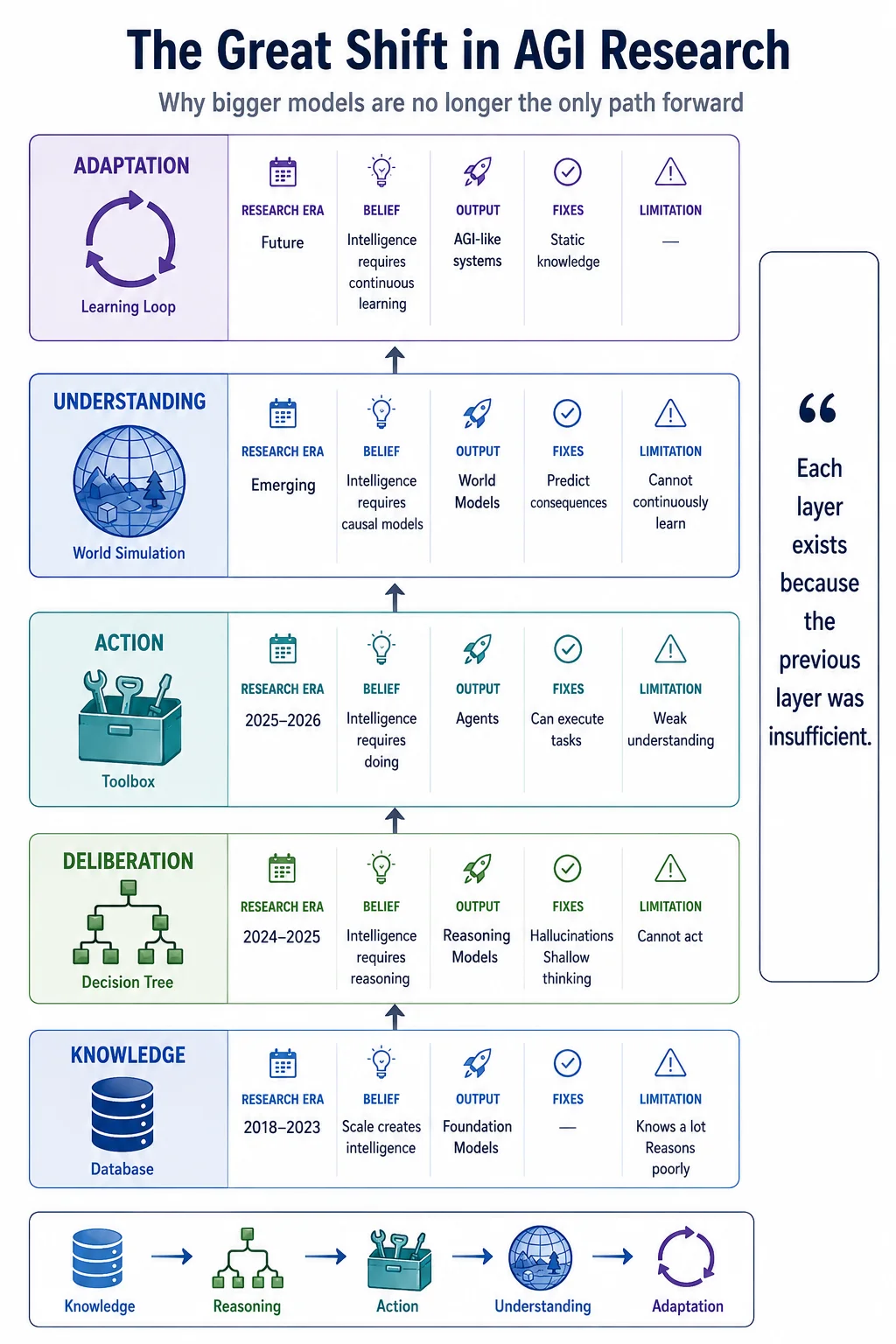
- Modern AGI is a five-layer stack: Knowledge, Deliberation (reasoning models), Action (agents), Understanding (world models), and Adaptation (continual learning).
- Current frontier models sit at DeepMind Level 3 (Expert) in narrow domains. Fluid intelligence, measured by ARC-AGI, remains unsolved.
- Seven parallel research bets are active: test-time compute, agents, memory, world models, reinforcement learning, embodiment, and self-improving AI.
- AGI will not arrive as a single event. It is a continuous, decentralized process already underway.
- The Original Dream: Intelligence as Logic
- The Deep Learning Revolution
- Why AGI Returned to the Conversation
- Beyond the Scaling Myth: The Five-Layer AGI Stack
- What AGI Actually Means
- The Seven Biggest Research Bets
- The Four Camps of AGI
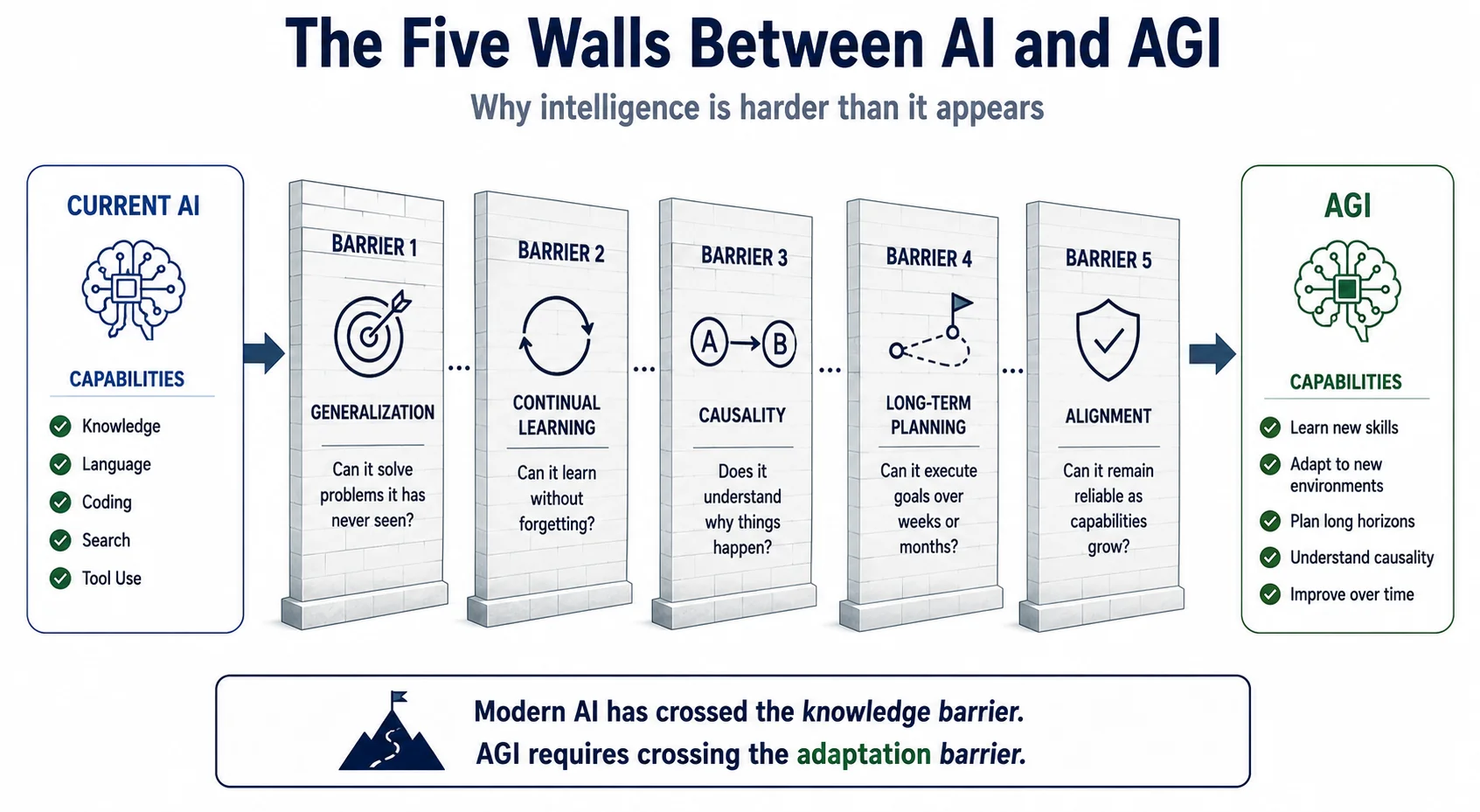
- The Hard Problems Nobody Has Solved
- The Most Plausible Future
- Conclusion
- Frequently Asked Questions
1. The Original Dream: Intelligence as Logic
At the dawn of the computing era, pioneers like Alan Turing proposed the Imitation Game (the Turing Test), suggesting that intelligence could be defined by a machine's ability to hold a conversation indistinguishable from a human. This behavior-based definition led early researchers to a foundational assumption: human cognition was fundamentally an exercise in formal logic.
In 1975, Allen Newell and Herbert A. Simon formalized this belief into the Physical Symbol System Hypothesis, arguing that intelligence was nothing more than the algorithmic manipulation of symbols. Symbolic AI operated on the premise that intelligence comes from rules. If human thought was just a search through a space of logical possibilities, engineers could program intelligence top-down as a sequence of rigorous deductions.
By the 1980s, this evolved into the commercial deployment of Expert Systems: software that relied on vast databases of hand-coded IF-THEN rules extracted from human professionals. Systems like MYCIN and XCON were designed to diagnose blood infections or configure computer components by strictly following human-built checklists.
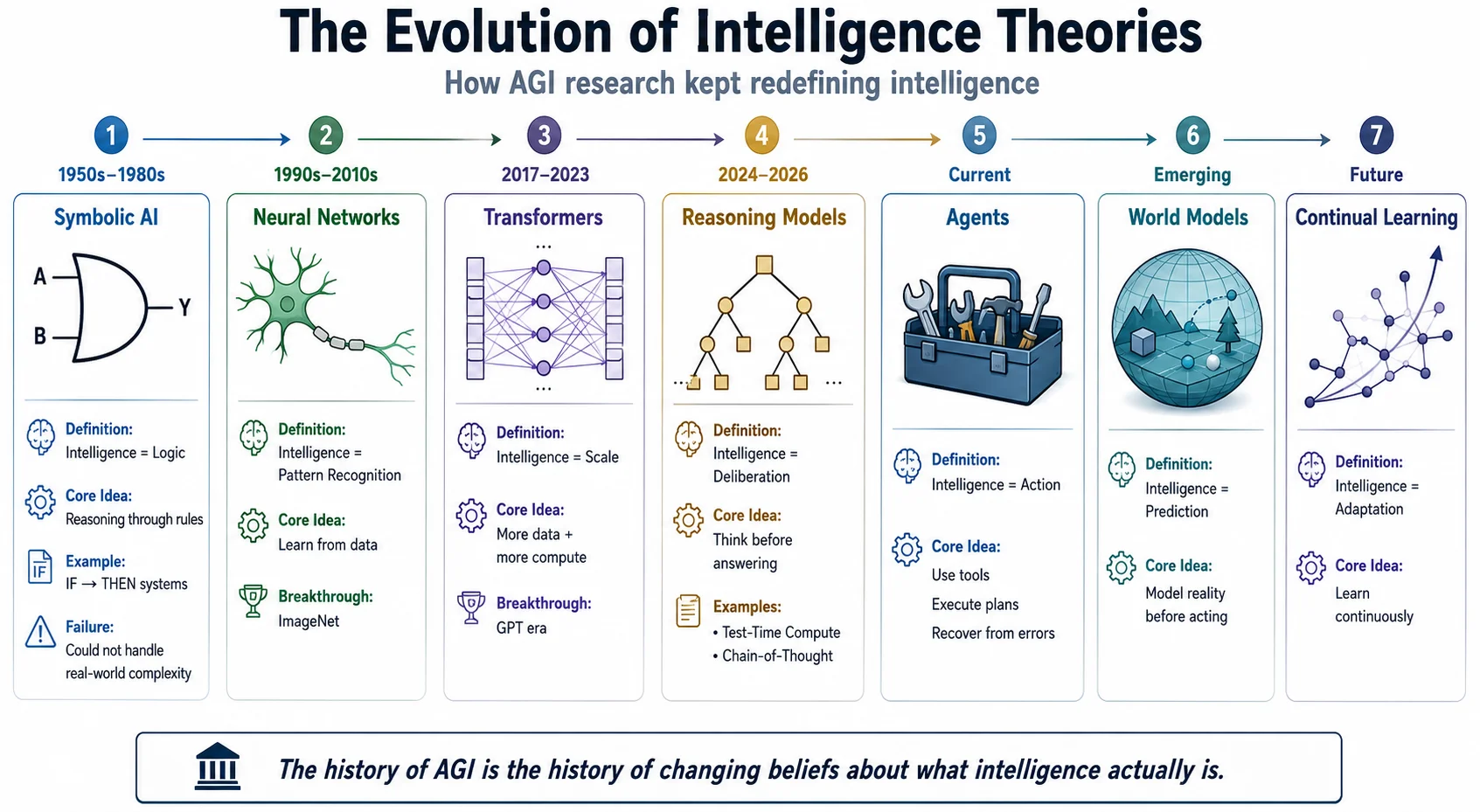
But the original dream soon collided with the messy, continuous reality of the physical world. Researchers hit what became known as the knowledge acquisition bottleneck: human experts could not translate their intuitive, subconscious, and tacit knowledge into rigid text statements. You cannot write an IF-THEN rule for how to balance on a bicycle, recognize a friend's face, or handle an unexpected variable.
Analogy: Imagine writing down every possible step for navigating a busy sidewalk. With every new pedestrian, the number of potential interactions multiplies exponentially, crashing your system.
Technical: As symbolic systems were applied to real-world scenarios, the number of possible states, interacting rules, and variables grew exponentially, rapidly overwhelming the hardware of the era.
Documented in the 1973 Lighthill Report, these failures proved that logic-based AI collapsed in complex reality. Funding evaporated, academic centers closed, and the field entered the first AI Winter.
Artificial Intelligence: A General Survey (The Lighthill Report, 1973), James Lighthill
2. The Deep Learning Revolution
The failure of Symbolic AI necessitated a fundamental paradigm shift. If human engineers could not explicitly write the rules of intelligence, machines would have to learn those rules autonomously from data. This realization pushed researchers toward Artificial Neural Networks: connectionist computing systems inspired by the biological structure of animal brains.
For decades, neural networks remained marginalized, hindered by hardware constraints and the vanishing gradient problem, which caused deep network architectures to mathematically lose training signals before they could learn. Symbolic AI believed that intelligence comes from rules; Deep Learning counter-argued that intelligence comes from data.
By 2012, three essential breakthroughs converged: massive curated datasets (specifically the ImageNet database), the repurposing of GPUs for highly parallel matrix operations, and algorithmic fixes that maintained gradient flows. When a deep convolutional network named AlexNet crushed traditional algorithms in the ImageNet visual recognition challenge, the paradigm shifted permanently.
- Intelligence comes from hand-coded rules
- Engineers write explicit IF-THEN logic
- Knowledge extracted from human experts
- Brittle in dynamic, real-world environments
- Fails at tacit, intuitive knowledge
- Intelligence comes from data
- Models learn internal representations autonomously
- Knowledge extracted statistically from datasets
- Generalizes across image, text, and audio domains
- Excels at pattern recognition at scale
Yet processing sequential data like language remained a bottleneck. Recurrent Neural Networks (RNNs) processed words step-by-step and suffered from information loss, forgetting early context by the time they reached the end of a long sentence.
In 2017, Google researchers published Attention Is All You Need, introducing the Transformer architecture. Transformers discarded sequential processing entirely in favor of a self-attention mechanism that evaluated all tokens in parallel.
Analogy: When reading, your brain instantly links a pronoun like "it" back to the noun mentioned three lines earlier. Attention allows the machine to do this instantly across massive paragraphs.
Technical: Each token is projected into three vectors: Query, Key, and Value. The dot product between Queries and Keys generates attention scores that dictate how much each token relates to every other token, enabling parallel processing across tens of thousands of GPUs.
Because Transformers did not process data linearly, they could be scaled across unprecedented distributed compute clusters, unlocking the ability to train massive Foundation Models on internet-scale data.
3. Why AGI Returned to the Conversation
Following the Transformer, organizations like OpenAI, Google DeepMind, and Anthropic began aggressively scaling language models. As parameter counts grew from billions to trillions, researchers observed a profound phenomenon: emergent capabilities. Models trained exclusively on the simple objective of predicting the next token spontaneously demonstrated abilities for which they were never explicitly trained.
Systems like GPT-3 and eventually GPT-4 could translate languages, summarize dense legal documents, pass advanced academic examinations, and write complex software code. Through Chain-of-Thought prompting, these systems used text generation as a workspace for multi-step logical reasoning. By 2023 through 2026, the integration of vision and audio created multimodal systems capable of reasoning natively across text, images, and sound.
Observing these models decompose logic puzzles, many researchers began arguing that these systems were exhibiting "sparks of AGI," shifting the industry from questioning whether AGI was possible to fiercely debating when it would arrive.
On the Dangers of Stochastic Parrots: Can Language Models Be Too Big?, Emily M. Bender et al.
4. Beyond the Scaling Myth: The Five-Layer AGI Stack
Between 2018 and 2023, the industry operated under a singular assumption: scale creates intelligence. The belief was that if you fed enough data into larger neural networks, AGI would naturally emerge as a byproduct of raw computational volume.
By 2024 through 2025, the industry hit a Scaling Wall. Researchers discovered that next-token prediction on static internet text faces severe diminishing returns. Building larger pre-trained models required exponential amounts of energy and data for increasingly marginal cognitive gains. This forced a profound realization: knowledge is not the same thing as intelligence.
To move past this wall, researchers stopped treating intelligence as a massive, static library of facts and began building it as a layered, active architecture. Each layer is explicitly designed to solve a fatal limitation of the layer beneath it.
5. What AGI Actually Means
Because the definition of intelligence has shifted from static knowledge to active adaptation, measuring progress requires operational rigor. To measure progress rigorously, researchers use frameworks like Google DeepMind's Levels of AGI, which scores systems purely on capability breadth and performance depth.
| Level | Label | Definition | Current Example |
|---|---|---|---|
| 0 | No AI | Narrow non-AI algorithms | Simple compilers, calculators |
| 1 | Emerging | Equal to or slightly better than an unskilled human | Early conversational LLMs |
| 2 | Competent | At least 50th percentile of skilled adults on specialized tasks | Advanced single-domain agents |
| 3 | Expert | At least 90th percentile of skilled adults | Modern reasoning models (math, coding) |
| 4 | Virtuoso | At least 99th percentile of skilled human professionals | Not yet achieved |
| 5 | Superhuman | Outperforms 100% of humanity across all cognitive domains | Theoretical |
Current frontier models sit firmly at Level 3 in narrow domains like mathematics and code execution. The critical boundary separating Level 3 from Level 4 is the distinction between Crystallized Intelligence (memorized internet text) and Fluid Intelligence (the capacity to solve entirely novel problems from first principles).
The ARC Prize 2025 Technical Report, François Chollet et al.
6. The Seven Biggest Research Bets
Achieving true fluid intelligence requires solving distinct technical bottlenecks. Researchers are placing massive parallel bets across seven core paradigms, each representing a completely different philosophy of what machine intelligence needs to become next.
7. The Four Camps of AGI
Because researchers disagree on which of these seven bets will pay off, the global AI community has fractured into four distinct ideological camps. These camps dictate where hundreds of billions of dollars in computational infrastructure are deployed.
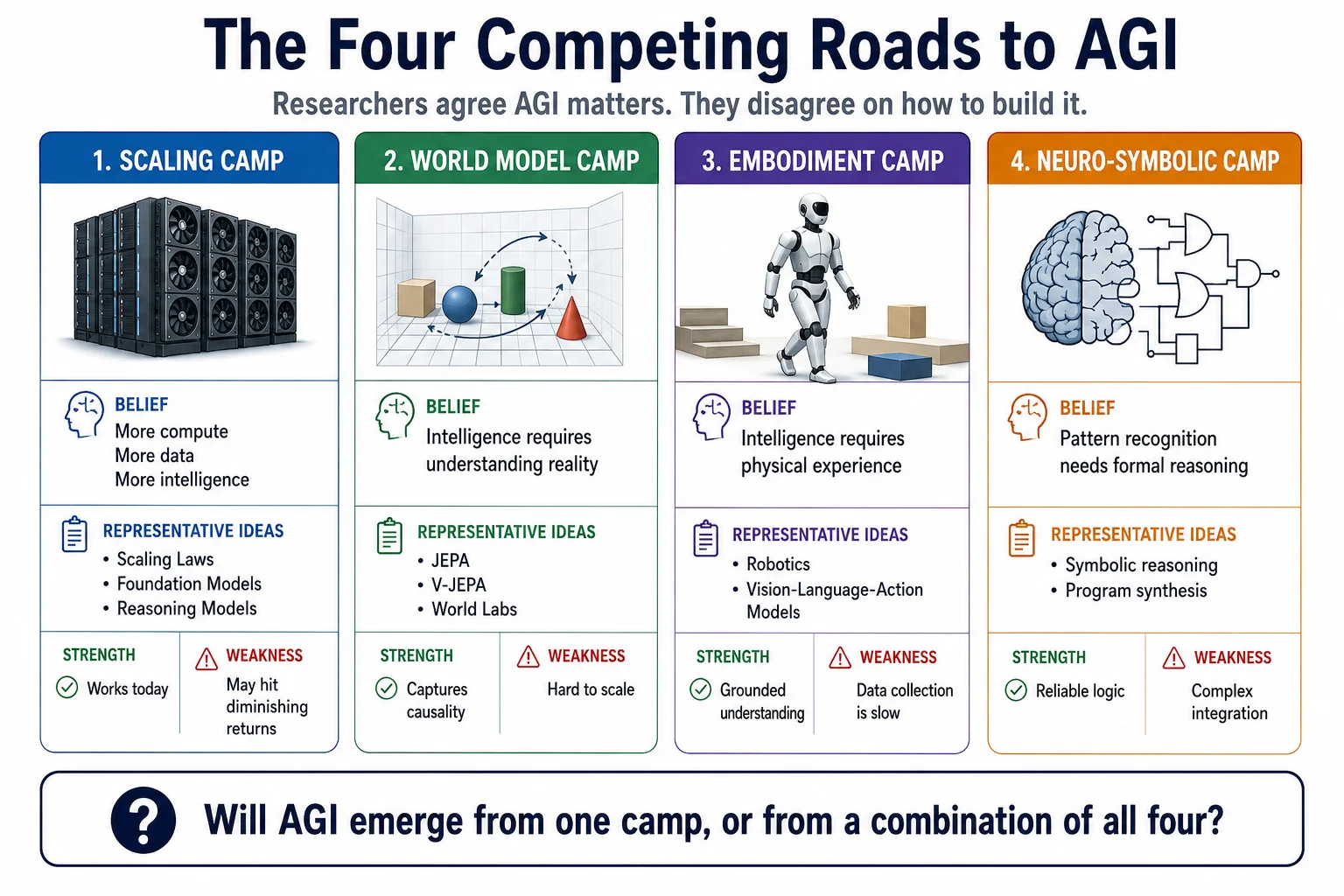
| Camp | Core Belief | Key Evidence | Major Criticism |
|---|---|---|---|
| Scaling | Current autoregressive Transformers, expanded with multimodal data and test-time compute, will naturally emerge into AGI. | General methods leveraging massive computation always outperform domain-specific architectures (The Bitter Lesson). | The Scaling Wall. Predicting the next token will never generate an understanding of causality or physics. |
| World Models | Autoregressive LLMs are an architectural dead end. AGI requires a predictive mental model of physical reality. | V-JEPA demonstrates zero-shot robotic control using a fraction of generative training data. | World models are largely theoretical or confined to narrow visual tasks, lacking the multi-domain utility of modern LLMs. |
| Embodiment | True intelligence cannot exist as passive code. It must be physically grounded in 3D space to comprehend reality. | Human cognition evolved entirely to navigate physical environments. 3D grounding eliminates hallucinations by forcing geometry compliance. | Exceptionally slow and capital-intensive. The robotic data flywheel is physically bottlenecked compared to virtual scaling. |
| Neuro-Symbolic | High-dimensional neural networks must be formally fused with Symbolic AI to enforce strict rule-following and algebraic logic. | LLMs fail at flawless mathematical consistency. Neuro-symbolic integration offers mathematically verifiable outputs for high-stakes infrastructure. | A regression to failed Expert Systems. Interfacing messy neural representations with rigid discrete logic is fragile and computationally inefficient. |
8. The Hard Problems Nobody Has Solved
Despite massive investments and vast compute clusters, several foundational scientific problems fiercely resist being solved merely by adding more computing power. These are structural barriers, not engineering gaps.
9. The Most Plausible Future
When we evaluate the future of AGI, we must stop viewing it as a static destination or a singular calendar event. AGI is not a box we build. It is an evolutionary process. Instead of focusing on speculative arrival dates, we must evaluate the technical signals that dictate our trajectory.
- Test-Time Compute continues to scale reasoning efficiently without hitting a prompt optimization floor.
- Reinforcement learning frameworks let models self-improve indefinitely without model collapse.
- Open-weight benchmarks like ARC-AGI see a sudden surge, indicating synthetic fluid intelligence has been unlocked.
- The Scaling Wall holds firm and pre-training data pools dry up before structural alternatives mature.
- Catastrophic forgetting resists architectural workarounds, trapping models in fixed contexts.
- World Models prove too computationally expensive to simulate chaotic, real-world physical dynamics efficiently.
The most plausible future belongs to decentralized, composite, and modular systems. The era of relying on a single, monolithic language model trained on all internet text is plateauing. The future is a blurred, continuous transition marked by specialized deliberation tokens, localized Sovereign AI nodes, and persistent memory modules.
Conclusion
Every generation of AI research began with immense optimism, believing they had finally discovered the singular key to cognition. In the 1950s, researchers were convinced that intelligence was formal logic. In the 2010s, they believed it was pure pattern recognition. In the early 2020s, they asserted it was raw computational scale. Today, we believe it is a layered integration of deliberation, action, causal simulation, and continuous adaptation.
- The definition of intelligence keeps changing as each architectural bet reveals that cognition is more complex than the previous model assumed.
- The scaling wall proved that knowledge is not intelligence. The frontier has shifted to a layered stack of reasoning, action, and adaptation.
- The hard problems (compositional cliff, catastrophic forgetting, causal blindness) are structural, not engineering. More compute alone will not solve them.
- AGI will not arrive as an event. It is a continuous, decentralized evolutionary process already underway, manifesting as cognitive infrastructure absorbing human labor one domain at a time.
Every single milestone has revealed that intelligence is vastly more complex, fluid, and intricate than our models originally assumed. In trying to build an artificial mind, we are slowly uncovering the true depth of our own.
Frequently Asked Questions
What is AGI?
Artificial General Intelligence (AGI) refers to a machine that possesses fluid intelligence: the ability to autonomously reason, plan, and efficiently learn entirely new skills across multiple cognitive domains when exposed to novel, out-of-distribution environments. Unlike current LLMs, which excel at pattern retrieval from training data, AGI requires integrated deliberation, autonomous tool use, causal world understanding, and continuous adaptation.
Is ChatGPT or Claude AGI?
No. Current frontier models have reached DeepMind's Level 3 (Expert) in narrow domains such as mathematics, coding, and graduate-level reasoning, and Level 2 (Competent) across broader general tasks. What they lack is fluid intelligence: persistent memory, causal world understanding, and the ability to learn new skills from scratch in truly novel environments. These are the capabilities that separate narrow expertise from Level 4 general autonomy.
What is the difference between AGI and current LLMs?
LLMs are next-token correlation engines optimized to retrieve and format text patterns from historical training data. AGI requires an integrated stack of capabilities beyond language: deep reasoning tokens, autonomous tool usage, causal world models, and continuous adaptation to entirely new environments without retraining.
Why is achieving AGI so difficult?
AI models face several foundational barriers: a compositional cliff when forced to reason outside training data, catastrophic forgetting when weights are updated with new skills, causal blindness (correlation without causation), and black-box opacity that makes verifying outputs in high-stakes systems unreliable. These are not engineering problems solvable by more compute alone.
Which companies are leading AGI research?
Frontier development spans different architectural philosophies. OpenAI and Anthropic lead in proprietary scale and test-time compute. Meta AI (via AMI Labs) and World Labs lead in non-generative world models and spatial intelligence. DeepSeek and India's Sarvam AI are democratizing open-weight and sovereign infrastructure. No single lab has a monopoly on the path to AGI.