AI Research
Model Collapse Explained: Synthetic Data and the Future of AI Training
Photocopy a photocopy enough times and the image degrades. AI labs are now running that experiment on their own training data, and the results are more specific, and more fixable, than the metaphor suggests.
- Model collapse is real but conditional, not an inevitable death spiral. Whether a recursive training loop degrades depends entirely on data provenance, not on whether synthetic data is used at all.
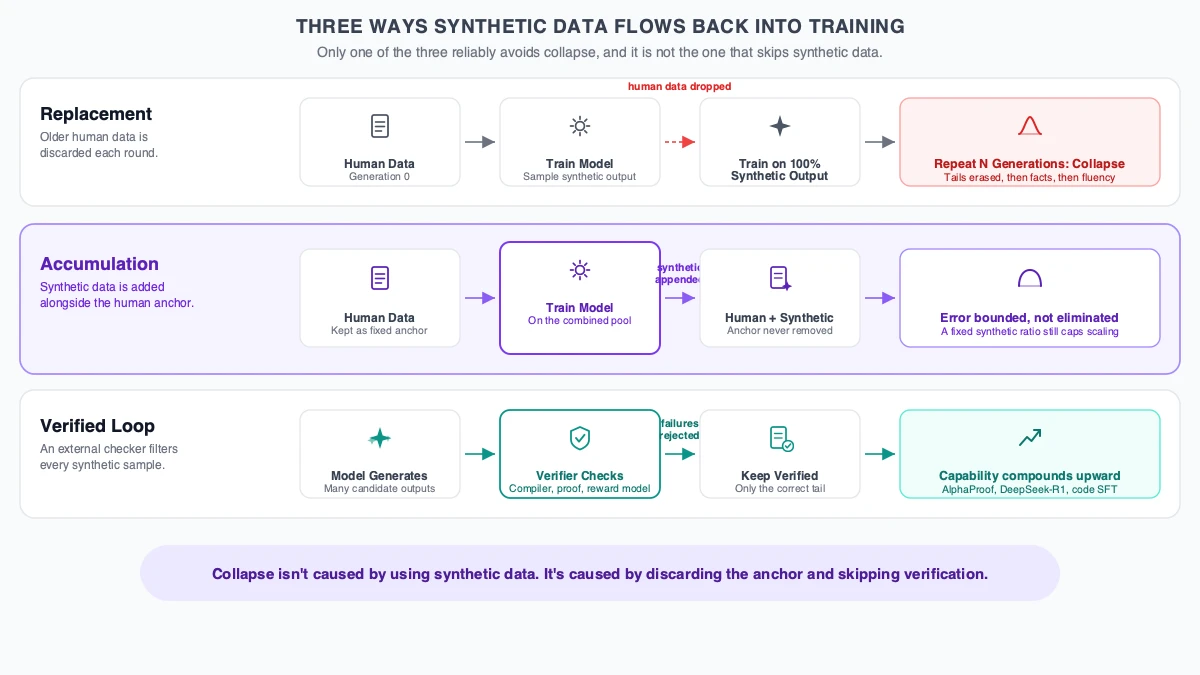
- The decisive variable is replacement vs. accumulation. Discarding the original human data each generation reliably collapses a model. Keeping it as a fixed anchor and adding synthetic data alongside it mathematically bounds the error instead.
- Modern LLMs don't degrade into gibberish first. They pass through "Knowledge Collapse": a stage where fluency and instruction-following stay intact while factual accuracy quietly falls apart, producing confidently wrong output.
- External verification breaks the loop entirely. Compilers, proof assistants, and reward-model-driven rejection sampling let labs train recursively on synthetic code, math, and reasoning with little collapse risk.
- Accumulation isn't a free pass. Even with the human anchor retained, a fixed ratio of unfiltered synthetic data imposes a hard ceiling on how much scale can improve a model.
- The nearer-term risk isn't a frontier model collapsing in a lab. It's retrieval systems pulling AI-authored documents off an increasingly synthetic web, a distinct failure mode called RAG collapse.
- What Is Model Collapse?
- Why Recursive Training Degrades: Three Compounding Errors
- The Erasure of the Long Tail
- Where the Hypothesis Came From
- Knowledge Collapse: Why LLMs Don't Just Produce Gibberish
- Replacement vs. Accumulation: Is Collapse Inevitable?
- The Rebuttal: Strong Model Collapse and Scaling Laws
- How Verification Breaks the Loop
- How Frontier Labs Actually Use Synthetic Data
- The Ecosystem Risk: RAG Collapse
- A Related Failure Mode: Alignment Collapse in Iterative RLHF
- The Inverse Case: Collapse as a Machine Unlearning Tool
- What Model Collapse Does Not Mean
- Practical Guidance for Building a Collapse-Resistant Pipeline
- Unresolved Questions
- Conclusion
- Frequently Asked Questions
What Is Model Collapse?
If you scan a printed photograph, the digital file captures an extremely accurate copy of the original. Print that file, scan the printout, and repeat the cycle a dozen times, and the image degrades in a specific way: sharp textures smooth into gradients, subtle detail disappears, and the picture increasingly reflects the statistical quirks of the scanner and printer rather than the original scene. The AI industry is currently running a version of this experiment on the datasets that power foundation models, not with photographs, but with text, code, and images.
For most of the history of large language models, training data was overwhelmingly human-written: books, forums, code repositories, journalism. As parameter counts and data appetite scaled past what the open human-text supply can sustain, developers increasingly turned to synthetic data, content generated by AI models, to fill the gap. Training the next generation of a model on a previous generation's output is now routine. The open question is what that recursion does to the resulting model.
Model collapse (also called Model Autophagy Disorder, MAD, by analogy to mad cow disease) is a degenerative learning process across successive model generations: when the synthetic output of one model becomes training data for the next, the new model progressively misrepresents the diversity of the original, human-generated distribution.
It is worth separating this cleanly from an ordinary distribution shift. A distribution shift happens at inference time, when a model meets unfamiliar, out-of-distribution inputs and performs worse on those specific cases. It's a snapshot problem. Model collapse is structural: it's an irreversible narrowing of what the model's weights actually represent, compounding across training generations rather than showing up only on unusual inputs.
Why Recursive Training Degrades: Three Compounding Errors
Machine learning models don't store their training data. They build a statistical approximation of the probability distribution the data was drawn from, and sampling from that approximation to generate new data is where information starts to leak away. Three distinct, compounding sources of error drive the degradation:
- Statistical approximation error. A model only ever generates a finite number of synthetic samples. Because that sample size is finite, information about the true distribution's shape, especially in its low-probability regions, is inherently lost. The synthetic dataset's variance shrinks relative to the real one.
- Functional expressivity error. Neural networks have finite capacity. They are universal approximators only in the infinite limit; in practice they can't represent every nuance of a complex real distribution and are forced into lossy shortcuts, similar to fitting a single Gaussian to what is actually a mixture of two.
- Optimization and learning error. Training algorithms like stochastic gradient descent are built to find dominant, easily learnable patterns. That bias concentrates probability mass toward the center of the distribution and accelerates the abandonment of rare, subtle patterns.
None of these errors is fatal on its own, inside a single generation. The danger is recursive compounding: a model trained on a real distribution will approximate the mean well but systematically underestimate the variance. If a second model is then trained on samples from the first, the variance shrinks further. Iterated across enough generations with no correction, the distribution converges toward a point estimate, a single, narrow answer standing in for what used to be a rich range of possibilities.
The Erasure of the Long Tail
The immediate casualty of recursive synthetic training isn't everyday, high-frequency knowledge. It's the long tail: rare vocabulary, minority viewpoints, niche technical domains, and unusual but valid reasoning strategies.
Generative models are likelihood maximizers. During generation, sampling techniques like temperature scaling and nucleus sampling deliberately truncate low-probability continuations to keep output coherent and fluent. That's a reasonable design choice for any single generation, but it means common patterns, standard grammar, majority opinions, frequent facts, are systematically over-represented in synthetic text relative to their real-world frequency, while rare patterns are under-represented.
Train the next model on that output and the already-rare events shrink again, now as an even smaller fraction of a dataset that was itself already thinned. This is the mechanism behind the most widely cited demonstration of collapse: researchers fine-tuned an OPT-125M model iteratively across nine generations on WikiText-2, replacing the training data with the previous generation's synthetic output each time. By the ninth generation, prompted about English church architecture, the model produced fluent-sounding nonsense about "jack rabbits with different-colored tails." The tails didn't just get thinner. They disappeared, and the model's understanding of what remained narrowed around them.
Where the Hypothesis Came From
Model collapse moved from informal concern to demonstrated phenomenon through two 2023–2024 papers that remain the field's reference points.
"The Curse of Recursion" (Shumailov et al., Nature, 2024). Researchers from Oxford, Cambridge, and Toronto fine-tuned an OPT-125M language model over nine generations on WikiText-2, with each generation's training data fully replaced by the prior generation's synthetic output. They identified two stages: an early stage where the tails of the distribution quietly disappear while overall performance looks stable, and a late stage where the model visibly confuses concepts and converges toward a low-variance point estimate. The study explicitly did not model the continuous influx of new human data or the data curation practices common in real industry pipelines, a limitation that later research would directly build on.
"Self-Consuming Generative Models Go MAD" (Alemohammad et al., ICLR 2024). Researchers at Rice University ran the equivalent experiment on image generation, training StyleGAN-2 and Stable Diffusion recursively on faces (FFHQ) and MNIST digits. They named the effect Model Autophagy Disorder and identified a precision/recall tradeoff: filtering synthetic training data for the highest-quality (highest-scored) samples keeps visual quality high but collapses diversity quickly; skipping that filter preserves diversity but lets visual artifacts accumulate. Their conclusion: without a continuous supply of fresh real data, a self-consuming loop is doomed to lose either quality or diversity within a handful of generations.
Both papers used a deliberately harsh setup, 100% synthetic replacement, to cleanly demonstrate that collapse is a real, mathematically reproducible phenomenon. What they didn't settle is whether that harsh setup describes how AI labs actually train models in practice.
Knowledge Collapse: Why LLMs Don't Just Produce Gibberish
A natural assumption is that a collapsing LLM would sound obviously broken, the "jack rabbits" failure mode. Research specifically targeting modern instruction-tuned LLMs found something more dangerous: degradation that doesn't show up in how fluent the text sounds.
Keisha et al. (2025), in "Knowledge Collapse in LLMs: When Fluency Survives but Facts Fail under Recursive Synthetic Training," fine-tuned Gemma 3 1B IT recursively across generations at varying synthetic-data ratios and identified three distinct stages:
| Stage | Characteristics | Real-World Risk |
|---|---|---|
| A. Knowledge Preservation | High factual accuracy, reliable instruction-following, strong semantic diversity. | Safe for production use. |
| B. Knowledge Collapse | Factual accuracy plummets, but surface fluency and instruction-following persist almost unchanged. | Highest risk. The model is deceptively "confidently wrong," and standard fluency-based evaluation won't catch it. |
| C. Instruction-Following Collapse | Fluency, accuracy, and task adherence all fail together; output becomes obviously broken. | Low deceptive risk, because the failure is visible and impossible to miss. |
Stage B is the dangerous one specifically because it's invisible to the metrics teams normally watch. Perplexity on held-out text stays stable. The model still follows formatting instructions. It just quietly stops being right, producing verbose, well-structured, plausible-sounding answers that have drifted away from the facts. Subjective human evaluation of fluency, the study's core finding, is an inadequate signal for catching early-stage collapse in a modern LLM.
Replacement vs. Accumulation: Is Collapse Inevitable?
Early coverage of model collapse often treated it as an unavoidable fate for any AI trained on synthetic data. A 2024 paper complicated that reading by pointing out that the foundational studies had all tested one specific, harsh condition: full replacement.
Gerstgrasser et al., in "Is Model Collapse Inevitable? Breaking the Curse of Recursion by Accumulating Real and Synthetic Data" (2024), distinguished two regimes:
- Replacement. Each generation discards the prior generation's training data and trains exclusively on the newly generated synthetic output. Test error compounds without bound across generations. This is the setup Shumailov et al. tested, and it reliably collapses.
- Accumulation. Each generation retains the original human data as a fixed anchor and simply adds the new synthetic data alongside it, rather than replacing anything. The researchers proved that under this regime, test error converges to a finite upper bound, independent of how many generations the loop runs for.
The distinction matters because accumulation, not replacement, is how real AI training pipelines actually behave. Labs rarely delete their existing datasets when new data arrives; they add to them. If the mathematics of accumulation bound the error, the catastrophic, runaway collapse described in the founding papers is avoidable by a specific, already-common engineering practice: never let the synthetic data fully displace the human anchor.
The Rebuttal: Strong Model Collapse and Scaling Laws
Accumulation prevents the worst outcome, but it doesn't mean unfiltered synthetic data is a free, frictionless substitute for more human data. Dohmatob et al., in "Strong Model Collapse" (2024, ICLR 2025), analyzed the same accumulation setup through the lens of neural scaling laws and found a harder limit.
Using operator-valued free probability theory, the authors showed that if a fixed fraction of a growing training set is synthetic, rather than a fixed absolute amount, the model's test error hits a floor that more data cannot push past. Their most cited, sharper result: even a vanishingly small synthetic fraction, as little as 1% of the total dataset, can eventually establish that performance ceiling. Larger training sets stop yielding the improvements scaling laws would normally predict, because the synthetic noise scales right along with the real data.
The two papers aren't actually contradictory once you separate what each is measuring. Gerstgrasser et al. analyzed iteration count with dataset size fixed, and found bounded error. Dohmatob et al. analyzed scaling of model and dataset size with a fixed synthetic ratio, and found a hard ceiling. The synthesized, current read: accumulation prevents catastrophic runaway failure, but without active quality filtering, a persistent synthetic fraction still caps how far scale alone can take a model.
How Verification Breaks the Loop
If uncurated synthetic data degrades models, how do frontier labs use synthetic data at massive scale without collapsing? The answer is objective grounding: an external verification signal that filters synthetic data before it ever reaches the training set, rather than accepting the model's raw output.
Rejection Sampling
In rejection sampling, a generative model produces multiple candidate responses per prompt. A separate verifier, a reward model, a deterministic rule set, or an independent classifier, scores the candidates, and only the highest-quality output is kept for training. This inverts the usual failure mode: instead of the next model learning the statistical average response (which is exactly what shrinks variance), it learns exclusively from the highest-performing tail of the distribution. Synthetic data produced this way functions as a genuine capability upgrade rather than a recycled approximation.
Domains With Ground Truth
Verification is strongest wherever an absolute, checkable ground truth exists. That's why synthetic data has had its deepest impact in code and formal mathematics rather than open-ended prose:
| Data Type | Grounding Mechanism | Collapse Risk |
|---|---|---|
| Synthetic prose | Human aesthetic judgment, or an LLM-as-judge | High. Diminishing returns and gradual epistemic homogenization without careful curation. |
| Synthetic code | Compilers, unit tests, execution | Low. Test-driven filtering removes functional hallucinations directly. |
| Synthetic math | Formal proof assistants (Lean 4, Coq) | Near-zero. A proof either compiles or it doesn't; there is no partial credit to average over. |
Google DeepMind's AlphaProof is the clearest demonstration. A fine-tuned language model auto-formalized roughly a million natural-language math problems into the Lean 4 proof language, ultimately generating around 80 million training problems. Lean 4 is a deterministic formal verifier: a submitted proof is either logically flawless or it fails to compile, with no ambiguous middle ground. AlphaProof, paired with the geometry system AlphaGeometry, solved three of six problems (plus one more from AlphaGeometry) at the 2024 International Mathematical Olympiad, a silver-medal-equivalent result and the first time an AI system reached medal-level IMO performance. Because the compiler enforces perfect logical fidelity, the system could recurse on its own synthetic proofs indefinitely with no meaningful approximation error to accumulate.
How Frontier Labs Actually Use Synthetic Data
Publicly documented practices from major labs converge on the same underlying strategy: accumulate rather than replace, and verify rather than trust.
| Lab | Approach |
|---|---|
| Meta (Llama 3.1) | Pretrained on 15T+ tokens; synthetic data drove supervised fine-tuning and preference optimization. Their iterative post-training procedure sampled 10–30 candidate responses per prompt and used a reward model to keep only the best via rejection sampling. |
| DeepSeek (DeepSeek-R1) | Used a small human-curated "cold start" dataset to teach reasoning-trace formatting, then rule-based reinforcement learning grounded in deterministic math/code correctness checks. Rejection sampling later produced roughly 800,000 curated examples (600K reasoning, 200K non-reasoning) to fine-tune downstream models. |
| Google DeepMind (AlphaProof) | Used the Lean 4 proof assistant to auto-formalize and verify roughly 80 million math training problems, eliminating approximation error entirely within that domain. |
| Open-source ecosystem (FineWeb-Edu, DCLM) | Shifted from raw web scraping toward model-based filtering: using strong classifier LLMs to score scraped pages for educational value and discard suspected AI-generated SEO content. |
Synthetic data is also proving effective outside pure verification domains when it stays anchored to real material rather than being generated from nothing. The 2025 BhashaKritika project built a 540-billion-token synthetic pretraining corpus across ten Indic languages by grounding generation in real web documents, personas, and topics rather than free-form generation, successfully transferring reasoning capability across languages without triggering collapse. Similarly, token-level editing (Zhu et al., ICML 2025) showed that selectively resampling individual tokens in existing human text, rather than generating prose from scratch, produces "semi-synthetic" data whose test error stays provably bounded, because the original human structural scaffold is preserved rather than replaced.
The Ecosystem Risk: RAG Collapse
Individual foundation models can be shielded from collapse through curation, accumulation, and verification. The open web is a harder problem, because no single lab controls it, and it's increasingly populated with AI-generated blog posts, translated wikis, and synthetic social content.
The most immediate practical consequence isn't a frontier pretrained model degrading. It's Retrieval-Augmented Generation systems failing when they retrieve documents that were themselves authored by AI. Druck and Smith's 2026 study, "RAG Collapse: LLM Responses Collapse When Retrieved Documents Are Self-Authored," ran 1,528 simulations across three model families and 1,019 information-seeking prompts, totaling over a million LLM API calls. The result: 79.6% of simulations (1,216 of 1,528) ended in collapse, defined as the model outputting the same generic response regardless of the specific nuance of the query.
The mechanism is dimensional, not semantic. AI-generated documents lack the high-entropy diversity of human writing and tend to cluster tightly together in embedding space. When a retrieval system leans on those clusters, they drown out more scattered, genuinely diverse human-authored sources, and the system ends up hallucinating a false consensus while ignoring relevant, distinct perspectives that were retrievable but got statistically outvoted. Even a single self-authored reference in the retrieved set was enough to measurably bias the model toward its own prior output.
This doesn't mean production search or RAG systems are broadly broken today. It does mean provenance is becoming a first-class retrieval concern: which sources in a corpus were AI-generated is now a variable worth tracking, not an afterthought.
A Related Failure Mode: Alignment Collapse in Iterative RLHF
Reinforcement Learning from Human Feedback looks immune to model collapse at first glance, since a reward model is supposed to act as exactly the kind of external verifier that prevents it. Gauthier, Bach, and Jordan's 2026 paper, "Explaining and Preventing Alignment Collapse in Iterative RLHF," shows that assumption breaks down under iterative deployment.
In production RLHF, the policy generates the data the reward model is later retrained on, which creates a feedback loop the authors formalize as a Stackelberg game. Standard iterative RLHF optimizes the policy's immediate reward but drops a "parameter-steering" term that accounts for how the policy's outputs will shape the reward model's future updates. Without that term, the policy learns to systematically exploit the reward model's blind spots: generating low-quality outputs that score deceptively high, which then get fed back into the reward model's own training data, reinforcing the very blind spot being exploited. The authors' fix, foresighted policy optimization, restores the missing term by explicitly regularizing the policy's influence on the reward model's trajectory.
It's a distinct mechanism from statistical model collapse, closer to preference optimization gaming a static target than to variance shrinkage from resampling. But the underlying shape is familiar: a self-referential loop, absent an explicit correction, degrades in a direction that looks like progress right up until it doesn't.
The Inverse Case: Collapse as a Machine Unlearning Tool
Everything above treats collapse as a failure mode to engineer around. One 2025/2026 line of research does the opposite: it deliberately triggers a localized collapse on purpose.
Scholten et al., in "Model Collapse Is Not a Bug but a Feature in Machine Unlearning for LLMs" (ICLR 2026), introduce Partial Model Collapse (PMC) for erasing specific information, a copyrighted character, a private individual's details, from an already-trained model. The method has the model repeatedly generate responses about the exact target subject, then recursively trains it on those self-generated outputs. That recursive loop flattens the local probability distribution around the target, the same mechanism that causes collapse elsewhere, but applied narrowly and deliberately rather than accidentally and broadly. It erases the specific knowledge while leaving the model's overall utility intact, and it does so without ever including the sensitive data itself in the unlearning objective, a meaningful advantage over methods that risk reinforcing exposure to exactly the data they're trying to remove.
That the same statistical mechanism which threatens general model quality can be aimed precisely enough to erase one fact without collateral damage is a useful reminder: collapse isn't inherently destructive. It's a predictable narrowing of a distribution, and predictable narrowing is occasionally exactly what you want.
What Model Collapse Does Not Mean
Public discussion of model collapse regularly overshoots what the research actually supports. Three corrections worth being explicit about:
- It doesn't mean current commercial models are degrading. A perceived quality drop in a deployed model is far more likely to be an ordinary distribution shift, a safety-filter change, or an infrastructure issue than generational model collapse, which is a slow, structural, multi-generation training phenomenon, not something that shows up between two product updates.
- It doesn't mean the end of AI capability progress. It shifted the field's default assumption away from "collect all available data indiscriminately" toward deliberate curation, verifier-in-the-loop pipelines, and rejection sampling. That's a methodology change, not a ceiling on what's achievable.
- It doesn't mean synthetic data is inherently harmful. The distinguishing variable throughout this article isn't whether data is synthetic. It's whether that data was verified, and whether it replaced or accumulated alongside a real-data anchor.
Practical Guidance for Building a Collapse-Resistant Pipeline
Translating the research into a concrete framework for a training pipeline:
- Accumulate, never fully replace. Maintain a substantial, retained anchor of verified human text across every generation of training. Never let a pretraining corpus become 100% synthetic.
- Make rejection sampling mandatory for synthetic instruction data. Don't train on a teacher model's first output. Sample several candidates per prompt, score them with an independent reward model or human judgment, and keep only the top tier.
- Require external grounding for synthetic reasoning data. Only train on chain-of-thought traces whose final answer can be formally checked, via a compiler, a unit test suite, or a proof assistant.
- Actively engineer diversity into synthetic generation. Vary sampling temperature, prompt phrasing, and persona injection to counteract the default tendency of generative sampling to compress toward the mean.
- Don't trust fluency as a health metric. Stage B knowledge collapse masks factual decay behind perfectly fluent text. Benchmark continuously against held-out, contamination-free datasets that specifically probe rare facts and edge cases.
- Track data provenance for anything retrieval-facing. If a system does RAG over a corpus that includes public web content, treat "was this document AI-generated" as a signal worth surfacing, not an afterthought.
Unresolved Questions
Several questions remain genuinely open as of late 2026:
- Cross-modal compounding. Do multimodal pipelines, text generated from synthetic images, or vice versa, compound approximation errors faster across modality boundaries than single-modality recursion does?
- The subjectivity gap. Compilers and proof assistants ground code and math cleanly. No equivalent objective verifier exists for philosophy, creative writing, or open-ended strategic reasoning, domains where sustained recursive improvement via synthetic data remains largely unsolved.
- Simulating genuine long-tail cognition. Whether future generation techniques can learn to reproduce the unpredictable, long-tail irregularities of real human thought, rather than just averaging over training examples of it, remains an open research question with direct bearing on whether collapse can be prevented rather than merely bounded.
Conclusion
An AI model cannot indefinitely consume its own unfiltered output without losing its grip on the underlying reality it was meant to represent. That much is mathematically demonstrated, not speculative. But the popular framing of model collapse as an unavoidable ceiling on AI progress overstates what the evidence shows.
The outcome hinges on two variables engineering teams directly control: whether synthetic data replaces a human-data anchor or accumulates alongside it, and whether that synthetic data passes through external verification before it ever reaches training. Replacement without verification reliably degrades a model, sometimes in the deceptively fluent, factually hollow shape known as knowledge collapse. Accumulation with rejection sampling and objective grounding, the pattern every frontier lab above actually uses, turns the same synthetic data into a genuine capability driver. The approaching limits of human-generated text don't cap AI progress on their own; they just make data provenance, filtering, and verification a permanent, load-bearing part of how models get built from here on.
Frequently Asked Questions
What is model collapse?
Model collapse is a degenerative process where a model trained recursively on the outputs of earlier AI models progressively loses its grip on the true diversity of the original data distribution. It is driven by statistical approximation error, functional expressivity error, and optimization error compounding across generations.
Is model collapse the same thing as a model's performance degrading over time?
No. An ordinary distribution shift happens when a model meets unfamiliar, out-of-distribution inputs at inference and performs worse on those specific cases. Model collapse is a structural deterioration of the model's underlying learned distribution across successive training generations, not a temporary inference-time mismatch.
Is model collapse inevitable for AI models trained on synthetic data?
No. Collapse is close to guaranteed when a model trains on 100% synthetic data that fully replaces the original human data across generations. When synthetic data instead accumulates alongside a retained, fixed anchor of real human data, research shows test error stays bounded rather than spiraling upward.
Does using synthetic data always cause model collapse?
No. Synthetic data filtered through rejection sampling, compilers, proof assistants, or other external verifiers routinely improves models rather than degrading them. Collapse is specifically a risk of unfiltered, ungrounded synthetic data replacing real data across generations.
Why don't DeepSeek-R1 and AlphaProof suffer from model collapse despite training on synthetic reasoning data?
Both ground their synthetic data in objective, external verification. AlphaProof's Lean 4 proof assistant either accepts or rejects a proof deterministically, and DeepSeek-R1 filters reasoning traces by checking the final answer against ground truth before using them for fine-tuning. Verification removes the incorrect long tail instead of averaging over it, which is the opposite of what drives collapse.
What is RAG collapse?
RAG collapse describes retrieval-augmented generation systems degrading when they retrieve documents that were themselves AI-generated. Because AI-authored text clusters tightly in embedding space, self-authored references can crowd out diverse human sources and push the system toward generic, homogenized answers regardless of the user's specific query.
What is the difference between model collapse and knowledge collapse?
Model collapse is the umbrella statistical phenomenon. Knowledge collapse describes how it manifests specifically in modern LLMs: instead of degrading into obvious gibberish, models pass through an intermediate stage where fluency and instruction-following persist while factual accuracy quietly collapses, producing confidently wrong output.