Tokenization
Why AI Charges Per Token: A Tour of Tokenization and Inference Economics
Before a machine can reason, it must first reduce your prompt to numbers.
- Tokenization is not preprocessing. It is the single bottleneck that dictates a model's reasoning capability, memory footprint, latency, and commercial viability.
- Character-level and word-level encoding both fail. Subword tokenization (Byte Pair Encoding) is the engineered middle ground, and byte-level fallback guarantees zero out-of-vocabulary failures.
- Formatting is a cost decision. Verbose JSON can inflate token counts by up to 40%, and scripts without dedicated Unicode slots can cost 4-5x more tokens than English for identical meaning.
- Output tokens cost 3-5x more than input tokens for a hardware reason, not a pricing one. Prefill is compute-bound; decoding is memory-bandwidth bound.
- The KV cache is the model's working memory. PagedAttention borrows OS-style virtual memory paging to kill fragmentation and make prompt caching economically viable.
- Tokens may not be permanent. Multi-Token Prediction and byte-level state-space models like MambaByte point toward architectures that skip fixed vocabularies entirely.
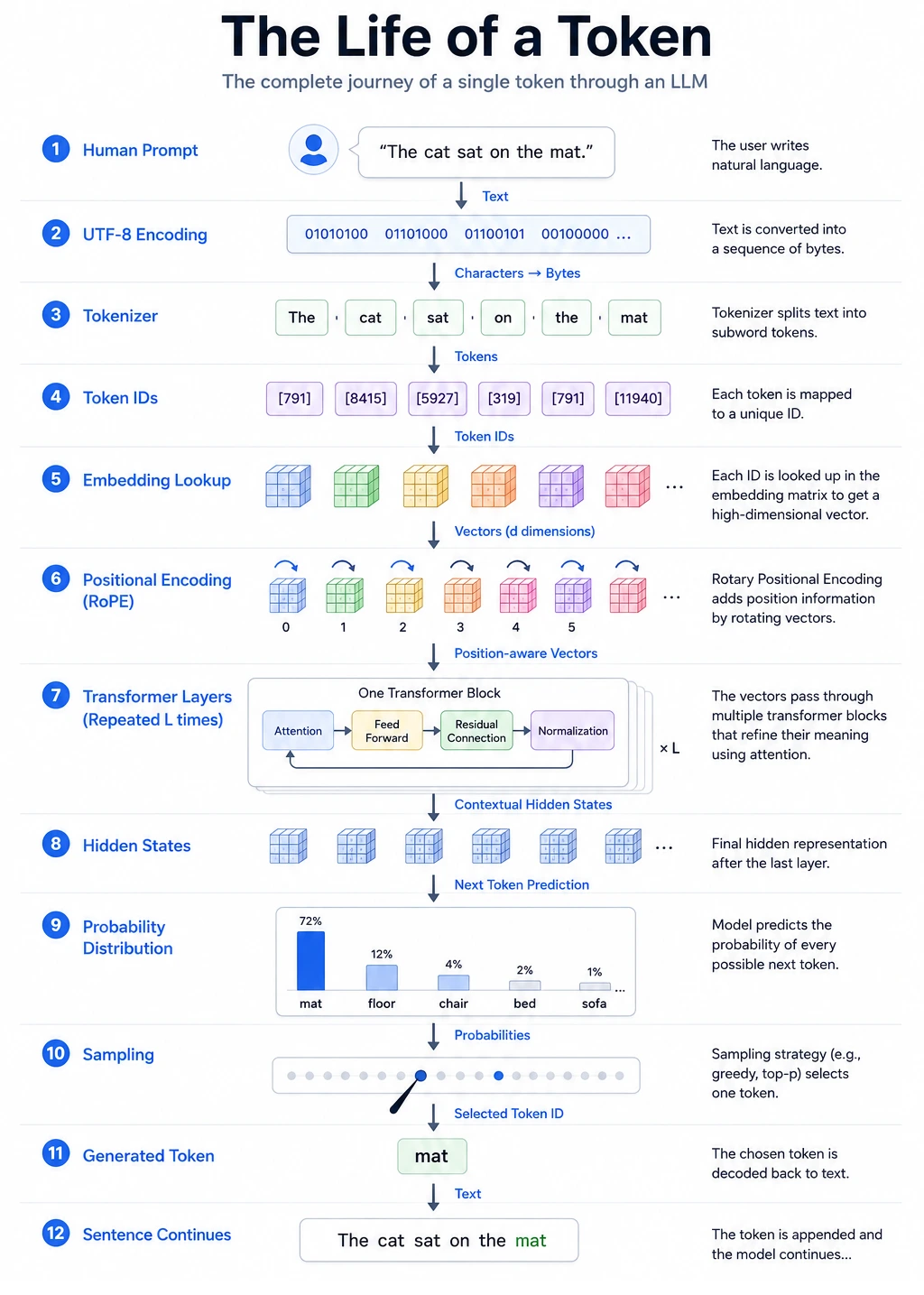
The Journey From Prompt to Token
- The Core Problem: Why Computers Cannot Read
- The Goldilocks Solution: Subword Tokenization
- Inside the Machine: How Modern Tokenizers Work
- Token Economics: The Multilingual and Code Tax
- The Hardware Reality: Why Output Costs More
- Working Memory: The Context Window
- The Physics of Location: Positional Encoding
- Breaking the Speed Limit: Inference Optimization
- The Future: Are Tokens a Dead End?
The Journey From Prompt to Token
You type a prompt. You hit Enter. What actually happens in the next ten milliseconds?
Biological intelligence does not perceive the world in discrete, pre-packaged chunks. A human brain processes a continuous, flowing stream of sensory information. But artificial neural networks operate exclusively on discrete, floating-point numbers. They do not understand English grammar, the letter "A," or the concept of an apple.
So something has to give. Before the model can reason, your prompt is converted into numbers it can actually operate on.
This translation layer is called tokenization. It is not merely a preprocessing step; it is the singular bottleneck defining modern artificial intelligence. Tokens dictate a model's reasoning capabilities, its memory footprint, its latency, and ultimately, its commercial viability.
Why do cloud providers charge you "per token"? Why does a Hindi document cost exponentially more to process than an English one? Why is generating text so much slower than reading it?
We'll cover how AI actually reads text, why physical GPU memory constrains it, and how to make your systems faster, smarter, and cheaper.
1. The Core Problem: Why Computers Cannot Read
To understand tokens, we must first understand why simpler methods, like feeding raw letters or entire dictionary words into an AI, completely fail.
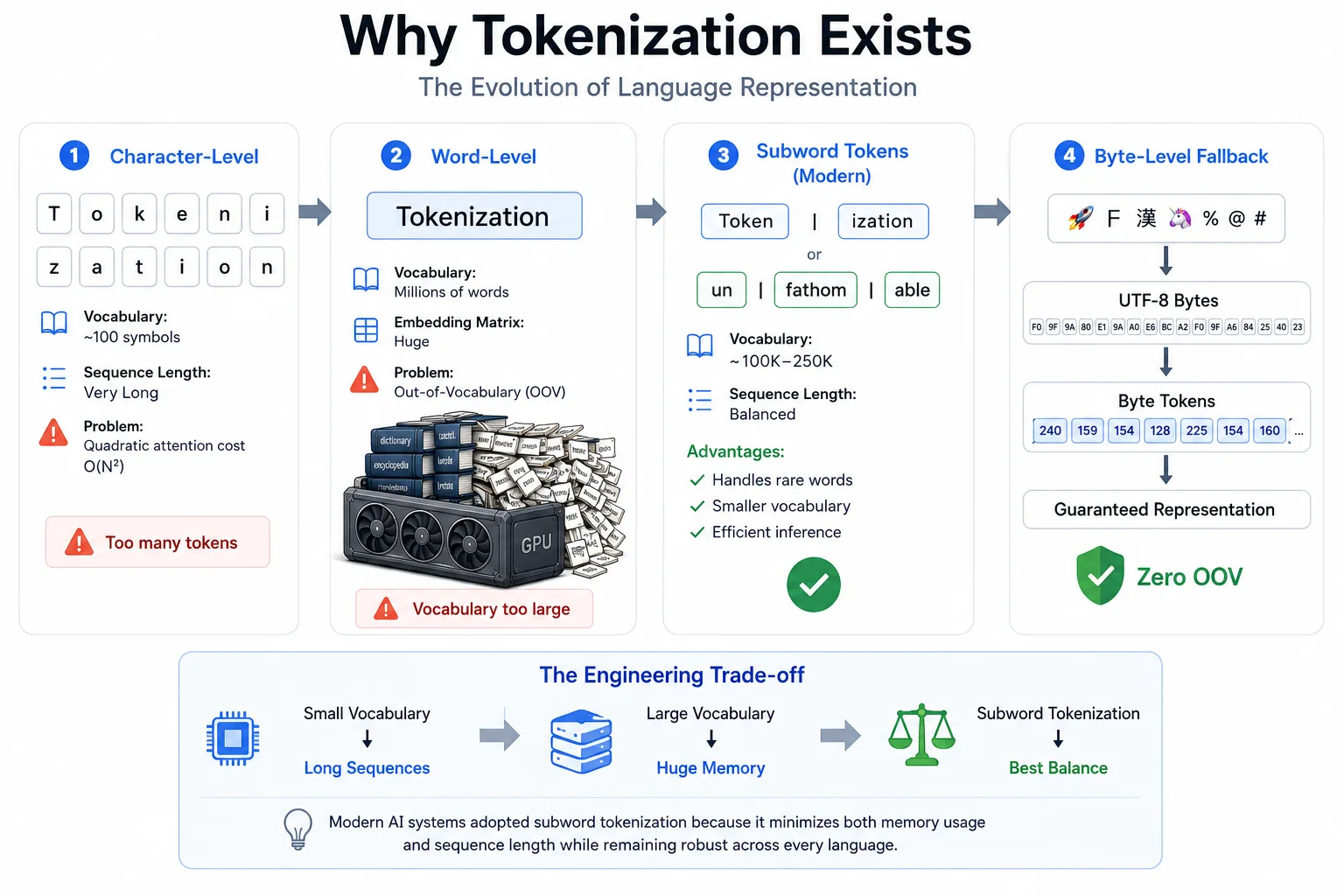
If neural networks only understand numbers, the simplest solution seems obvious: assign a unique number to every character (A=1, B=2, C=3) or every word (Apple=100, Banana=101).
Historically, AI researchers tried both. Both failed.
The Failure of Characters
Pre-2015, engineers experimented with character-level models. Because there are only 26 English letters, some punctuation, and numbers, the model's vocabulary was tiny. This elegantly eliminated the "Out-Of-Vocabulary" (OOV) problem.
But there is a catch: Sequence length, represented mathematically as .
The word "Tokenization" is 12 characters long. In a standard Transformer architecture, the attention mechanism scales quadratically, . Character models expanded intolerably, wasting massive amounts of compute simply teaching the model how to spell.
The Failure of Words
If characters create sequences that are too long, words must be the solution, right? Word-level models perfectly minimized the sequence length .
However, they suffered from an exploding vocabulary size, represented as .
There are hundreds of thousands of words in English alone, not counting slang, typos, or other languages. Assigning a unique vector to every possible word renders the neural network's embedding matrices massive.
2. The Goldilocks Solution: Subword Tokenization
Since characters are too slow and words are too large, the industry needed a compromise. That compromise is the "Token."
In 2016, researchers adapted a data compression technique called Byte Pair Encoding (BPE) for neural networks. BPE created the perfect middle ground: subwords.
Subwords keep highly common words whole, but break down rare words into meaningful, reusable chunks.
Think of subword tokens like LEGO bricks.
- The common word "the" is a single, large, pre-assembled LEGO block.
- The rare word "unfathomable" is broken into three smaller bricks: "un", "fathom", and "able".
How Byte Pair Encoding Learns
BPE does not understand human grammar. It relies strictly on statistical frequency.
- It initializes with a base alphabet of 256 raw bytes.
- It scans a massive corpus of text and counts the frequency of adjacent pairs .
- The most frequent pair is iteratively merged into a new, single token , which is added to the vocabulary.
The mathematical complexity to construct this vocabulary is roughly .
In 2019, GPT-2 solved this by introducing Byte-Level BPE. By utilizing 256 raw UTF-8 bytes as the absolute base alphabet, the tokenizer is mathematically guaranteed to have zero Out-Of-Vocabulary failures, regardless of the script or typo.
3. Inside the Machine: How Modern Tokenizers Work
Theory is great, but production code is different. We need to look at how real, modern tokenizers process your text at lightning speed.
OpenAI's tiktoken library fundamentally changed tokenization speed. Operating 3x to 6x faster than legacy HuggingFace tokenizers, it shifted BPE logic to highly optimized Rust code and stripped away legacy NLP preprocessing.
Here is exactly what happens when you send a prompt to GPT-4o (tokenizer code name: o200k_base):
- Regex Pre-Segmentation: Before any BPE merging occurs, the raw text is aggressively fractured using a regex pattern. This prevents the algorithm from accidentally merging punctuation into adjacent words. It isolates contractions ('re), caps digit groupings to 3 digits to aid the model's arithmetic logic, and strictly preserves whitespace.
- UTF-8 Byte Encoding: The fractured chunks are converted into raw UTF-8 bytes (0-255).
- Merge Rank Lookup:
tiktokenloads a massive hash table mapping byte sequences to integer ranks. The Rust code performs a greedy longest-match-first search across adjacent byte pairs, always merging the pair with the lowest integer rank, which equates to the highest frequency in training.
Reality: Tokenization happens entirely on the CPU before the text ever reaches the GPU.
tiktoken drops Python's Global Interpreter Lock (GIL) to process distinct text strings concurrently via Rust threads.
4. Token Economics: The Multilingual and Code Tax
Tokens are the absolute currency of AI. Understanding how your text breaks down directly impacts your API bills and context window limitations.
Token fertility represents the average number of tokens required to represent a single word. High fertility destroys effective context windows and spikes API costs.
The JSON Tax
Imagine you are building a gamified educational quiz app for AI and Machine Learning topics. You want to award users XP, track levels, and maintain daily streaks. Your backend logic relies on structured data. But formatting this data carelessly can silently drain your token budget.
- Before (expensive JSON):
{"event": "test_complete", "xp_earned": 50, "streak_kept": true} - After (cheaper, same data):
Event|XP|Streak\ntest_complete|50|true
The JSON snippet above consumes up to 40% more tokens than the pipe-delimited version because BPE tokenizers are optimized for natural prose. The repeated punctuation, quotes, colons, and braces around every key rarely match a single merged token, so the tokenizer falls back to individual characters, inflating output costs. The compact alternative requires a fraction of the compute for the same information.
The Multilingual Byte-Fallback Penalty
If a tokenizer is biased toward Western text, non-Latin scripts suffer brutally.
An Odia 37-character sentence consumes 99 tokens on standard open-source tokenizers (like Mistral's Tekken) because the tokenizer lacks dedicated Brahmic Unicode slots. Because it lacks these slots, every 3-byte UTF-8 character shatters into 3 distinct tokens.
Specialized models like BrahmicTokenizer-131K compress that exact same sentence into just 21 tokens, a 76% reduction in compute cost, without degrading English efficiency.
tiktoken for OpenAI, SentencePiece for Gemini).
5. The Hardware Reality: Why Output Costs More
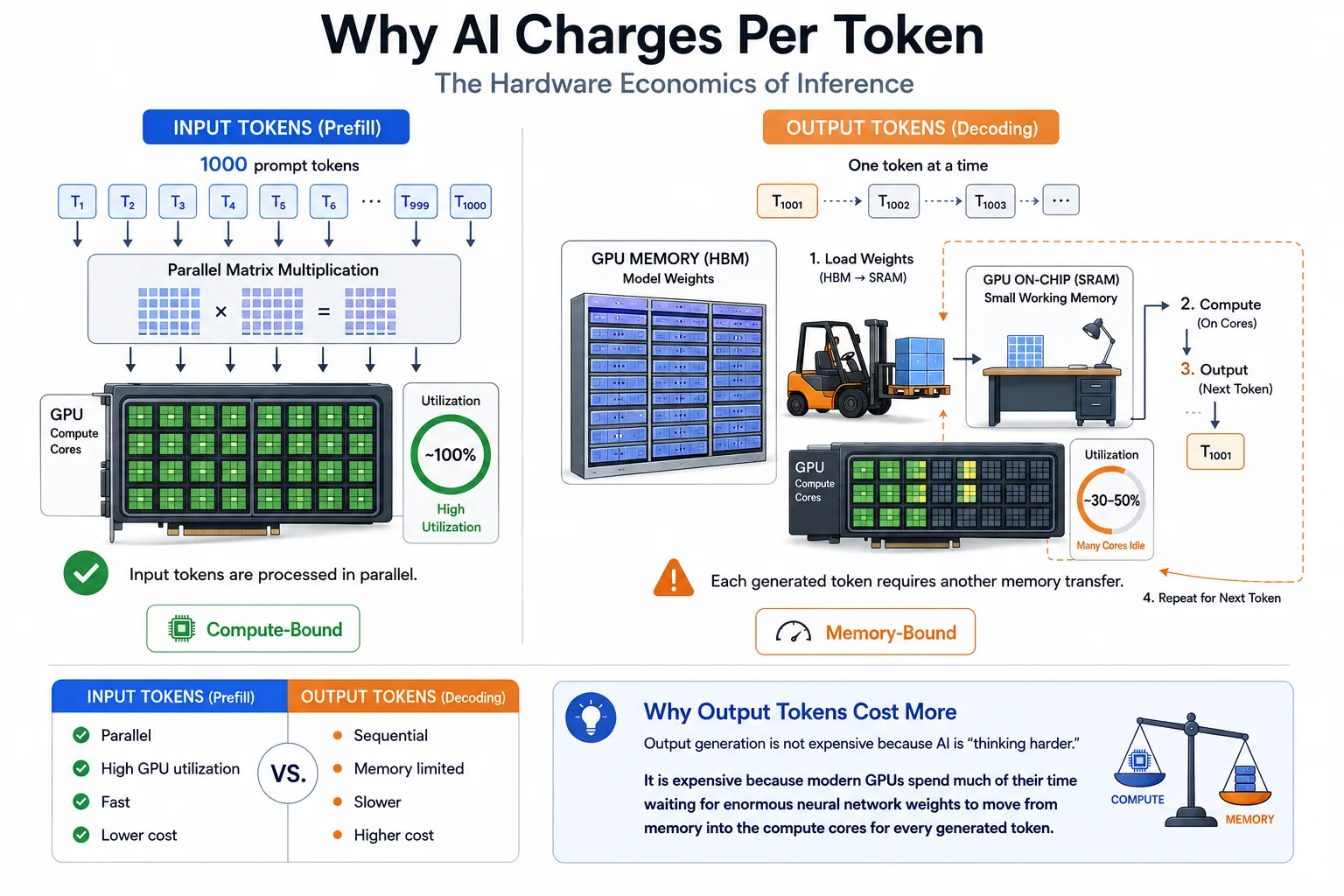
Cloud providers universally charge 3x to 5x more for output tokens than input tokens. To understand why, we have to look at the physics of a GPU.
The cost disparity lies purely in the Memory Wall.
Input Tokens (Prefill Phase)
When you submit a prompt, the text is processed entirely in parallel. The GPU computes massive matrix multiplications () utilizing its parallel core clusters (TFLOPS).
- State: Compute-Bound.
- Hardware Reality: The GPU is efficiently saturated and operating at peak performance.
Output Tokens (Decoding Phase)
Generation is autoregressive; the model must generate one token before it can generate the next.
To produce token , the GPU must read the entire massive weight matrix (e.g., 140GB for a 70B model) from High Bandwidth Memory (HBM) into its on-chip SRAM. It moves all this data just to perform a tiny vector-matrix multiplication.
- State: Memory-Bandwidth Bound.
- Hardware Reality: The compute cores sit idle waiting for data to arrive from memory.
Standard attention during decoding has an arithmetic intensity of . This is incredibly inefficient compared to a GPU's optimal ratio, explaining the heavy premium cost.
6. Working Memory: The Context Window
A model needs to remember what was said earlier in the prompt. How does it do this without re-reading the entire conversation every single step?
During generation, an LLM must attend to all previous tokens. Recomputing this history every step is mathematically impossible. Therefore, previous Key () and Value () tensors are stored in VRAM.
This is the KV Cache. Think of it as the model taking ongoing lecture notes so it doesn't have to re-read the textbook to answer every new question.
PagedAttention
Historically, serving engines pre-allocated contiguous, max-length blocks of memory for the KV cache, causing 60%-80% memory waste due to fragmentation.
PagedAttention (popularized by vLLM) resolves this by porting Operating System virtual memory concepts to the GPU:
- Logical Blocks: The request's context is split into fixed-size logical blocks (e.g., 16 tokens).
- Physical Blocks: These are allocated non-contiguously in GPU memory strictly on demand.
7. The Physics of Location: Positional Encoding
Without positional data, Attention is an unordered bag of words. The model wouldn't know the difference between "The dog bit the man" and "The man bit the dog."
Rotary Position Embeddings (RoPE)
Used by Llama, Mistral, and DeepSeek, RoPE multiplies Query and Key vectors by a rotation matrix rather than adding an absolute vector.
The -dimensional vector is split into 2D pairs. Pair is rotated by angle , where is the absolute position and :
Because rotations are orthogonal, the dot product becomes a function purely of the relative distance . You get relative positioning mathematically for free.
Stretching the Window (ALiBi)
When scaling context from 4K to 128K+, standard RoPE high-frequency dimensions encounter unseen rotations and fail.
ALiBi solves this by abandoning embedding manipulation entirely. It directly biases the raw attention logit prior to the softmax:
Where is a head-specific slope. This linear penalty acts like a fading spotlight, allowing flawless zero-shot extrapolation to unseen context lengths.
8. Breaking the Speed Limit: Inference Optimization
As context windows grow to millions of tokens, standard attention mathematics threaten to break the hardware. Engineers had to rewrite the rules of memory access.
FlashAttention
Standard attention computes , resulting in an matrix. For a 32K context, storing this intermediate matrix requires ~2GB per attention head, immediately causing Out-Of-Memory (OOM) errors and catastrophic latency.
FlashAttention uses tiling. It divides into blocks that fit perfectly into the ultra-fast on-chip SRAM (e.g., 192KB). It computes the softmax normalization locally using an online accumulator (), discarding intermediate results.
This reduces memory traffic complexity from to , delivering 3x-4x speedups and enabling infinite context windows.
Speculative Decoding
To bypass the memory-bandwidth limit of autoregressive generation, Speculative Decoding brings in a helper.
- A tiny "draft" model (the junior engineer) generates a sequence of tokens rapidly.
- The massive target model (the senior engineer) verifies all tokens in parallel in a single forward pass.
- If the target model agrees, the sequence is accepted. If they diverge, rejection sampling halts the sequence at the error.
9. The Future: Are Tokens a Dead End?
The constraints described above (vocabulary size, sequence length, the memory wall) aren't fixed laws of AI. They're active research targets, and some may not survive the decade.
From a computational and information-processing perspective, forcing language into rigid chunks is an artificial limitation. Biological intelligence doesn't read the world in chunks; it processes continuous streams.
Multi-Token Prediction (MTP)
Proposed by Meta, Multi-Token Prediction alters the transformer architecture to predict tokens into the future simultaneously. Rather than training a separate draft model, MTP utilizes a shared backbone with lightweight, independent prediction heads for tokens . This forces the model to learn long-range planning in its latent space, yielding up to 3x inference acceleration.
Token-Free Byte Models (MambaByte)
Standard byte-level Transformers suffer because sequence length explodes. MambaByte utilizes State-Space Models (SSMs) to ingest raw UTF-8 bytes directly.
Because Mamba features a fixed-size recurrent hidden state , it processes infinite bytes with memory rather than . Mamba uses Zero-Order Hold (ZOH) discretization to convert continuous differential equations into discrete steps:
This allows byte-level processing that is highly robust to typos and cross-lingual inequities without relying on a fixed tokenizer vocabulary. It operates much closer to how biological intelligence processes a continuous stream of sensory input.
Conclusion: Tokens Are the Real Interface
A token is not merely a preprocessing artifact.
It is the fundamental atomic unit connecting human language, data compression, mathematics, GPU hardware, and economics. It dictates the size of your embedding matrices, the latency of your KV cache, the physics of your positional encodings, and the literal dollars you spend on cloud computing.
By deeply understanding the mechanics of Byte Pair Encoding, the physical constraints of the VRAM memory wall, and the engineering strategies of prompt caching, you stop guessing at AI behavior and start engineering it.
As we look toward the horizon of token-free state-space models and continuous sequence architectures, a crucial question remains for those building systems today: given the massive disparities in token fertility across formats and languages, how are you currently auditing the true semantic density of your applications?