Post-Quantum Cryptography Explained: Why Engineers Are Preparing for Q-Day
Every day you delay migrating to post-quantum cryptography, adversaries collect more of your encrypted traffic. Here is what the quantum threat actually is, why software bugs are the bigger immediate risk, and exactly what engineering teams must do today.
- The math securing your passwords, banking, and internet traffic can be broken by a powerful enough quantum computer. That threshold is approaching faster than most expect.
- Sophisticated threat actors are recording encrypted internet traffic today, intending to decrypt it once a quantum computer arrives. Your data is already being collected.
- In August 2024, regulators released three new encryption standards built to withstand quantum attacks: one for securing connections, one for digital signatures, and one as a high-assurance backup.
- The biggest risk right now is not quantum hardware. It is bugs in the new quantum-resistant software. A single implementation flaw can silently eliminate all protection.
- The only responsible strategy today is running old and new encryption in parallel, so breaking one still leaves the other intact.
- Timelines have compressed. New architectures suggest a cryptographically relevant quantum computer may require far fewer components than previously thought.
Note: this article is more technical than most on this blog. Sections 1 to 3 are accessible to any reader. Sections 4 onwards assume some familiarity with how encryption works.
- Why Your Encryption Is Already at Risk
- The Math Quantum Computers Will Break
- Harvest Now, Decrypt Later
- NIST's Answer: FIPS 203, 204, and 205
- How Lattice Cryptography Works
- The Bigger Threat: Software Bugs in PQC Code
- The Hybrid Approach: Defense in Depth
- State of the Art in 2026
- What Engineers Should Do Today
- Conclusion
- Frequently Asked Questions
1. Why Your Encryption Is Already at Risk
Every time a user logs into a banking application, pushes code to a private repository, or establishes a secure VPN connection, they rely on a mathematical promise. That promise, built on RSA and Elliptic Curve Cryptography (ECC), assumes that certain math problems are simply too difficult for any computer to solve. For decades, that assumption was safe.
As of mid-2026, the global cryptographic landscape has crossed a critical threshold. The transition to Post-Quantum Cryptography (PQC) is no longer a theoretical exercise confined to academic papers. It is a complex engineering reality unfolding across global infrastructure.
- New mathematical algorithms designed to resist quantum attacks
- Runs on ordinary classical computers: your laptop, a web server, a smartphone
- A software migration: drop-in replacement for RSA and ECC inside TLS, SSH, and VPNs
- No new hardware required for deployment
- Uses physical quantum mechanics, entangled photons, to transmit encryption keys
- Requires specialized fiber-optic hardware and quantum detectors
- Not a software update. An entirely different physical infrastructure
- Not interoperable with today's internet protocols
This distinction matters because the two are routinely confused in executive briefings and vendor marketing. PQC is purely a math upgrade. You do not need a quantum computer to deploy it.
The urgency is role-specific. If you build, secure, or deploy software, the impact is already at your door:
2. "RSA is already broken." False. No quantum computer in 2026 is large enough to break RSA-2048.
3. "Quantum computers break everything instantly." False. They excel at specific mathematical problems, not all computation.
4. "AES becomes useless." False. Grover's Algorithm halves effective key strength. AES-128 becomes equivalent to AES-64. AES-256 remains highly secure and is the recommended standard going forward.
5. "We can wait until Q-Day to upgrade." False. Adversaries are already harvesting and storing your encrypted traffic today.
2. The Math Quantum Computers Will Break
Modern public-key infrastructure (PKI) relies on two mathematical traps that are trivial to compute in one direction and practically impossible to reverse on classical hardware.
- Integer Factorization (RSA): Multiplying two massive prime numbers is instant. Finding the original primes from the product is computationally infeasible for classical computers, requiring billions of years at scale.
- Discrete Logarithms (ECC / Diffie-Hellman): Computing a point on an elliptic curve is fast. Reversing the operation to find the secret starting point is practically impossible.
These systems act like enormous mazes. A classical computer has to blindly explore nearly every path to find the exit. The bigger the maze (longer the key), the longer the search takes.
In 1994, mathematician Peter Shor developed Shor's Algorithm. By exploiting quantum superposition and quantum interference, Shor's Algorithm does not blindly explore the maze. It identifies the hidden mathematical periodicity of the problem and collapses the search space exponentially faster than any classical approach.
Once a quantum computer scales to enough stable logical qubits, Shor's Algorithm renders RSA, ECC, and Diffie-Hellman entirely obsolete. Every TLS handshake, every SSH session, and every encrypted VPN tunnel becomes retroactively breakable.
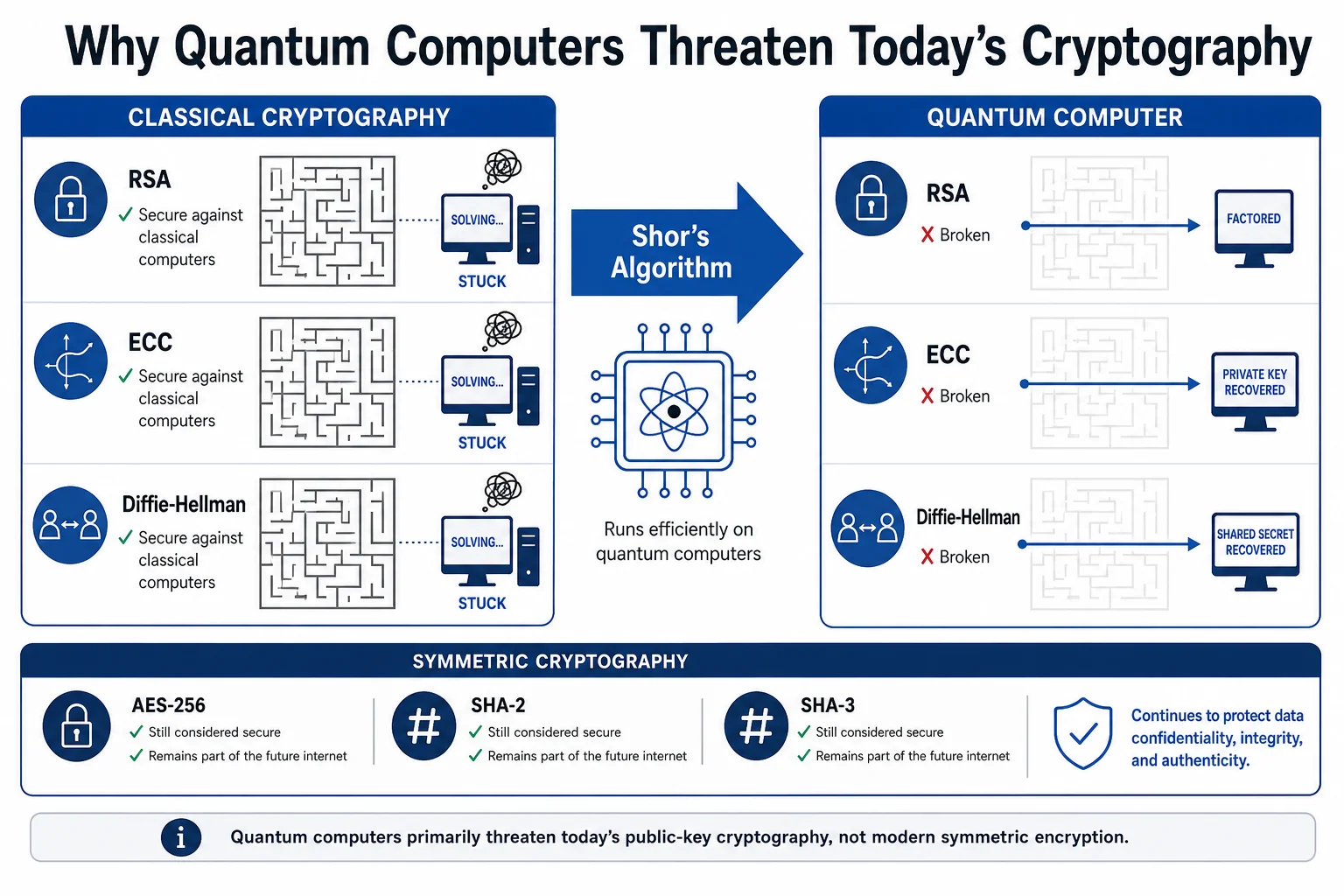
Symmetric encryption like AES is not broken by Shor's Algorithm, but it is weakened by a different quantum algorithm. Grover's Algorithm performs an unstructured search across all possible keys simultaneously, effectively halving the bit-security of a symmetric key. AES-128 becomes equivalent in security to a 64-bit key. AES-256, however, retains 128-bit effective security and remains the recommended standard going forward.
3. Harvest Now, Decrypt Later
The question security leaders often ask is: if a quantum computer capable of breaking RSA will not exist for several more years, why are organizations spending millions to migrate today?
The answer is the Harvest Now, Decrypt Later (HNDL) strategy.
Sophisticated threat actors are actively intercepting and archiving vast volumes of encrypted internet traffic. They cannot read this data today. They are hoarding it with the explicit expectation that once they acquire a Cryptographically Relevant Quantum Computer (CRQC), they will retroactively decrypt the archives using Shor's Algorithm.
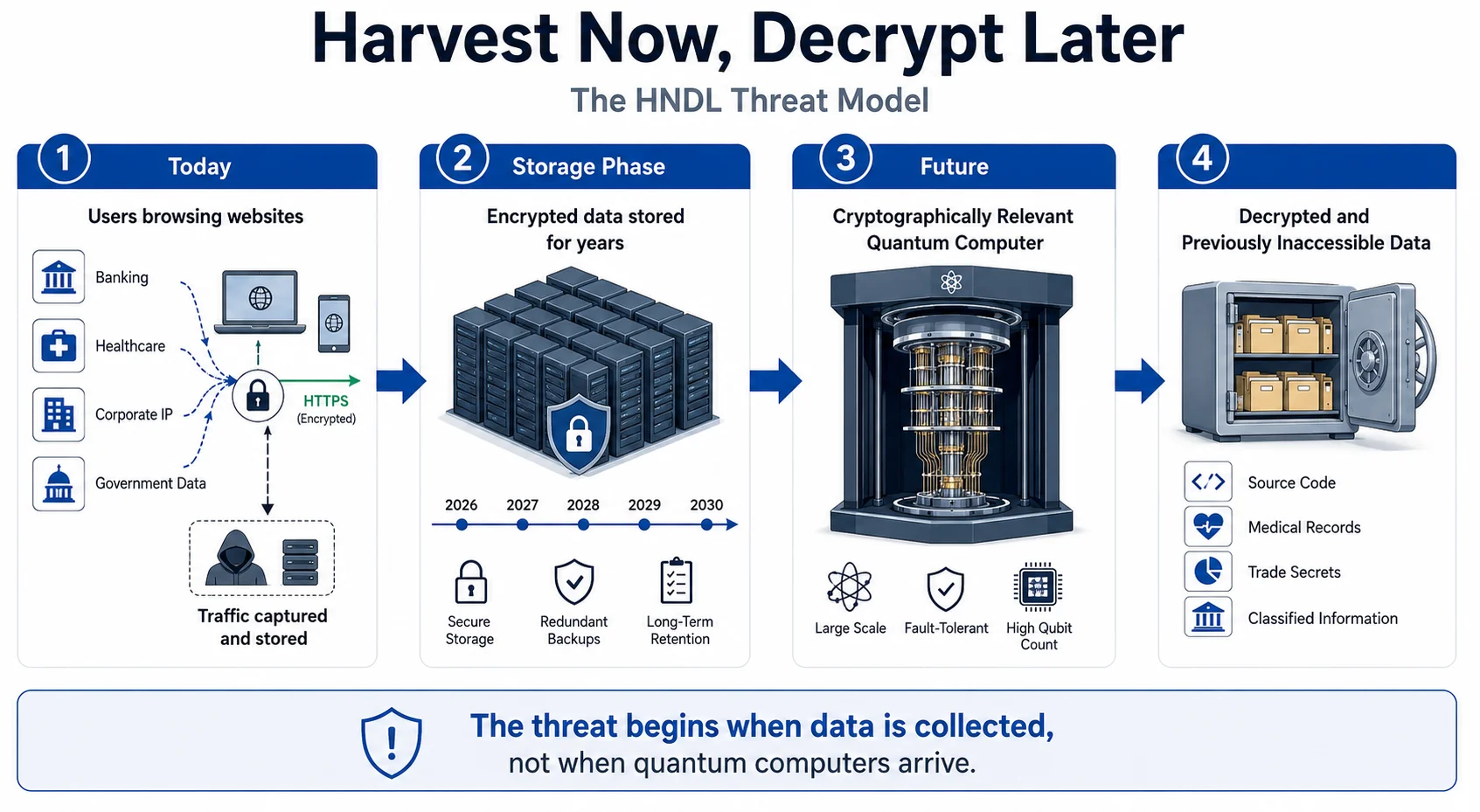
For data with a short lifespan, like a temporary session cookie or a public price query, this is not a concern. But consider data whose confidentiality must hold for 8 to 10 years or more:
- Intelligence operative identities
- Proprietary source code and trade secrets
- Genomic and long-term healthcare records
- Long-term financial ledgers and audit trails
4. NIST's Answer: FIPS 203, 204, and 205
Recognizing this existential threat to the digital economy, the U.S. National Institute of Standards and Technology (NIST) launched a global, multi-year competition to evaluate and standardize PQC algorithms. In August 2024, NIST finalized the first wave of Federal Information Processing Standards, permanently altering the cryptographic landscape.
| Standard | Algorithm | Derived From | Replaces | Key Trade-off |
|---|---|---|---|---|
| FIPS 203 | ML-KEM | CRYSTALS-Kyber | ECDH, RSA key exchange (TLS, VPNs) | Fast compute; larger key sizes than ECC increase network overhead |
| FIPS 204 | ML-DSA | CRYSTALS-Dilithium | RSA, ECDSA digital signatures | Computationally fast; signature sizes expand certificate chains from 4.5 KB to 15+ KB |
| FIPS 205 | SLH-DSA | SPHINCS+ | High-assurance backup signatures (root CAs) | Ultra-conservative security based only on hash functions; very slow with massive signature sizes |
NIST is also developing an architectural backup in HQC, a code-based algorithm derived from error-correcting code mathematics, entirely separate from the lattice assumptions underlying ML-KEM and ML-DSA. If the primary lattice mathematics were ever broken, HQC would provide a defense-in-depth fallback with a completely different mathematical foundation.
5. How Lattice Cryptography Works
The vast majority of the modern cryptographic transition rests on lattice-based cryptography, specifically a mathematical framework known as the Learning With Errors (LWE) problem, introduced by cryptographer Oded Regev.
The simplest way to understand LWE is through the analogy of noisy equations. Imagine a standard system of linear algebra equations. You have a public matrix and an output vector, and you need to find the hidden secret variables. A classical computer solves this instantly using Gaussian elimination.
LWE introduces one critical twist: a tiny, random "error" or "noise" is added to every equation before it is published. Without the noise, the problem is trivially solvable. With the noise, the equations become geometrically chaotic. Finding the secret becomes mathematically equivalent to locating the nearest lattice point in a massive, high-dimensional grid. This is believed to be hard even for quantum computers.
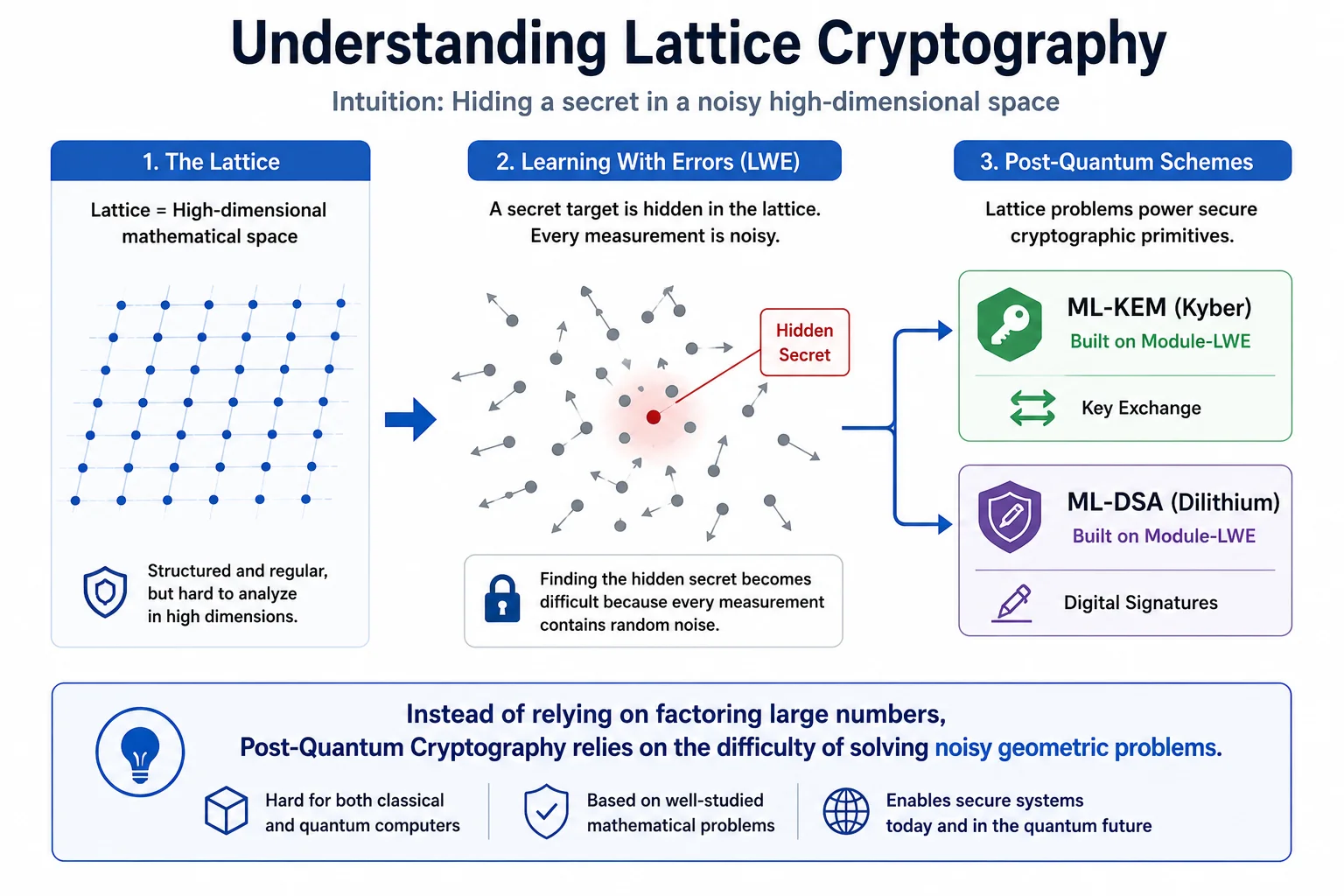
To make keys smaller and improve computational efficiency for web traffic, researchers created Module-LWE (M-LWE). This variant structures the equations using polynomial rings, creating a precisely tunable trade-off between performance and security. Both ML-KEM and ML-DSA are built on M-LWE.
The strongest theoretical property of this math is its worst-case reduction. Researchers proved that if any adversary can write a program to break a random M-LWE encryption, that exact same program could solve the hardest theoretical lattice problems known to mathematics. In 2026, researchers published an unconditional mathematical proof of Weber's conjecture for k up to 12, cementing the algebraic structure underlying ML-KEM's security assumptions.
6. The Bigger Threat: Software Bugs in PQC Code
Here is the most important realization for engineering teams today: the immediate threat to the global cryptographic ecosystem stems not from quantum computers, but from classical implementation vulnerabilities in the PQC software being deployed right now.
Historically, cryptography rarely fails because the math breaks. It fails because the code is flawed. Heartbleed in OpenSSL, the agonizingly slow deprecation of SHA-1, and the BEAST attack against TLS 1.0 were all implementation failures, not mathematical ones. PQC implementations are highly complex, mathematically dense, and fundamentally immature. Three critical vulnerability classes have already emerged.
7. The Hybrid Approach: Defense in Depth
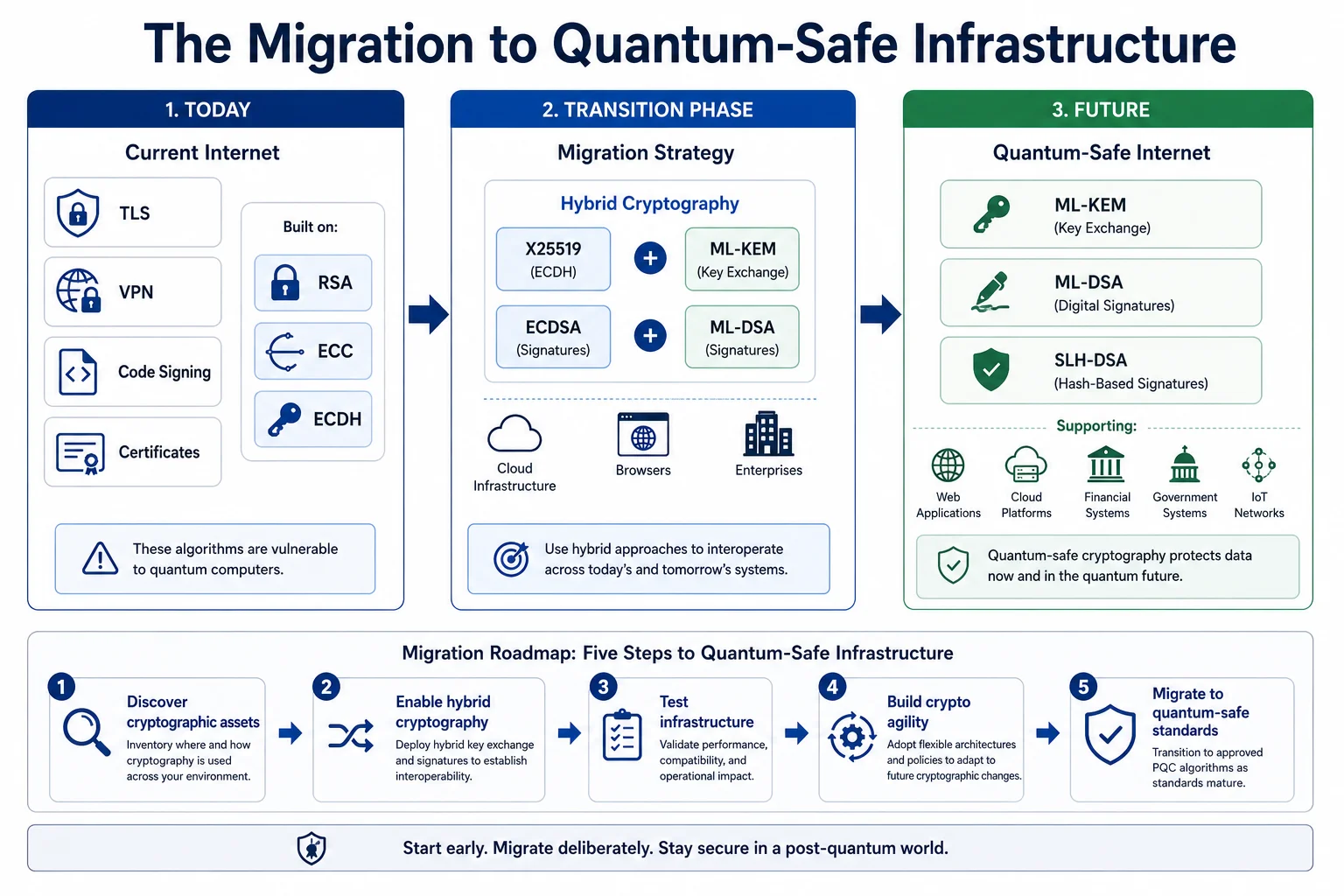
Because the industry faces a dual threat, quantum computers breaking old math and software bugs breaking new math, the responsible deployment strategy is hybrid cryptography: combining a classical algorithm with a post-quantum algorithm in every cryptographic transaction.
In a hybrid key exchange, both a classical key (typically X25519, an elliptic curve algorithm) and a post-quantum key (ML-KEM) are established simultaneously. Both keys are passed through a Key Derivation Function (KDF) to produce a single final session key. An attacker must break both cryptographic paradigms simultaneously to compromise the session.
- Protected against future quantum computers
- Vulnerable if a classical flaw is found in ML-KEM or ML-DSA
- No safety net if an algebraic attack collapses the M-LWE assumption
- Dangerously premature given the immaturity of implementations
- Protected against quantum computers via the PQC layer
- Protected against PQC implementation flaws via the classical layer
- Defense-in-depth: both paradigms must fail simultaneously
- Universally endorsed by NIST, NSA CNSA 2.0, and academic consensus
Adoption of hybrid deployment is already extensive at the infrastructure level. Cloudflare, Google, and Apple have enabled hybrid ML-KEM plus X25519 key exchanges by default across their platforms. The Open Quantum Safe project provides production-ready open-source libraries bridging PQC algorithms into real-world software stacks.
Regulatory compliance is accelerating this further. The U.S. CNSA 2.0 mandate sets strict migration timelines for cloud and national security infrastructure. In Europe, NIS2 and DORA directives classify quantum-vulnerable cryptography as failing "state-of-the-art" security standards. India's National Quantum Mission requires Critical Information Infrastructure to complete migration by 2029.
8. State of the Art in 2026
The PQC landscape is moving faster than anticipated on both the threat side and the defense side. Engineering teams must separate established facts from speculative projections.
The three most plausible scenarios for the next decade are shaped by whether the math holds, the quantum hardware scales, or both fail simultaneously.
9. What Engineers Should Do Today
The transition to PQC forces a fundamental redesign of foundational digital architecture. You cannot wait for a security patch to handle this. Engineering teams must take deliberate action now.
Conclusion
The cryptographic migration to post-quantum standards is unlike any security upgrade the industry has previously undertaken. Every prior migration, from MD5 to SHA-1, from SSLv3 to TLS 1.3, was painful and slow. The PQC migration is more complex in every dimension: the algorithms are newer, the implementations are denser, the network penalties are real, and the adversaries collecting your traffic are not waiting.
- The quantum threat is real and accelerating. New architectural optimizations have compressed the estimated qubit requirement for breaking RSA by two orders of magnitude in two years.
- The migration is not optional. HNDL attacks mean that long-lived sensitive data transmitted today is already at risk. The urgency is dictated by data shelf-life, not Q-Day arrival.
- The immediate risk is software, not hardware. The AABBCC bug and zero-store elimination attacks demonstrate that classical adversaries can exploit PQC implementation flaws right now, with a laptop.
- Hybrid cryptography is the only responsible strategy. Combining classical and PQC algorithms provides defense-in-depth against both a quantum computer and an undiscovered flaw in the new math.
- Crypto-agility is the permanent lesson. Even if every PQC algorithm were proven unbreakable today, SIKE showed us that mathematical confidence erodes. Systems must be designed to evolve.
The engineers who treat this as a compliance checkbox will spend years doing emergency rework. The engineers who build crypto-agile infrastructure today will find that rework is a configuration change.
Frequently Asked Questions
What is Post-Quantum Cryptography?
Post-Quantum Cryptography (PQC) refers to new mathematical algorithms designed to run on classical computers that are resistant to attacks from quantum computers. PQC does not require quantum hardware to deploy. The goal is to replace vulnerable algorithms like RSA and ECC inside existing internet protocols such as HTTPS and SSH with quantum-resistant math, without requiring end-users to upgrade their physical devices.
Is RSA already broken by quantum computers?
No. As of 2026, no known quantum computer is large or stable enough to break production-grade RSA-2048. However, recent algorithmic optimizations have significantly compressed the estimated qubit requirement. The threat is real and accelerating, even if RSA has not been broken today.
What is Harvest Now, Decrypt Later?
Harvest Now, Decrypt Later (HNDL) is an attack strategy where adversaries intercept and store encrypted internet traffic today, while it is still unreadable. Once they acquire a Cryptographically Relevant Quantum Computer (CRQC), they plan to retroactively decrypt the archived data using Shor's Algorithm. Any data with a confidentiality requirement extending 8 to 10 years or more that is transmitted using classical encryption today should be considered potentially compromised.
What are FIPS 203, 204, and 205?
FIPS 203, 204, and 205 are the first NIST-standardized Post-Quantum Cryptography algorithms, finalized in August 2024. FIPS 203 (ML-KEM, derived from CRYSTALS-Kyber) replaces RSA and ECDH for key exchange. FIPS 204 (ML-DSA, derived from CRYSTALS-Dilithium) replaces RSA and ECDSA for digital signatures. FIPS 205 (SLH-DSA, derived from SPHINCS+) is a conservative hash-based backup signature scheme for high-assurance applications like root certificate authorities.
What is crypto-agility and why does it matter?
Crypto-agility is the architectural property that allows a software system to swap cryptographic algorithms through configuration rather than a codebase rewrite. It matters because PQC implementations are still maturing: new vulnerabilities are being discovered, and some candidates may be broken by classical math before quantum computers even arrive. Systems with hardcoded algorithms cannot respond quickly. Crypto-agile systems can failover to a new algorithm via a configuration change, reducing exposure time from months to hours.