Defining a Qubit
A qubit is a unit vector in a 2D complex vector space, capable of existing in continuous superpositions of |0> and |1>
Source: mortalapps.com- A qubit is the fundamental unit of quantum information, capable of existing in a superposition of states.
- The state of a qubit is represented as a unit vector in a two-dimensional complex vector space (C²).
- The general state is written as |ψ⟩ = α|0⟩ + β|1⟩, where α and β are complex probability amplitudes.
- The normalization condition requires that |α|² + |β|² = 1, ensuring total probability sums to 100%.
- Upon measurement, the probability of obtaining state |0⟩ is |α|², and the probability of obtaining |1⟩ is |β|².
- Qubits can be physically realized using superconducting circuits, trapped ions, photons, or other quantum systems.
Why This Matters
Now that we have formalized the classical bit as a discrete vector, we are ready to take our first major conceptual leap into the quantum realm. A quantum bit, or qubit, is the fundamental unit of quantum information. Unlike its classical counterpart, which is restricted to existing in one of two isolated states, a qubit can exist in a continuous blend of both states simultaneously. This phenomenon, known as superposition, is not a state of uncertainty or temporary transition, but a fundamental physical reality.
In this topic, we will formally define the qubit. We will move beyond the qualitative descriptions often found in popular science and establish the precise mathematical framework that governs a single qubit. We will explore how a qubit's state is represented as a vector in a two-dimensional complex vector space, introducing the complex coefficients that dictate its behavior.
By the end of this topic, you will understand the mathematical definition of a qubit, write down a general qubit state vector, and understand the physical significance of the normalization constraint. This foundation will unlock the ability to analyze quantum algorithms and hardware in the subsequent sections.
Core Intuition
To understand a qubit, imagine a coin. A classical bit is like a coin lying flat on a table: it is either showing heads ($|0\rangle$) or tails ($|1\rangle$). It is strictly in one state or the other. A qubit, however, is like that same coin spinning rapidly on the table. While it is spinning, it is not strictly heads, nor is it strictly tails. It exists in a dynamic combination of both possibilities. Only when you slap your hand down to stop the coin does it collapse into a definite heads or tails state.
Another excellent analogy is a dimmer switch compared to a standard on/off light switch. While the classical switch can only be fully off or fully on, the dimmer switch can be set to any continuous level of brightness in between. The state of the dimmer switch is a single, precise setting, but it contains elements of both darkness and light. Similarly, a qubit state is a single, precise mathematical state that blends the characteristics of $|0\rangle$ and $|1\rangle$.
It is vital to understand that a spinning coin is not 'confused' about its state; its spinning is a perfectly well-defined physical state. In the same way, a qubit in superposition is in a highly precise, coherent state. It is only when we interact with it through measurement that we force it to choose a classical identity.
Visualization
Technical Explanation
Mathematically, a qubit is a physical system whose state is represented by a unit vector in a two-dimensional complex vector space, denoted as $\mathbb{C}^2$. We write the general state of a qubit, $|\psi\rangle$ (pronounced 'psi'), as a linear combination of our computational basis states $|0\rangle$ and $|1\rangle$:
$$|\psi\rangle = \alpha|0\rangle + \beta|1\rangle$$
Here, $\alpha$ (alpha) and $\beta$ (beta) are complex numbers, meaning $\alpha, \beta \in \mathbb{C}$. These coefficients are called probability amplitudes. Because the state vector must be normalized to unit length (a concept we explored in Section 2), the sum of the squared magnitudes of these amplitudes must equal exactly 1:
$$|\alpha|^2 + |\beta|^2 = 1$$
This is known as the normalization condition. The physical significance of this condition is rooted in probability: when we measure the qubit, the probability of finding it in state $|0\rangle$ is $|\alpha|^2$, and the probability of finding it in state $|1\rangle$ is $|\beta|^2$. Since the qubit must collapse into one of these two states upon measurement, the total probability must sum to 1 (or 100%).
We can write this state vector in column form as:
$$|\psi\rangle = \begin{pmatrix} \alpha \\ \beta \end{pmatrix}$$
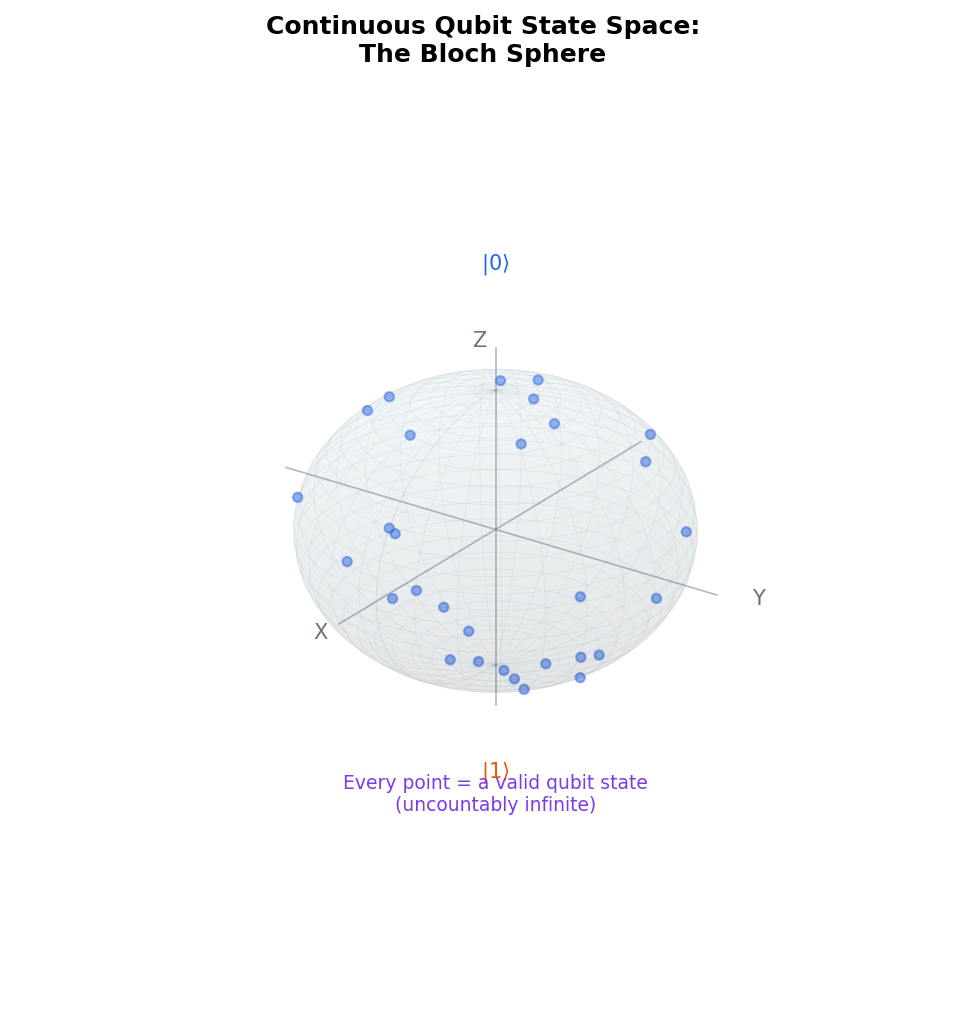
Because $\alpha$ and $\beta$ are complex numbers, they contain both a magnitude and a phase. This allows the qubit to access an infinite number of states, forming a continuous state space that we will soon visualize geometrically.