Superposition Mathematically
Superposition is a linear combination of basis vectors with complex coefficients, not a vague state of uncertainty
Source: mortalapps.com- Superposition is mathematically defined as a linear combination of basis vectors.
- The coefficients α and β are complex numbers that represent probability amplitudes.
- The normalization condition |α|² + |β|² = 1 must always be satisfied for a physical state.
- Complex amplitudes allow quantum states to experience constructive and destructive interference.
- The states |+⟩ and |-⟩ are equal superpositions with different relative phases, making them mathematically orthogonal.
- Superposition allows a quantum computer to process multiple computational paths simultaneously.
Why This Matters
Superposition is often described in popular culture as a mystical state where a particle is 'in two places at once' or 'both 0 and 1 simultaneously.' While these descriptions capture the wonder of quantum mechanics, they lack the precision needed to build quantum technologies. Mathematically, superposition is simply a linear combination of vectors. It is governed by rigorous, elegant linear algebra that we can calculate with absolute certainty.
In this topic, we will demystify superposition by analyzing its mathematical structure. We will explore how the complex coefficients $\alpha$ and $\beta$ act as precise coordinates on a complex unit circle. We will learn how to construct, manipulate, and normalize superposition states, and understand how these complex numbers allow quantum states to interfere with one another.
By the end of this topic, you will be able to write down any single-qubit superposition state, calculate its normalization factor, and map its coefficients to the complex plane. This mathematical mastery is the key to unlocking quantum algorithms, which rely entirely on the precise manipulation of these superposition amplitudes.
Core Intuition
Imagine mixing paint. You start with two primary colors: a bucket of pure blue paint ($|0\rangle$) and a bucket of pure yellow paint ($|1\rangle$). If you mix them, you get green. The exact shade of green depends entirely on the ratio of blue to yellow. A 50/50 mix gives a classic forest green, while a 90/10 mix gives a subtle teal. This mixture is a superposition. The ratios of the paint are the equivalent of our probability amplitudes.
However, quantum superposition has a superpower that paint does not: the ratios can be negative or even complex numbers. To visualize this, imagine a musical chord. When you play a C and a G note simultaneously on a piano, your ear hears a single, rich sound that is a superposition of both frequencies. Because sound consists of waves, these frequencies can constructively interfere (adding together to get louder) or destructively interfere (canceling each other out to create silence).
This wave-like interference is why we use complex numbers for our amplitudes. The amplitudes do not just represent 'how much' of a state is present; they also represent the 'phase' or timing of the wave. This allows quantum states to cancel each other out during a computation, a critical mechanism that drives quantum algorithms to find correct answers.
Visualization
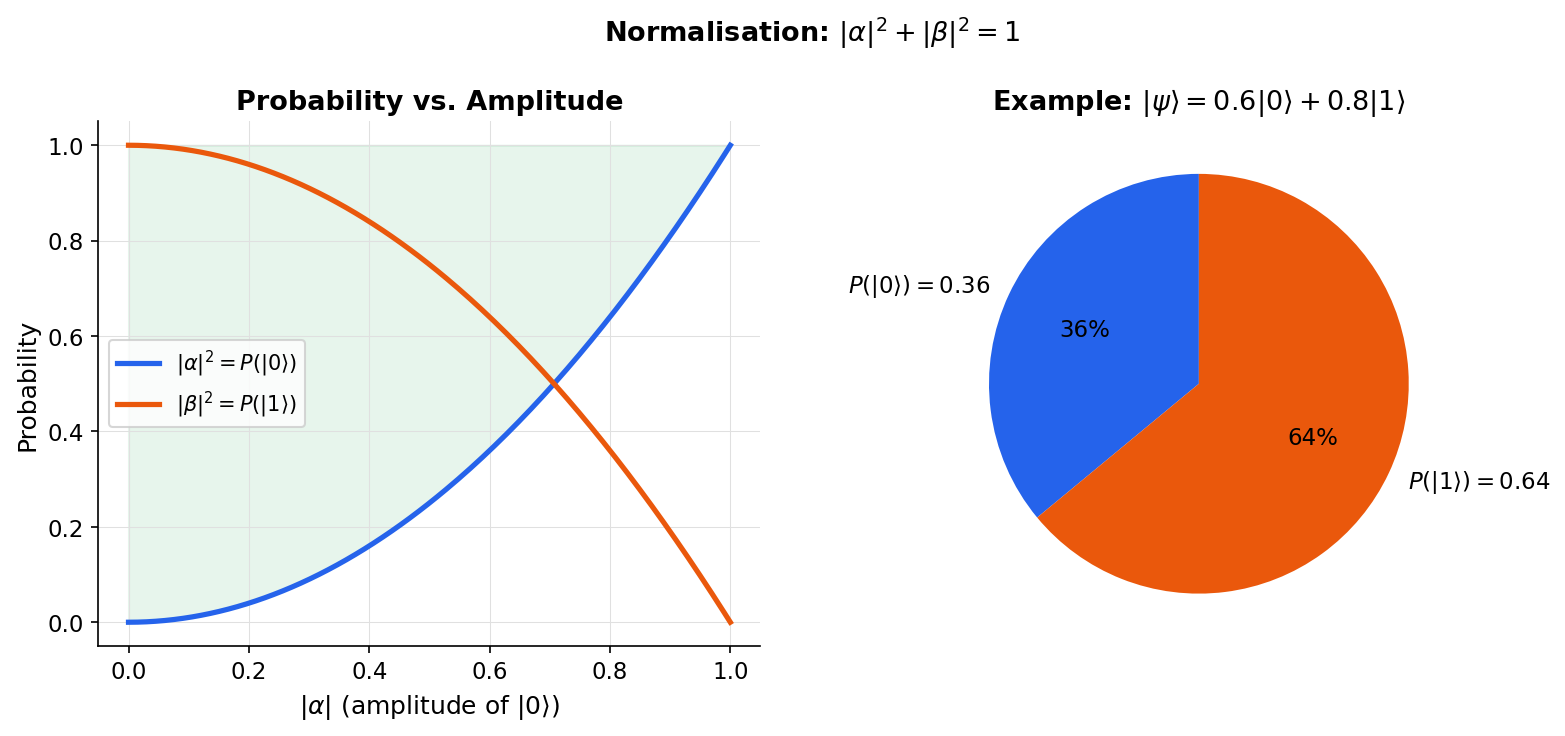
Technical Explanation
A general quantum superposition state is written as:
$$|\psi\rangle = \alpha|0\rangle + \beta|1\rangle$$
where $\alpha, \beta \in \mathbb{C}$. We can express these complex numbers in polar form as $\alpha = r_a e^{i\theta_a}$ and $\beta = r_b e^{i\theta_b}$, where $r_a, r_b$ are real, non-negative numbers representing the magnitudes, and $\theta_a, \theta_b$ represent the phases.
The normalization condition states that:
$$|\alpha|^2 + |\beta|^2 = 1$$
Using the definition of the complex modulus squared ($|z|^2 = z \cdot z^*$, where $z^*$ is the complex conjugate), we can write this as:
$$\alpha\alpha^* + \beta\beta^* = 1$$
This equation defines a unit hypersphere in a four-dimensional real space (since two complex numbers have four real dimensions). However, due to physical redundancies (which we will explore in the topic on Phase), this space can be mapped to a three-dimensional sphere.
Let us look at a concrete example of a superposition state:
$$|+\rangle = \frac{1}{\sqrt{2}}|0\rangle + \frac{1}{\sqrt{2}}|1\rangle$$
Here, $\alpha = \frac{1}{\sqrt{2}}$ and $\beta = \frac{1}{\sqrt{2}}$. Both amplitudes are real and equal. Another state is:
$$|-\rangle = \frac{1}{\sqrt{2}}|0\rangle - \frac{1}{\sqrt{2}}|1\rangle$$
Here, $\alpha = \frac{1}{\sqrt{2}}$ and $\beta = -\frac{1}{\sqrt{2}}$. While both states have the exact same measurement probabilities (50% for 0, 50% for 1), they are mathematically distinct and orthogonal to each other, representing different physical states due to the negative sign (phase difference).