AI Models
Can You Run Qwen3.8-Flash-Next Locally? Architecture, Memory, and Hardware Guide
176B parameters, 6B active per token, and a 51B lookup table that changes the whole hardware conversation.
- Active, resident, and bandwidth are three different numbers. Active parameters describe compute, resident parameters determine memory capacity, and memory bandwidth determines how fast data reaches the compute units, confusing them is the single most common mistake when sizing hardware for this model.
- The model splits into two very different components. A 125B main MoE model (only ~6B active per token) plus a 51B Prompt Lookup Engine (PLE), a giant n-gram lookup table that can live in slower memory.
- The PLE is designed to be offloaded. Officially to system RAM, experimentally to NVMe storage by community runtimes, since it behaves more like a dictionary than active reasoning weights.
- mmap is not magic. Memory-mapping an SSD-backed PLE reduces RAM pressure, but page faults, readahead, and read amplification mean it never behaves like real RAM.
- Gated DeltaNet and QSA replace the standard KV cache with a fixed-size recurrent state and block-level sparse attention, which is dramatically more memory-efficient, but "efficient" is not the same as "does not grow."
- There is no single hardware number that answers this. The right setup depends on your quantization, where the PLE lives, and what performance tier you actually need.
- Architectural Deep Dive: Main Model, PLE, and Active Parameters
- Offloading the PLE: Official Design vs Experimental Implementations
- Demystifying mmap and SSD Behavior
- Memory Requirements and Storage Calculations
- Hardware Recommendations and Decision Framework
- Apple Silicon Considerations
- NVIDIA GPU Considerations
- NVMe SSDs in Inference
- Running with llama.cpp: Official vs Experimental
- Performance and Benchmarks
- Final Verdict
- Frequently Asked Questions
Running a state-of-the-art, massively scaled large language model locally has traditionally required specialized, enterprise-grade hardware. Qwen3.8-Flash-Next, released by Alibaba's Qwen team on August 26, 2026 as an open-weight architecture preview toward Qwen4, complicates that picture in an interesting way: it combines a highly sparse Mixture-of-Experts (MoE) main model with a massive external n-gram lookup table, creating new opportunities and new bottlenecks for local inference at the same time.
This guide breaks down the real architecture, the exact memory mechanics, and what it actually takes to run this model on Apple Silicon, NVIDIA GPUs, and NVMe-assisted setups, using the official design where it exists and being explicit about what is still experimental.
Architectural Deep Dive: Main Model, PLE, and Active Parameters
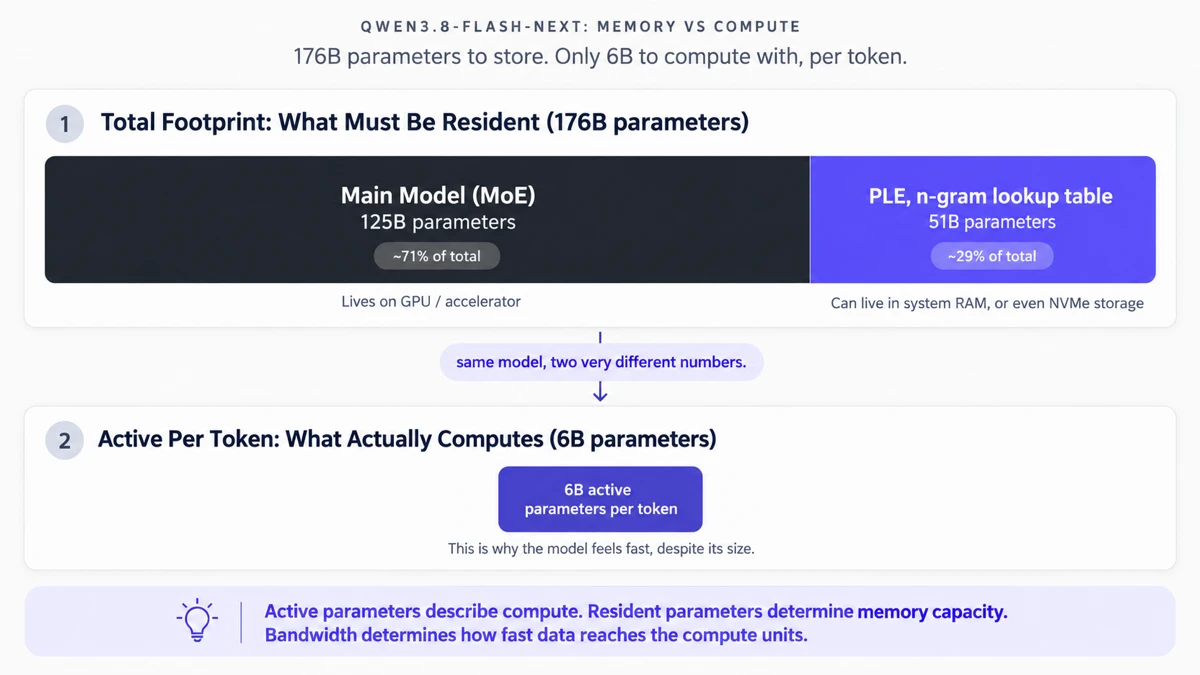
To size hardware for Qwen3.8-Flash-Next, you have to understand how its parameters are distributed. You cannot evaluate this model by looking at a single aggregate parameter count. It has a combined capacity of roughly 176B parameters, but that number is strictly partitioned:
- 125B main-model parameters: the core Mixture-of-Experts transformer layers responsible for reasoning and generation.
- ~51B PLE parameters: a specialized n-gram embedding lookup table, officially called the Prompt Lookup Engine.
- ~6B activated parameters per token: the actual weights engaged during a single forward pass for a given token.
Compute Sparsity vs Memory Capacity vs Memory Bandwidth
It is worth being explicit about the difference between these three things, since conflating them is the single most common mistake people make sizing hardware for this model.
Because the model uses an MoE architecture, only about 6B active parameters per token are used during generation. That is massive compute sparsity: the GPU performs relatively few matrix multiplications compared to a dense model of similar total size.
But do not mistake active parameters for memory requirements. Just because only ~6B parameters are active for any given token does not mean only ~6B parameters need to be stored or moved, since the router can call on a different set of experts for the next token. Memory capacity has to account for the entire resident model and runtime state, and memory bandwidth determines how fast the system can stream those dynamically selected parameters from RAM or VRAM into the compute units.
Gated DeltaNet, QSA, and the KV/State Memory
Context window scaling is normally a severe memory bottleneck in standard Transformers, since the Key-Value cache grows linearly with every token. Qwen3.8-Flash-Next uses a hybrid design instead: three out of every four layers use Gated DeltaNet (GDN), which continuously compresses history into a fixed-size recurrent state rather than storing a conventional per-token KV cache, while the remaining layer uses Qwen Sparse Attention (QSA), which indexes the sequence into micro-blocks and selectively attends to only the most relevant regions for precise long-range retrieval, rather than attending to every individual token.
Because of this, memory growth is architecture-dependent rather than equivalent to a standard Transformer's KV cache. It is not accurate to say the state "does not grow." State memory still scales with context length under GDN and QSA, just far more efficiently than conventional attention, and how much is allocated depends on the specific runtime implementation.
The Prompt Lookup Engine (PLE)
The ~51B parameter PLE is a large learned n-gram embedding table containing bigram and trigram entries. By matching input n-grams against this table, the model improves prompt comprehension and generation quality with relatively little additional computation. Because the PLE functions essentially as a massive dictionary rather than active reasoning weights, it does not need to reside in the most expensive, highest-bandwidth memory tier, which is the single design decision that makes local deployment of a 176B-class model even conceivable.
Offloading the PLE: Official Design vs Experimental Implementations
The defining challenge of running Qwen3.8-Flash-Next locally is managing the 51B-parameter PLE alongside the 125B main model.
Official Qwen Design
In the officially supported architecture, PLE/n-gram embeddings can be offloaded to host memory (system RAM). The GPU computes the MoE main model while the CPU and system memory handle n-gram lookups. Asynchronous prefetching is part of the intended design, letting the system look up upcoming n-grams while the GPU processes the current token, hiding the latency of the slower RAM path.
Experimental and Community Implementations
Because 51B parameters still require substantial memory capacity, community developers are actively exploring more extreme offloading techniques: NVMe/SSD-backed PLE storage, mmap-based PLE access, direct-read approaches that bypass the page cache, and experimental llama.cpp branches implementing all of the above. In these implementations, the PLE can be accessed directly from an NVMe drive, keeping system RAM free for the main model or other tasks. Qwen does not officially recommend or support running the PLE directly from an SSD, this remains a cutting-edge, community-driven effort, not part of the official design.
Demystifying mmap and SSD Behavior
When discussing experimental NVMe offloading, the term mmap (memory mapping) comes up constantly. A common misconception is that mmap perfectly loads only the exact requested bytes, always reads in tidy 4KB chunks, or effectively makes an SSD behave like RAM. None of that is true.
Actual I/O under mmap involves real OS-level behavior:
- Page faults: accessing unmapped memory triggers an interrupt that halts execution while the OS fetches the data.
- Page cache: the OS caches read pages in available system RAM, so repeat accesses to the same data are fast, but memory is still consumed dynamically as a result.
- Readahead and filesystem behavior: the OS often reads more data than requested, anticipating sequential access, which can waste bandwidth on the random-access patterns typical of MoE or PLE workloads.
- Implementation-specific prefetching: the application layer may issue its own additional reads on top of the OS's behavior.
Because the PLE involves highly scattered, random reads driven by user input, mmap can produce substantial read amplification: fetching one small embedding can pull an entire page or several pages, sharply reducing effective SSD bandwidth. This is exactly why current llama.cpp work on PLE access has investigated direct-read approaches that bypass mmap and the page cache entirely, rather than relying on ordinary mmap to solve the problem.
Memory Requirements and Storage Calculations
These are illustrative storage calculations, not guaranteed runtime memory requirements. Actual usage also depends on tensor layout, runtime buffers, state memory, PLE representation, and the specific implementation.
| Component | FP16 (theoretical) | INT8 (theoretical) | INT4 (theoretical) |
|---|---|---|---|
| Main model (125B) | ~250GB | ~125GB | ~62.5GB |
| PLE / n-gram table (51B) | ~102GB | ~51GB | ~25.5GB |
| Total parameter storage | ~352GB | ~176GB | ~88GB |
As a configuration-specific example: in a heavily quantized setup where the main model compresses to around 50GB and the PLE to around 25GB, the total file size on disk lands around 75GB. Runtime overhead on top of that will still require additional memory allocation beyond the raw file size.
Hardware Recommendations and Decision Framework
Because of the split architecture, generic hardware thresholds are not very useful here. Rather than chasing one specific GB number, use conditional guidance based on your actual configuration:
- More VRAM keeps more of the main model's computation on the accelerator, avoiding PCIe bottlenecks.
- More system RAM keeps more PLE and model data resident, avoiding costly page faults to disk.
- Faster memory bandwidth speeds up movement of resident data to the compute units, which matters a great deal for MoE architectures specifically.
- NVMe SSDs expand available capacity for experimental PLE offloading, at much higher latency than RAM.
When evaluating any specific hardware, it helps to distinguish between four different states, since "it works" can mean very different things:
- Can load: the model allocates successfully without an out-of-memory crash.
- Can generate tokens: the model produces text, even if painfully slowly.
- Interactive/usable: generation speed is fast enough for a human to comfortably read along, typically 5 to 10 tokens per second.
- High-performance inference: fast enough for automated agents, batch processing, or serving multiple users.
The Decision Framework
- If the PLE fits comfortably in RAM, keep it resident there. System RAM will always outperform hitting an SSD.
- If the main model fits but the PLE does not, storage-backed PLE access may help where supported by experimental community runtimes.
- If your configuration requires extensive paging of the main model itself, not just the PLE, performance may become impractical. Generating each token requires loading expert weights for that token; if those experts live on an SSD, generation will grind to a halt.
- More memory generally improves feasibility, but it does not guarantee throughput. 192GB of RAM will let you load the model; poor memory bandwidth will still cap your tokens per second.
Apple Silicon Considerations
Apple Silicon (the M-series, especially Max and Ultra variants) is popular for local inference because it uses unified memory, the CPU and GPU share the exact same physical memory pool, which means large unified-memory systems avoid moving data over a PCIe bus between separate system RAM and discrete VRAM.
Be wary of OS-level swap behavior, though. macOS is aggressive about swapping inactive memory to SSD, and that is a completely different mechanism from deliberate PLE storage offloading implemented in an inference engine's own code. Heavy OS swap can introduce substantial, unpredictable performance penalties. If a model exceeds your physical unified memory, do not count on macOS swap to provide a smooth experience, it was not designed for this workload.
NVIDIA GPU Considerations
For discrete NVIDIA GPUs, VRAM capacity and memory bandwidth are the primary limiting factors. MoE sparsity reduces the compute performed per token, but memory bandwidth and the movement of expert and model data can still become major bottlenecks in their own right.
If you split the 125B main model across multiple consumer GPUs, for example dual RTX 3090s or 4090s, you get around 48GB of high-bandwidth VRAM to work with. If the model is quantized to fit that VRAM, the GPUs can execute the MoE layers very quickly, but the system still has to manage the 51B PLE in system RAM. The speed at which your CPU and RAM can perform n-gram lookups and pass them over PCIe to the GPUs sets the real ceiling on your inference speed, not the GPUs alone.
NVMe SSDs in Inference
When experimenting with NVMe-backed PLE offloading, it helps to manage expectations around storage media specifically. SSD latency is far higher than RAM latency, and raw advertised IOPS figures are not sufficient to predict real inference performance. In practice, filesystem behavior, page cache overhead, read amplification, concurrency limits, prefetching logic, and the runtime's own implementation dominate actual throughput far more than a drive's theoretical spec sheet.
A faster PCIe Gen 5 SSD does not automatically produce proportionally faster tokens per second compared to a Gen 4 drive. The bottleneck is usually the software stack's ability to request data efficiently, not the drive's raw theoretical limits. SSD offloading expands your memory envelope; it does not turn an SSD into RAM.
Running with llama.cpp: Official vs Experimental
llama.cpp is at the forefront of supporting novel architectures like this one, but you need to be precise about which branch and flags you are actually using, since different features live in different places.
1. Normal model loading
For loading the entire quantized model (main model plus PLE) into standard RAM/VRAM, the standard upstream llama.cpp command pattern applies:
./llama-cli -m qwen3.8-flash-next-INT4.gguf -n 512 -ngl 992. Host-memory PLE offloading
If the main model is fully loaded into GPU VRAM (-ngl 99) but you want the CPU and system RAM to explicitly handle the PLE, check the documentation of your specific inference framework for its current tensor-split or offload-exclusion flags, since these are not yet standardized across runtimes.
3. Experimental NVMe-backed PLE
If you are using an experimental branch or fork of llama.cpp built specifically for direct-read, storage-backed PLE access, you may encounter fork-specific flags such as --model-ngram and --ngram-load-mode. An example of a configuration-specific experimental command, valid only on specific forks, not upstream:
./llama-cli -m qwen3.8-main-INT4.gguf --model-ngram qwen3.8-ple-INT4.gguf --ngram-load-mode direct -ngl 99Do not treat branch-specific commands like this one as universal upstream llama.cpp syntax. Community-provided GGUF quantizations from Unsloth are also available; verify the exact filename and quantization scheme you need against the current repository listing rather than assuming a specific file exists.
Reasoning and template generation settings, such as any reasoning-effort style flags, are strictly runtime- and version-dependent. Check the exact Qwen3.8 model template documentation for your chosen UI or runtime to see what is currently supported.
Performance and Benchmarks
Evaluating performance requires strict categorization. Do not compare incompatible benchmark configurations as though they are directly comparable.
Reference / official benchmarks
When reviewing official performance claims, note the exact source and configuration. Official benchmarks often run unquantized models on multi-node clusters with enterprise GPUs (for example 8x H100 80GB) using highly optimized tensor-parallel runtimes like vLLM or TensorRT-LLM, an entirely different regime from a single local machine.
Community / local benchmarks
For local setups, a community benchmark is only genuinely useful if it reports the full context. A trustworthy local benchmark should specify:
- Hardware: CPU model, GPU model, and motherboard PCIe generation.
- RAM: total capacity, type (for example DDR5-6000), and channel configuration.
- VRAM: total capacity available.
- Runtime/version: for example llama.cpp at a specific commit hash, MLX, or ExLlamaV2.
- Quantization: exact format and bit rate (for example Q4_K_M).
- PLE location: resident in VRAM, resident in RAM, or mmap/direct-read from NVMe.
- Context: the context size actually used during the test.
- Prefill/decode: prompt-processing speed and generation speed reported separately, not blended together.
If no reliable benchmark exists for your specific hardware category, for example a budget gaming laptop attempting an experimental NVMe branch, expect the system to successfully load the model but fail to reach interactive generation speeds.
Final Verdict
- Casual local user on a single consumer GPU: feasible only at reduced expectations. Expect to lean heavily on system RAM for the PLE and accept modest tokens-per-second, not high-performance serving.
- Apple Silicon or high-RAM workstation owner: the unified-memory or large-system-RAM path is the most practical route today, provided you quantize appropriately and are realistic about macOS swap behavior.
- Enthusiast willing to run experimental branches: NVMe-backed PLE offloading via community llama.cpp forks genuinely expands what's possible, but treat it as a moving target, verify flags and filenames against the current repository state every time, not against any single article, including this one.
Qwen3.8-Flash-Next's real achievement is architectural: separating a fast-reasoning 125B MoE core from a 51B lookup table that does not need to live in expensive memory. That split is what makes a 176B-class model even conceivable on non-datacenter hardware. It does not make it effortless, and the gap between "it loads" and "it performs well" is still real.
Frequently Asked Questions
Does the 6B active parameter count mean I only need a 6GB to 8GB GPU?
No. The 6B active parameter figure describes compute sparsity, how few calculations the GPU performs per token, not how much memory is needed. Memory capacity has to account for the weights actually loaded, KV/state memory, and runtime buffers, which is a much larger number than the active-parameter count.
I don't have enough RAM for the full model. Do I still need to store all those parameters?
The model totals roughly 176B parameters across its 125B main model and 51B PLE component, but they do not all have to be simultaneously resident in GPU memory. The PLE can be offloaded to system RAM in the official design, and experimental community implementations can access it from NVMe storage instead.
Can Qwen3.8-Flash-Next run on 12GB of VRAM?
Potentially, depending on the runtime, quantization, available system RAM, PLE placement, and what performance you consider acceptable. A 12GB GPU could hold a fraction of the MoE layers, with the rest of the main model and the PLE relying heavily on system RAM.
Does the KV cache consume all my memory on long prompts?
Qwen3.8-Flash-Next uses Gated DeltaNet and Qwen Sparse Attention instead of a conventional Transformer KV cache, so memory growth is architecture-dependent rather than growing the same way. It is substantially more efficient, but it still consumes state memory that scales with context length, it does not simply stay flat.
Will upgrading to a PCIe Gen 5 NVMe drive double my tokens per second over a Gen 4 drive?
Unlikely. A Gen 5 drive has higher theoretical bandwidth, but the bottleneck for NVMe-backed PLE offloading usually comes from read amplification, page fault latency, and queue depth limits in the OS and runtime, not raw drive throughput. SSD offloading expands capacity; it does not replace the latency profile of system RAM.
What is the PLE in Qwen3.8-Flash-Next?
PLE stands for Prompt Lookup Engine, a roughly 51-billion-parameter learned n-gram embedding table that matches input n-grams to improve comprehension and generation quality with relatively little added computation. Because it functions like a large lookup dictionary rather than active reasoning weights, it does not need to live in the most expensive high-bandwidth memory tier.