AI Infrastructure
vLLM vs SGLang vs llama.cpp: Architecting Production LLM Inference
Three engines, three different bottlenecks. Picking the wrong one looks fine in a demo and falls over under load.
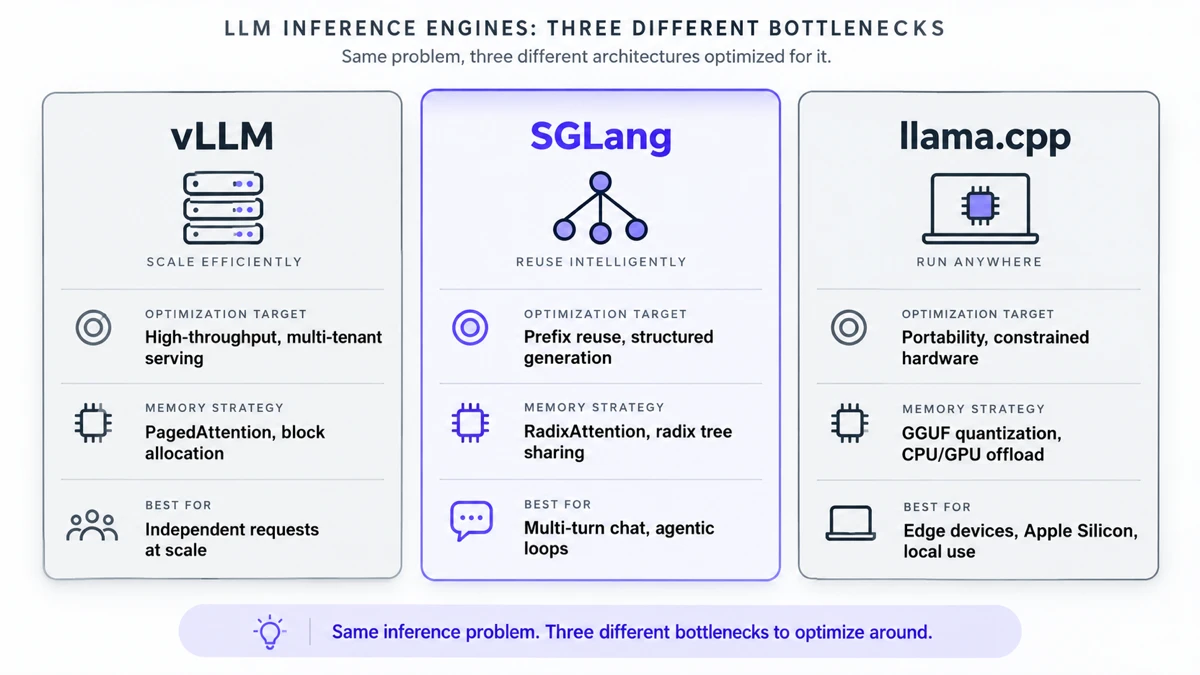
- These three engines optimize for different bottlenecks, not the same one. vLLM targets high-throughput multi-tenant serving, SGLang targets prefix reuse and structured generation, and llama.cpp targets portability and constrained hardware.
- vLLM's PagedAttention and SGLang's RadixAttention solve overlapping but different problems. Paging minimizes memory fragmentation; the radix tree maximizes structural prefix sharing.
- Continuous batching and chunked prefill are not the same mechanism. One decides which requests are running; the other decides how a large prompt's compute gets sliced so it doesn't stall everyone else.
- Prefix caching saves compute, not memory. A shared system prompt still has to sit in VRAM for the sharing to work at all.
- Raw tokens/sec is not a production metric. Goodput, throughput sustained while staying under your latency SLA, is what actually matters.
- There is no universal winner. The right engine is whichever one's memory management and scheduling match your actual workload's concurrency and prefix-overlap profile.
- Why Inference Engines Matter
- Three Engines, Three Design Philosophies
- Core Comparisons: The Trade-offs
- Prefill and Decode: The Physics of Inference
- The KV Cache: State Management
- Scheduling: Continuous Batching vs Chunked Prefill
- The Economics of Prefix Reuse
- PagedAttention vs RadixAttention
- vLLM: Architecture and When to Use It
- SGLang: Architecture and When to Use It
- llama.cpp: Architecture and When to Use It
- High-Concurrency Dynamics
- Benchmarking: The Throughput-Latency Frontier
- Production Decision Matrix
- A Practical Benchmarking Methodology
- Common Mistakes
- Conclusion
- Frequently Asked Questions
Why Inference Engines Matter
Deploying large language models turns from a machine-learning problem into a systems-engineering problem the moment multiple requests start sharing a model. Evaluating model accuracy is about weights and training data. Production LLM serving is fundamentally about memory management, hardware utilization, and latency, an entirely different discipline.
Running an LLM locally for single-user experimentation, the main constraint is fitting the model weights into available memory. In production, weights are only the baseline footprint. As concurrency rises, the KV cache, batch scheduling, prefill processing, decode execution, and memory fragmentation become the real operational bottlenecks. A local model runner and a production inference server optimize for different things: the former prioritizes hardware portability and minimal resource use, the latter prioritizes sustained throughput, latency guarantees under load, and multi-tenant isolation.
Three Engines, Three Design Philosophies
The open-source inference ecosystem has several robust engines, but three occupy overlapping yet meaningfully distinct design spaces:
- vLLM: a serving engine optimized for high-throughput GPU inference, built around virtualized, paged memory management for LLM context.
- SGLang: a serving architecture explicitly optimized for structured generation, deep prefix reuse, and efficient execution of multi-turn and agentic workflows.
- llama.cpp: a highly portable inference framework with extensive support for constrained hardware, edge computing, CPU/GPU heterogeneous execution, and aggressive model quantization.
Choosing an engine means matching its execution architecture and memory-management strategy to the target workload. Throughput numbers from synthetic benchmarks do not automatically translate into production goodput. One mental model governs the whole selection: prefill and decode create different bottlenecks, the KV cache determines memory pressure, scheduling dictates how concurrent requests compete, and prefix reuse changes the economics of repeated context.
| Dimension | vLLM | SGLang | llama.cpp |
|---|---|---|---|
| Primary optimization focus | High-throughput, multi-tenant serving | Prefix reuse, agentic loops, structured generation | Portability, edge inference, minimal footprint |
| Typical deployment hardware | Datacenter GPU clusters | Datacenter GPU clusters | Apple Silicon, consumer GPUs, CPUs, edge devices |
| KV-cache memory management | Paged block allocation (PagedAttention) | Radix-tree structured allocation (RadixAttention) | Contiguous or ring-buffer allocation |
| Prefix caching support | Automatic Prefix Caching (APC) | Native structural sharing via radix tree | Explicit prompt-caching mechanisms |
| Continuous batching | Core architectural mechanism | Supported | Supported (via llama-server) |
| Chunked prefill | Supported | Supported | Supported |
| Quantization ecosystems | AWQ, GPTQ, FP8, Marlin kernels | AWQ, FP8, GPTQ | Native GGUF, extensive integer K-quants |
| Multi-GPU topologies | Tensor & Pipeline Parallelism | Tensor Parallelism | Layer splitting / RPC distribution |
| Heterogeneous execution | Supported, heavily GPU-biased | Strongly GPU-optimized | Core design principle (CPU/GPU offload) |
Core Comparisons: The Trade-offs
vLLM vs SGLang
The choice generally centers on how the workload interacts with the KV cache. Both are datacenter-oriented GPU serving frameworks. vLLM is frequently used for general-purpose, multi-tenant API serving where requests are largely independent, its paged memory management excels at minimizing fragmentation to sustain high batch sizes. SGLang is designed around structural prefix sharing and frontend-backend co-design, and can provide substantial advantages when the workload leans on multi-turn conversations, agentic reasoning loops, or strict structured generation such as JSON.
vLLM vs llama.cpp
This is a choice between centralized throughput and distributed portability. vLLM is built for datacenter GPUs using high-bandwidth interconnects to maximize aggregate tokens per second across thousands of users. llama.cpp is engineered for flexibility, relying on the GGUF format and aggressive integer quantization, making it relevant for constrained hardware, Apple Silicon, or heterogeneous CPU/GPU setups where full model residency in VRAM is impossible.
SGLang vs llama.cpp
This contrasts a prefix-optimized server with a resource-constrained execution engine. If a team is deploying an autonomous agent platform on centralized datacenter GPUs, SGLang's ability to natively deduplicate an agent's system prompt across hundreds of concurrent reasoning loops offers real VRAM efficiency. If that same agent needs to run locally on a MacBook or edge device, llama.cpp's hardware integrations and memory mapping take precedence over structural prefix caching.
Prefill and Decode: The Physics of Inference
Understanding how these engines differ requires understanding how LLM inference is physically executed and measured. Inference has two distinct phases.
The Prefill Phase (prompt processing)
When a request arrives, the engine processes the input prompt to establish attention context before generating anything new.
- Computation: tokens in the input prompt are processed simultaneously, executing large matrix-matrix multiplications.
- Bottleneck: because it multiplies large activation matrices against the model weights, prefill is often compute-bound for sufficiently large prompts or batch sizes, heavily utilizing the GPU's tensor cores.
- Measurement (TTFT): Time to First Token, the span from request arrival to the first output token, including network latency, queueing, scheduler overhead, and prefill compute itself.
The Decode Phase (autoregressive generation)
After prefill, the model generates the response one token at a time.
- Computation: the previously generated token is appended to context and a forward pass predicts the next token. To generate a single token, the engine typically has to load the model's weight matrices from GPU High Bandwidth Memory into the compute cores.
- Bottleneck: because the math per token is small relative to the data movement required to load the weights, decode is usually memory-bandwidth-bound.
- Measurement (TPOT): Time Per Output Token, the average duration to generate each subsequent token. Inter-token latency is a related but distinct metric measuring the exact gap between successive tokens, which can jitter, where TPOT is typically an average over the full sequence.
The KV Cache: State Management
To avoid recalculating self-attention scores for every previous token on every decode step, engines cache the Key and Value tensors, the KV cache.
The KV cache footprint grows linearly with sequence length. Its memory pressure is dictated by batch size, context length, model architecture, and precision format (FP16, FP8, and so on). Naive implementations allocated one contiguous block of memory sized for a request's maximum possible sequence length, causing severe internal fragmentation and bottlenecking concurrency well before hardware limits were reached. Modern architectures exist specifically to solve this capacity constraint.
Scheduling: Continuous Batching vs Chunked Prefill
To maximize hardware utilization, engines batch requests together. Static batching, waiting for a fixed group of requests before processing, wastes compute on sequences of differing lengths. Modern engines use more advanced scheduling instead, and it's worth being precise about two frequently conflated concepts.
Continuous batching (execution scheduling)
Continuous batching, or in-flight batching, controls which sequences run together across successive iterations.
- When a request finishes generating, the scheduler immediately ejects it from the active batch.
- A new request from the waiting queue is dynamically slotted into the vacated capacity for the next decode iteration.
- This keeps hardware from idling on length mismatches. It increases overall throughput and utilization, but does not by itself guarantee low latency for any individual request, it optimizes batch density, not per-request speed.
Chunked prefill (workload partitioning)
Chunked prefill controls how large prompt-processing work is partitioned so it can coexist with other work.
- If a server is actively decoding a batch and a new request arrives with a 50,000-token prompt, processing that prompt in one forward pass could monopolize the GPU, starving concurrently decoding requests and spiking their TPOT.
- Chunked prefill splits the prompt into smaller segments, for example 2,048-token chunks.
- The engine schedules a prefill chunk alongside the decode iterations of the active batch. This protects existing requests' TPOT but intentionally increases the new request's own TTFT, since its prefill now needs multiple scheduling cycles to finish.
Continuous batching decides batch membership. Chunked prefill bounds compute interference. They solve related but genuinely different problems.
The Economics of Prefix Reuse
In production, completely unique, zero-context prompts are rare. Workloads routinely feature repeated system prompts, multi-turn chat histories, or shared RAG documents.
A practical example:
- Request A: [System prompt: You are a helpful AI coding assistant...] [User: How do I write a Python loop?]
- Request B: [System prompt: You are a helpful AI coding assistant...] [User: Explain the Rust borrow checker.]
- Request C: [System prompt: Translate the following to French...] [User: Hello world.]
When Request A arrives, the engine prefills the entire sequence and stores the K and V tensors in the KV cache. When Request B arrives, an engine with prefix caching recognizes the system prompt is identical to Request A's, skips the prefill matmuls for those tokens, and links Request B to the already-cached tensors, computing prefill only for the new user turn. Request C shares no prefix with the others, so its prefill runs in full.
Compute savings: skipping prefill execution frees the tensor cores, lowering TTFT for Request B and freeing cycles for other requests. Memory reality: prefix caching saves compute time, not memory, the cached KV tensors still occupy VRAM, and the engine has to retain the system prompt in memory for the sharing to work at all.
If the system prompt is 10,000 tokens long, prefix caching changes the economics of the workload substantially. But caching only works up to the point of divergence: insert something like a unique timestamp at the start of the system prompt and the sequences diverge immediately, breaking structural sharing entirely.
PagedAttention vs RadixAttention
Both vLLM and SGLang manage KV-cache state and can exploit prefix reuse, but they were built to solve overlapping, not identical, problems.
vLLM: paged block allocation
vLLM was built to address memory utilization and dynamic sequence growth. Its foundational mechanism, PagedAttention, adapts virtual-memory paging concepts to LLM serving.
- It divides the KV cache into fixed-size physical blocks, for example 16 tokens per block.
- Rather than allocating contiguous memory, vLLM allocates blocks dynamically as a sequence grows, mapped logically through a block table.
- This nearly eliminates internal fragmentation, letting the scheduler admit more concurrent requests and sustain higher batch sizes.
- Prefix caching in vLLM: Automatic Prefix Caching (APC) hashes the content of these blocks; if an incoming sequence's block hash matches one already in memory, it reuses it.
SGLang: radix-tree structured allocation
SGLang was explicitly designed around the assumption that modern workloads rely heavily on shared context. Its memory manager, RadixAttention, works differently.
- It structures the KV cache across the whole server as a radix tree, a compressed trie where nodes represent sequences of tokens.
- When a request arrives, SGLang traverses the tree to find the longest matching prefix.
- Structural sharing is native to how the engine allocates memory in the first place, rather than a hash lookup bolted onto a block allocator, and it natively deduplicates overlapping prefixes across requests.
vLLM's architecture centers on dynamic block allocation to maximize multi-tenant concurrency and memory utilization, with APC added on top of that foundation. SGLang's architecture is built from the ground up around structural sharing of reusable prefixes. Neither universally supersedes the other; a workload with zero prefix overlap will lean on continuous batching and fragmentation management, while a workload with massive prefix overlap will stress-test the efficiency of cache eviction and sharing.
vLLM: Architecture and When to Use It
vLLM is mature serving infrastructure widely used for large-scale, general-purpose API endpoints. Built in Python and C++, it relies on heavily optimized CUDA and Triton kernels.
- Serving architecture: an asynchronous event loop handling thousands of concurrent network connections, interfacing with a tightly tuned execution engine.
- Parallelism: extensive support for Tensor Parallelism (splitting weight matrices across GPUs) and Pipeline Parallelism (splitting model layers across GPUs or nodes), essential for 70B+ parameter models.
- Modern enhancements: chunked prefill, robust APC, and speculative decoding support (EAGLE, Medusa) to accelerate decode when compute headroom exists.
- API compatibility: an OpenAI-compatible HTTP server that drops into existing reverse proxies, load balancers, and observability stacks.
When to evaluate vLLM: when architecting high-concurrency GPU serving layers or standardizing multi-tenant API endpoints where requests are largely independent. When the goal is maximizing aggregate tokens/sec across a diverse user base while keeping latency bounded, vLLM's scheduler is a well-proven, resilient choice.
SGLang: Architecture and When to Use It
SGLang (Structured Generation Language) is both a frontend language for complex prompting and a high-performance backend runtime.
- Frontend integration: native primitives (
fork,join,select,gen) for programmatic prompt orchestration that compile down to optimized backend execution. - Structured generation: specialized optimizations for constrained decoding, for example enforcing a JSON schema. It uses compressed finite state machines to accelerate constraint validation, cutting overhead typically associated with logit-masking regex processors.
- Scheduling and execution: continuous batching, chunked prefill, and RadixAttention, running on advanced Triton kernels including optimizations for models with specialized attention mechanisms.
- Parallelism: Tensor Parallelism for multi-GPU execution.
When to evaluate SGLang: when the workload has substantial prefix overlap. For applications dominated by multi-turn conversation, RAG systems querying shared documents, or agents running deep reasoning loops, RadixAttention compresses the VRAM footprint and cuts redundant prefill compute. It's also a strong fit when strict JSON output is required at scale.
llama.cpp: Architecture and When to Use It
llama.cpp started as a lightweight project for running models on Apple Silicon and has matured into a genuinely versatile inference framework built around portability and resource constraints.
- GGUF and quantization: built around the GGUF file format and an extensive set of integer K-quantizations. Quantizing weights, and optionally the KV cache, dramatically cuts the memory bandwidth needed during decode.
- Heterogeneous execution: a defining feature is seamlessly offloading specific layers to available GPUs while running the rest on CPU and system RAM.
- Memory mapping: relies on mmap for model loading, handing memory paging off to the OS. This runs especially efficiently on Unified Memory Architectures like Apple's M-series chips.
- Server capabilities: the llama-server binary supports continuous batching, parallel decoding, and an OpenAI-compatible API.
- Multi-GPU support: layer splitting (pipeline-style distribution) and RPC-based distributed inference across machines.
When to evaluate llama.cpp: for local inference, edge devices, desktops, and any deployment facing real GPU memory constraints. If VRAM is limited and the goal is running a large model anyway, heterogeneous CPU/GPU offloading can make the deployment feasible at all. It's a strong default for Apple Silicon specifically, thanks to its Metal backend. As request concurrency and multi-tenant demand scale up, though, engines relying on standard memory allocation tend to hit fragmentation and queueing bottlenecks earlier than engines built around paged memory management.
High-Concurrency Dynamics
Moving from low-concurrency testing to high-concurrency production shifts the system bottleneck entirely. At scale, the constraint moves from the model's raw compute requirements to memory capacity and scheduler efficiency.
- KV-cache pressure: at high concurrency, total KV cache can easily exceed the model weights' own memory footprint. Without efficient block allocation, fragmentation causes premature capacity exhaustion.
- Queueing dynamics: a system near peak capacity will show queueing delays, and a single massive prefill request can stall the whole execution pipeline.
- Admission control: serving engines have to enforce strict admission control. Accepting requests beyond physical KV-cache capacity forces a choice between preempting active sequences (swapping to CPU memory, which devastates latency) or dropping requests outright.
Evaluating an engine purely on raw tokens/sec is not enough for production planning. High throughput achieved by starving a subset of users in the queue produces unacceptable tail latency, even if the average number looks great.
Benchmarking: The Throughput-Latency Frontier
As concurrent requests increase, an engine can batch more efficiently, aggregate throughput rises, and utilization improves. As the system approaches saturation, though, it can no longer keep the queue empty. Past that inflection point, throughput may plateau while queueing delay causes latency (TTFT and p99 TPOT) to rise exponentially.
The goal of benchmarking is not to find the maximum possible throughput in a vacuum, it's to find the maximum throughput the engine can sustain while staying under your latency SLA. That number is goodput.
| Metric | What it tells you |
|---|---|
| TTFT (Time to First Token) | How quickly a request starts producing output, including queueing and prefill. |
| TPOT (Time Per Output Token) | Streaming generation responsiveness and decode efficiency. |
| Requests/sec | Request-level capacity of the server. |
| Output tokens/sec | Aggregate generation capacity, raw throughput. |
| p95 / p99 latency | Tail-user experience; reveals latency variance and compute starvation. |
| KV-cache usage | Memory pressure, fragmentation efficiency, concurrency headroom. |
| Prefix-cache hit rate | Effectiveness of repeated-context reuse, critical for agentic workloads. |
| OOM / rejected requests | The capacity boundary and admission-control behavior. |
| Goodput | Useful aggregate work completed while meeting the defined latency SLA. |
Production Decision Matrix
Infrastructure selection means mapping workload characteristics to potential bottlenecks. Don't look for a universal winner, use this to decide which capabilities actually need evaluating.
| Workload | Primary bottleneck | Evaluate | Worth benchmarking |
|---|---|---|---|
| High-concurrency API, independent requests | Multi-tenant queueing, KV-cache fragmentation | Paged block allocation, batching efficiency | vLLM |
| High prefix reuse (agents, multi-turn chat) | Repeated prefill compute is expensive | Prefix-cache hit rate, cache eviction | SGLang, vLLM |
| Strict hardware constraints, low VRAM | Model cannot fit entirely in GPU memory | CPU/GPU layer offloading, integer quantization | llama.cpp |
| Structured JSON generation | Output validation slows decode | Finite-state-machine integration, constrained decoding | SGLang |
| Apple Silicon (Mac) deployment | Using unified-memory bandwidth efficiently | Metal optimization, memory mapping | llama.cpp |
| Massive-scale distributed serving | Model requires distribution across nodes/GPUs | Tensor/Pipeline Parallelism, interconnect bandwidth | vLLM, SGLang |
A Practical Benchmarking Methodology
To generate defensible data for an architecture decision, run a reproducible methodology on your target hardware.
- Define workload profiles. Build synthetic workloads that mirror production traffic instead of using generic datasets: an API profile (short independent inputs, short outputs), a RAG/summarization profile (long-context inputs, short outputs), and an agentic profile (heavy prefix reuse, repeated instructions with minor variations).
- Define concurrency thresholds. Benchmark across a spread of concurrency levels, for example 1, 8, 16, 32, 64, 128 concurrent users, and find the exact level where throughput plateaus and p99 latency degrades.
- Measure rigorously. Use dedicated load-testing tools (vLLM's own benchmark_serving, or the SGLang benchmarking suite) to capture TTFT, TPOT, p99 latencies, and total goodput. Track cache hit rates specifically for prefix-heavy tests.
- Run sustained load tests. A 30-second benchmark won't reveal production realities. Run for at least 15 to 30 minutes to expose queue accumulation, cache exhaustion, OS-level swapping, and thermal throttling.
- Evaluate state dynamics. Compare cold-start performance against warm-cache performance to properly assess the real impact of prefix caching and RadixAttention.
Common Mistakes When Selecting an Inference Engine
- Relying on synthetic maximums: assuming a GitHub repo's peak tokens/sec figure translates to multi-tenant API performance under your specific workload.
- Ignoring p99 latency: focusing entirely on average (p50) TPOT while a subset of users experiences severe generation stalls from request interference.
- Conflating throughput with user experience: running massive batch sizes without tuning chunked prefill, producing unacceptable TTFT/TPOT variance.
- Disregarding prefix economics: paying full compute cost for heavily repeated prompts by never evaluating a prefix-caching architecture.
- Scaling the wrong architecture: taking a low-concurrency prototype straight into a high-concurrency cloud API without accounting for the different memory-management design that requires.
- Ignoring software velocity: basing a decision on benchmarks published six months earlier, in a space where kernel-level optimizations ship constantly.
Conclusion
The open-source LLM inference ecosystem has genuinely specialized frameworks, each built for a distinct deployment reality.
vLLM provides a robust, scalable architecture built for production GPU serving. Its paged memory management and dynamic continuous batching are designed to sustain high throughput across multi-tenant workloads, making it a strong default for centralized infrastructure.
SGLang shifts the optimization target toward workload-aware execution. RadixAttention changes the operational economics of agentic loops, multi-turn chat, and structured generation, yielding real efficiency gains wherever prompt structure repeats.
llama.cpp provides deployment flexibility. Quantization support and heterogeneous memory offloading make sophisticated model execution possible on constrained hardware, edge environments, and unified-memory systems where a traditional datacenter stack simply cannot run.
Selecting an inference engine is an exercise in systems engineering, not a popularity contest. The correct architecture is whichever one's memory management, scheduling logic, and hardware support actually match your workload's constraints and concurrency profile.
Frequently Asked Questions
What is the difference between vLLM and SGLang?
Both are GPU-accelerated serving engines, but vLLM focuses on maximizing multi-tenant throughput via paged block allocation (PagedAttention), while SGLang is architected around structural prefix sharing (RadixAttention) to heavily optimize workloads with repeated context, such as multi-turn chat and agentic loops.
What is the difference between vLLM and llama.cpp?
vLLM is designed for centralized, multi-GPU datacenter environments serving high volumes of concurrent requests with maximal throughput. llama.cpp is optimized for portability, constrained hardware, and edge deployment, using aggressive quantization and CPU/GPU offloading to run models on hardware that lacks the VRAM for full GPU residency.
Is llama.cpp suitable for production inference?
It depends on the environment. It is highly suitable for single-user local applications, edge deployments, and constrained hardware. For massive multi-tenant cloud APIs handling hundreds of concurrent users, engines built explicitly around paged memory pools and high-concurrency schedulers are generally evaluated first.
When does prefix caching matter?
Prefix caching matters significantly when a workload involves repeated context, such as a large system prompt sent with every user message, multi-turn conversation histories, or shared retrieval documents. It reduces Time to First Token by skipping redundant prefill computation on the shared portion.
What is the difference between PagedAttention and RadixAttention?
PagedAttention (vLLM) manages the KV cache through virtual-memory-style paging, using non-contiguous physical blocks to minimize VRAM fragmentation. RadixAttention (SGLang) structures the KV cache natively as a shared tree, prioritizing physical sharing of overlapping token sequences across different requests.
Does SGLang always outperform vLLM?
No, performance is workload-dependent. SGLang can provide real architectural advantages for workloads with heavy prefix overlap or strict JSON generation. For general-purpose endpoints with independent, non-overlapping requests, performance is often comparable, and vLLM's mature scheduling ecosystem may be preferred.
Does llama.cpp support concurrent requests?
Yes. The llama-server backend supports continuous batching and parallel decoding, letting it serve concurrent requests, though its memory architecture still differs meaningfully from datacenter-first frameworks like vLLM and SGLang.
What should I measure when benchmarking inference engines?
Do not measure only raw throughput in tokens per second. Measure Time to First Token, Time Per Output Token, prefix-cache hit rate, and specifically p95/p99 tail latency under sustained concurrent load, since that combination is what determines real production goodput.