Distributed Quantum Systems
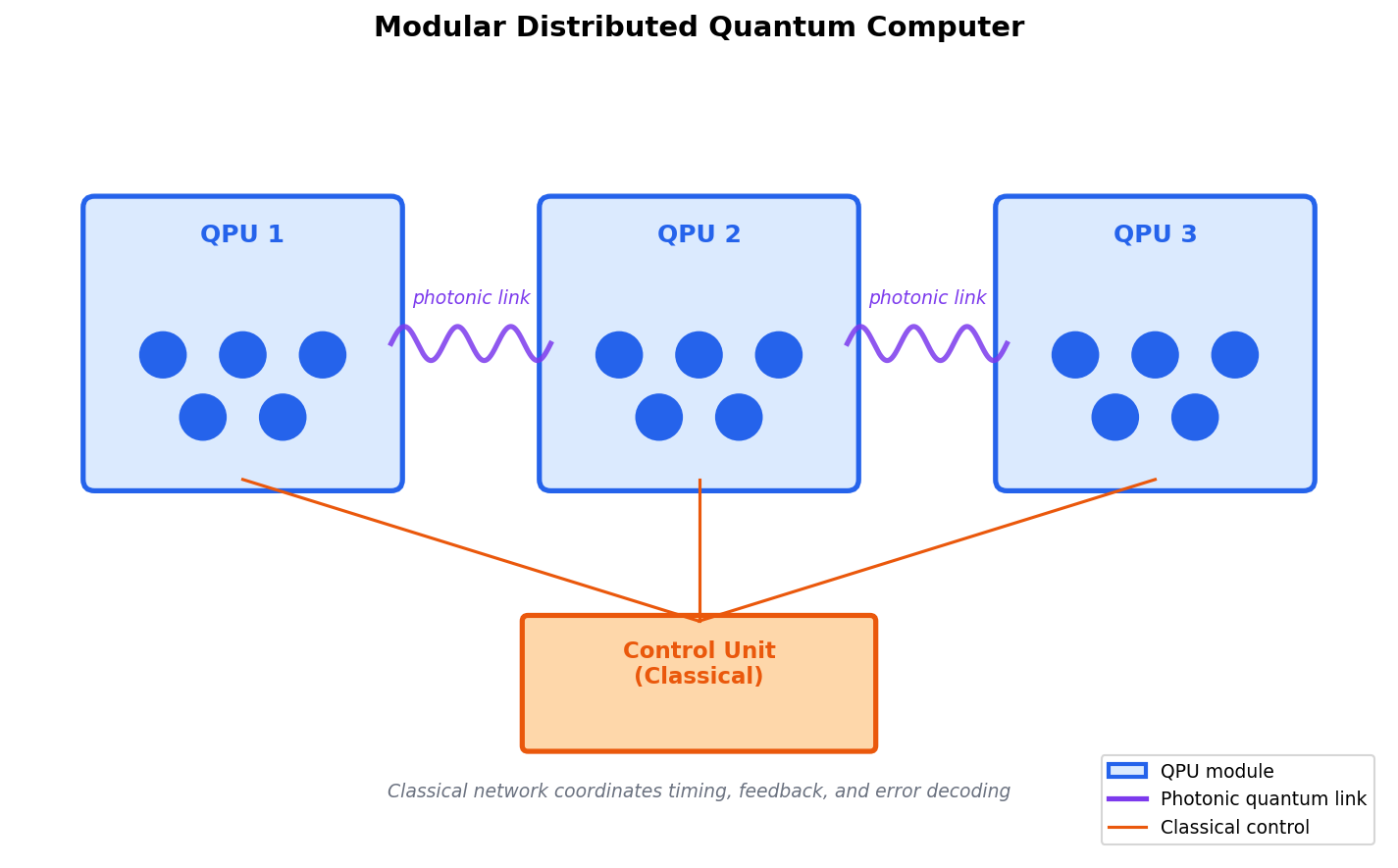
Distributed quantum computing links multiple QPUs via quantum networks for horizontal scaling beyond single-chip limits
Source: mortalapps.com- Distributed Quantum Computing (DQC) links multiple independent QPUs to act as a single logical machine.
- DQC enables horizontal scaling, bypassing the physical, thermal, and wiring limits of a single chip.
- Remote gates are executed using the teledialing (gate teleportation) protocol, requiring no physical movement of qubits.
- Teledialing consumes one shared Bell pair and requires two bits of classical communication.
- The fidelity of a remote gate is strictly limited by the fidelity of the shared entanglement link.
- Modular QPUs can be housed in separate dilution refrigerators, connected by optical fiber buses.
- Modularity is the primary engineering path on the roadmaps of IBM, IonQ, Quantinuum, and PsiQuantum.
Why This Matters
Once we have the technology to connect quantum processors via quantum networks, we can build Distributed Quantum Systems. In classical computing, we reached the physical limits of single-core CPUs decades ago, leading to the development of multi-core processors and massive distributed supercomputers. Quantum computing is following the exact same evolutionary path. Instead of trying to pack millions of physical qubits onto a single, massive chip, we can link multiple smaller Quantum Processing Units (QPUs) together to act as a single, powerful machine.
This distributed architecture is the key to horizontal scaling. It allows us to build modular quantum computers where each module is housed in its own dilution refrigerator, connected to other modules by high-speed quantum communication channels. However, executing quantum gates across different physical chips requires highly sophisticated protocols to maintain entanglement and coherence across the boundaries.
In this topic, we will explore the architecture of distributed quantum computing (DQC). We will analyze the teledialing protocol, the mechanism used to execute remote gates between separate QPUs, and examine the fidelity requirements for inter-QPU links. You will learn how modularity solves the physical scaling limits of single-chip systems and enables utility-scale quantum computing.
Core Intuition
To understand distributed quantum computing, imagine a large, complex puzzle that needs to be solved by a team of architects. If you force all the architects to sit around a single, tiny desk, they will constantly bump elbows, drop pencils, and get in each other's way. The physical space of the desk limits their productivity, no matter how smart they are.
To solve this, you can give each architect their own spacious desk in separate rooms. To collaborate, they use a high-speed, instant video conferencing system. They can share drawings, discuss ideas, and work together as a single, highly efficient team without any physical crowding. This is a distributed system.
In a quantum computer, the 'desk' is the physical chip inside the dilution refrigerator. If we try to pack 1,000,000 qubits onto one chip, the electromagnetic crosstalk, wiring congestion, and heat will ruin the computation. By separating the qubits into modular QPUs, each with its own 'desk' and cooling system, and connecting them with high-speed optical 'video links' (entangled channels), we can scale the system indefinitely without crowding the physical hardware.
Visualization
Technical Explanation
The fundamental operation in a distributed quantum computer is the Remote Gate (or non-local gate), which allows a qubit in QPU A to interact with a qubit in QPU B without physically moving them. This is achieved using a protocol called Teledialing (or gate teleportation).
Suppose we want to execute a CNOT gate between control qubit $C$ in QPU A and target qubit $T$ in QPU B. The QPUs are physically separated but share a pre-distributed Bell pair of communication qubits ($A$ and $B$):
$$|\Phi^+\rangle_{AB} = \frac{1}{\sqrt{2}}(|00\rangle + |11\rangle)_{AB}$$
where QPU A holds qubit $A$ and QPU B holds qubit $B$. To execute the remote CNOT, we run the following local operations and classical communication (LOCC) protocol:
1. In QPU A, apply a local CNOT gate between the control qubit $C$ and the communication qubit $A$. 2. In QPU B, apply a local CNOT gate between the communication qubit $B$ and the target qubit $T$. 3. In QPU A, measure the communication qubit $A$ in the $X$-basis (by applying a Hadamard gate and measuring in the computational basis), obtaining result $m_x \in \{0, 1\}$. 4. In QPU B, measure the communication qubit $B$ in the $Z$-basis, obtaining result $m_z \in \{0, 1\}$. 5. Alice and Bob exchange their measurement results classically. 6. If $m_x = 1$, Bob applies a $Z$ gate to the target qubit $T$. 7. If $m_z = 1$, Alice applies an $X$ gate to the control qubit $C$.
This protocol successfully executes the logical CNOT gate between the remote qubits $C$ and $T$, consuming one Bell pair and two bits of classical communication. The effective fidelity of this remote gate is directly bounded by the fidelity of the shared Bell pair: $F_{\text{remote}} \approx F_{\text{Bell}} \times F_{\text{local}}^2$.