Quantum Networking Basics
Quantum networks transmit entanglement across distances, requiring quantum repeaters as No-Cloning forbids amplification
Source: mortalapps.com- Quantum Networks transmit quantum states, superposition, and entanglement across physical distances.
- The No-Cloning Theorem prevents the use of standard optical amplifiers, making quantum repeaters necessary.
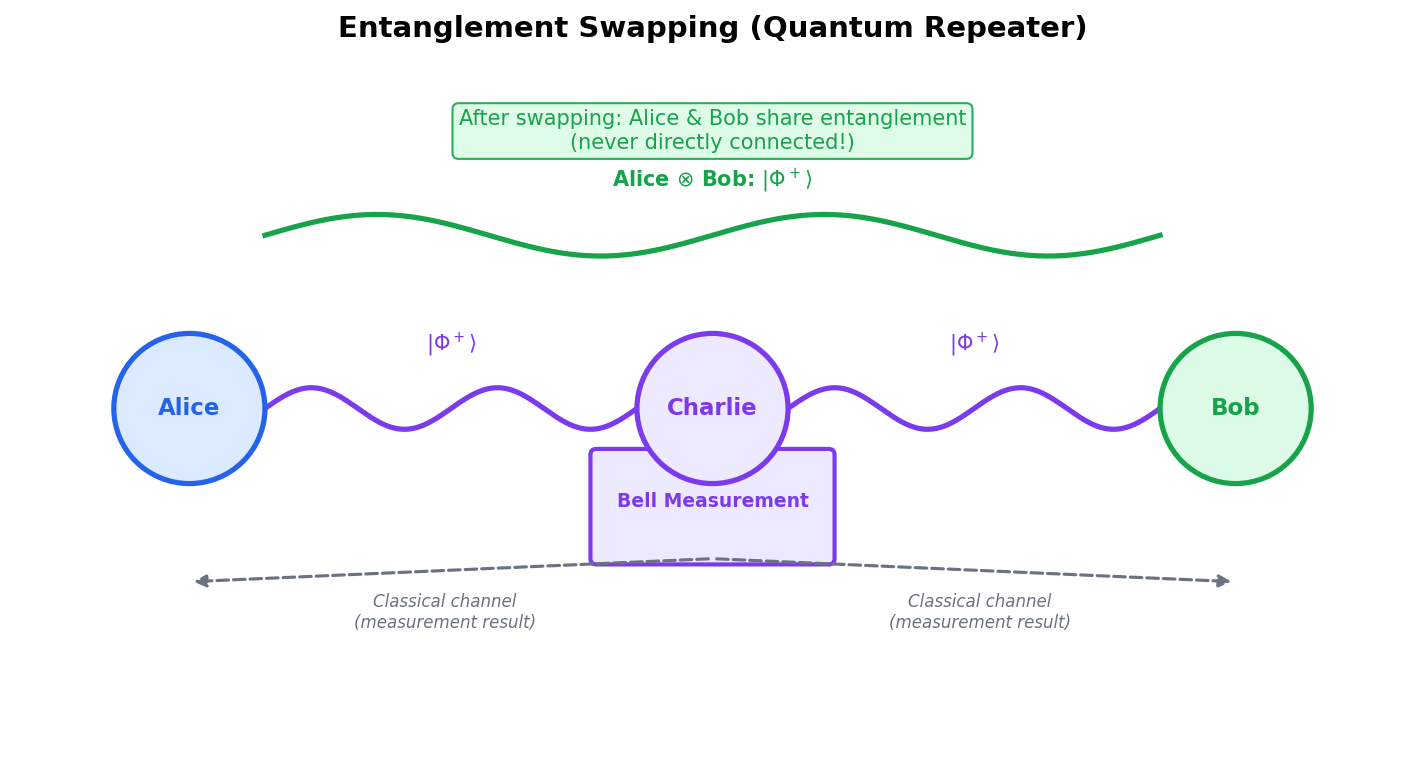
- Entanglement Swapping uses Bell state measurements at intermediate nodes to link independent entangled pairs.
- Quantum Repeaters divide a long-distance link into shorter segments, beating the exponential loss of optical fibers.
- Quantum memories are required to store quantum states while classical routing signals travel along the network.
- Quantum networking does not enable faster-than-light communication, as classical signals are still required for decoding.
- The primary near-term application of quantum networking is Quantum Key Distribution (QKD) for unbreakable security.
Why This Matters
As we look beyond the limits of a single quantum processor, we must explore how to connect multiple quantum systems together. Just as classical computers achieved their true potential when linked into local networks and the global Internet, quantum computers will require quantum networks to scale. A quantum network does not transmit classical bits (0s and 1s); it transmits quantum states, superposition, and entanglement across physical distances.
This task is fundamentally different from classical networking. We cannot amplify a quantum signal using standard optical amplifiers because the No-Cloning Theorem prevents us from copying an unknown quantum state. Instead, we must use the laws of quantum mechanics, specifically quantum entanglement and Bell state measurements, to transmit quantum information without loss. This is the domain of Quantum Networking.
In this topic, we will explore the foundational physics of quantum networking. We will analyze the Entanglement Swapping protocol, the mechanism used to distribute entanglement over long distances, and examine the architecture of Quantum Repeaters, which overcome the exponential loss of photons in optical fibers. This topic will introduce the core technologies that will power the future Quantum Internet.
Core Intuition
To understand quantum networking, imagine a classic 'bucket brigade' used to put out a fire. If a single person tries to carry a bucket of water from a well to a burning house miles away, the water will splash out and evaporate long before they arrive. To solve this, a line of people stands between the well and the house, passing the bucket from hand to hand. The water arrives safely because it is transferred in short, controlled steps.
In a quantum network, we cannot 'pass' the quantum state directly because photons are easily absorbed or scattered by optical fibers over long distances. Instead of passing the state, we use a quantum bucket brigade called a Quantum Repeater. We place intermediate stations along the fiber link. Each station generates local entanglement with its neighbors, and by performing a specialized measurement in the middle, we 'swap' the entanglement, stretching it across the entire distance. Once entanglement is established between the endpoints, we can transmit our quantum data instantly using quantum teleportation.
Another helpful analogy is a translation relay. If a speaker of Japanese wants to communicate with a speaker of Spanish, but they cannot find a single translator who speaks both languages, they can use an intermediate translator who speaks both Japanese and English, and another who speaks English and Spanish. By translating through the intermediate 'nodes', the message is successfully transmitted. Entanglement swapping is that translation step, linking independent quantum channels into a single, continuous quantum bridge.
Visualization
Technical Explanation
The core protocol of quantum networking is Entanglement Swapping. Suppose we have three nodes: Alice ($A$), Bob ($B$), and an intermediate node Charlie ($C$). Alice and Charlie share a maximally entangled Bell state of two qubits ($1$ and $2$):
$$|\Phi^+\rangle_{12} = \frac{1}{\sqrt{2}}(|00\rangle_{12} + |11\rangle_{12})$$
where Alice holds qubit 1 and Charlie holds qubit 2. Simultaneously, Charlie and Bob share an identical Bell state of qubits $3$ and $4$:
$$|\Phi^+\rangle_{34} = \frac{1}{\sqrt{2}}(|00\rangle_{34} + |11\rangle_{34})$$
where Charlie holds qubit 3 and Bob holds qubit 4. The total state of the system is the tensor product:
$$|\Psi\rangle = |\Phi^+\rangle_{12} \otimes |\Phi^+\rangle_{34} = \frac{1}{2}(|0000\rangle + |0011\rangle + |1100\rangle + |1111\rangle)_{1234}$$
Notice that Alice's qubit 1 and Bob's qubit 4 are completely unentangled. To entangle them, Charlie performs a Bell State Measurement (BSM) on his two qubits ($2$ and $3$). We can rewrite the total state in the Bell basis for qubits 2 and 3:
$$|\Psi\rangle = \frac{1}{2} \left( |\Phi^+\rangle_{23} |\Phi^+\rangle_{14} + |\Phi^-\rangle_{23} |\Phi^-\rangle_{14} + |\Psi^+\rangle_{23} |\Psi^+\rangle_{14} + |\Psi^-\rangle_{23} |\Psi^-\rangle_{14} \right)$$
When Charlie measures qubits 2 and 3, he projects them into one of the four Bell states. This measurement instantly projects Alice's qubit 1 and Bob's qubit 4 into the corresponding entangled state. Charlie communicates his measurement outcome classically to Bob, who applies a local Pauli correction ($I, X, Y,$ or $Z$) to his qubit. Alice and Bob now share a perfect Bell pair, despite never having interacted physically. This is entanglement swapping.