Bits vs Qubits
A classical bit is always 0 or 1, while a qubit can exist in a superposition of both simultaneously
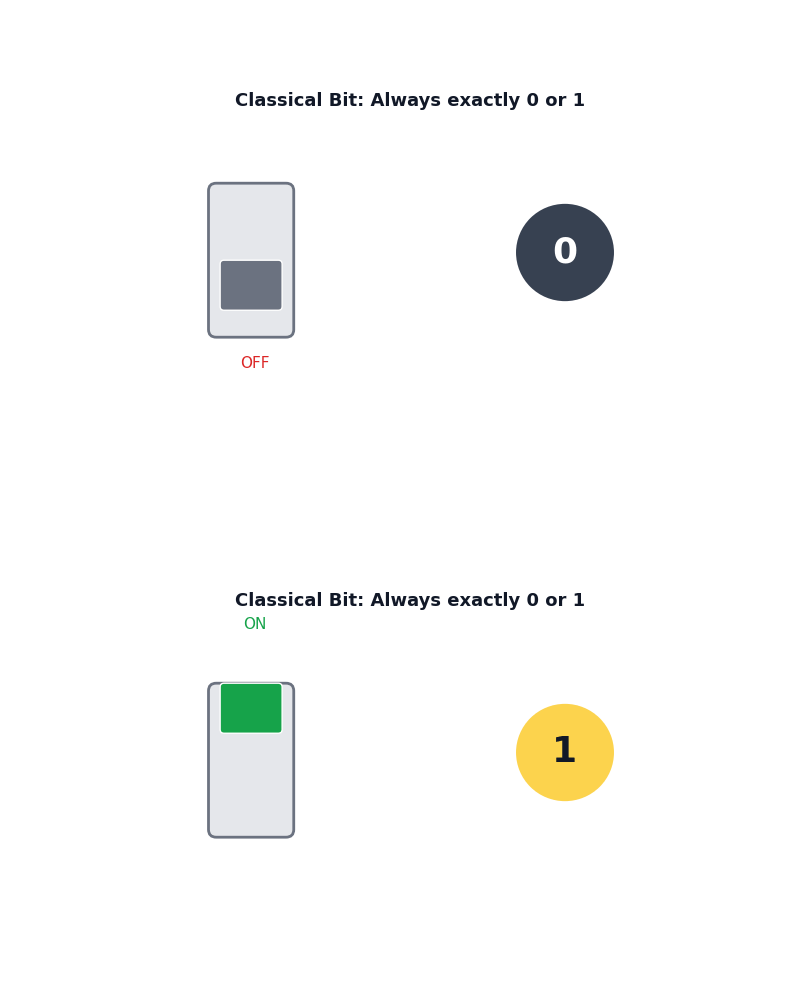
Source: mortalapps.com- A classical bit is always in a definite state: either 0 or 1.
- A qubit, or quantum bit, can exist in a superposition of both 0 and 1 simultaneously.
- Superposition means a qubit holds a blend of possibilities, with specific probabilities for each outcome.
- When a qubit is measured, its superposition collapses, yielding a definite 0 or 1 based on its probabilities.
- This ability to hold multiple states at once is a direct consequence of quantum mechanics.
- Qubits are the fundamental building blocks that enable quantum computers to process information in new ways.
Why This Matters
Every computer, from the simplest calculator to the most advanced supercomputer, relies on a fundamental unit of information. For classical computers, this unit is the 'bit.' It's a concept so ingrained that we rarely think about it, yet it defines everything our digital world does. But what if there was a different, more powerful way to represent information?
This topic introduces the 'qubit,' the quantum equivalent of a classical bit. The qubit is the cornerstone of quantum computing, and understanding its unique properties is the first major conceptual leap in grasping how quantum computers work. It's where the 'weirdness' of quantum physics truly begins to translate into computational power.
By the end of this topic, you'll clearly understand the difference between a bit and a qubit, and why the qubit's ability to exist in more than just two states is a game-changer for computation.
Core Intuition
Imagine a light switch. It's either ON or OFF. There's no in-between. This is exactly like a classical bit: it's either a 0 or a 1, definitively. If you want to represent more complex information, you need more switches, each in a definite state.
Now, imagine a dimmer switch. It can be fully OFF, fully ON, or anywhere in between – 25% on, 50% on, 75% on. This is a bit closer to a qubit. A qubit can be 0, 1, or a combination of both simultaneously. It's not just a 'maybe' or 'unknown' state; it's genuinely existing in both states at once, with a certain 'amount' of 0 and a certain 'amount' of 1.
Think of a spinning coin. While it's spinning in the air, it's neither heads nor tails; it's a blur of both. Only when it lands does it become definitively heads or tails. A qubit is like that spinning coin, but with a crucial difference: it can be 'more' heads or 'more' tails while spinning, and we can even manipulate it while it's in that 'blurry' state. This ability to hold multiple possibilities at once is what gives qubits their power.
Visualization
Technical Explanation
A classical bit is the most basic unit of information in classical computing. It can exist in one of two mutually exclusive states: 0 or 1. These states are typically represented by physical phenomena like an electrical voltage being high or low, a magnetic orientation being north or south, or a light pulse being present or absent. When you store data, send an email, or run a program, all that information is ultimately encoded and processed as sequences of these definite 0s and 1s.
A quantum bit, or qubit, is the fundamental unit of information in quantum computing. Unlike a classical bit, a qubit can exist in a state of superposition. This means it can be 0, 1, or a combination of both 0 and 1 simultaneously. It's not just an unknown state that will eventually become 0 or 1; it genuinely exists as a blend of both possibilities at the same time.
To understand superposition, think of it as a probability distribution. A qubit in superposition has a certain probability of being measured as 0 and a certain probability of being measured as 1. These probabilities are not arbitrary; they are precisely defined by the qubit's quantum state. When we 'measure' a qubit, its superposition collapses, and it definitively becomes either 0 or 1, with the outcome determined by these probabilities.
This ability to be in a superposition of states is a direct consequence of quantum mechanics. Physical systems that can act as qubits include the spin of an electron, the polarization of a photon, or the energy levels of a superconducting circuit. These systems are carefully isolated and manipulated to maintain their delicate quantum properties.
Crucially, a single qubit in superposition can effectively represent more information than a single classical bit. While a classical bit can only represent one value (0 or 1) at any given time, a qubit in superposition can represent both 0 and 1 simultaneously, with varying 'strengths' for each. This is the first step towards the exponential power of quantum computers.