Tensor Product Intuition
The tensor product combines individual qubit state spaces into a joint space that grows exponentially with qubit count
Source: mortalapps.com- The tensor product ($\otimes$) combines two vector spaces (or vectors) into a new, larger vector space.
- It is used to describe the combined state of multiple qubits from their individual states.
- For two qubits, the tensor product of their 2-dimensional state vectors results in a 4-dimensional state vector.
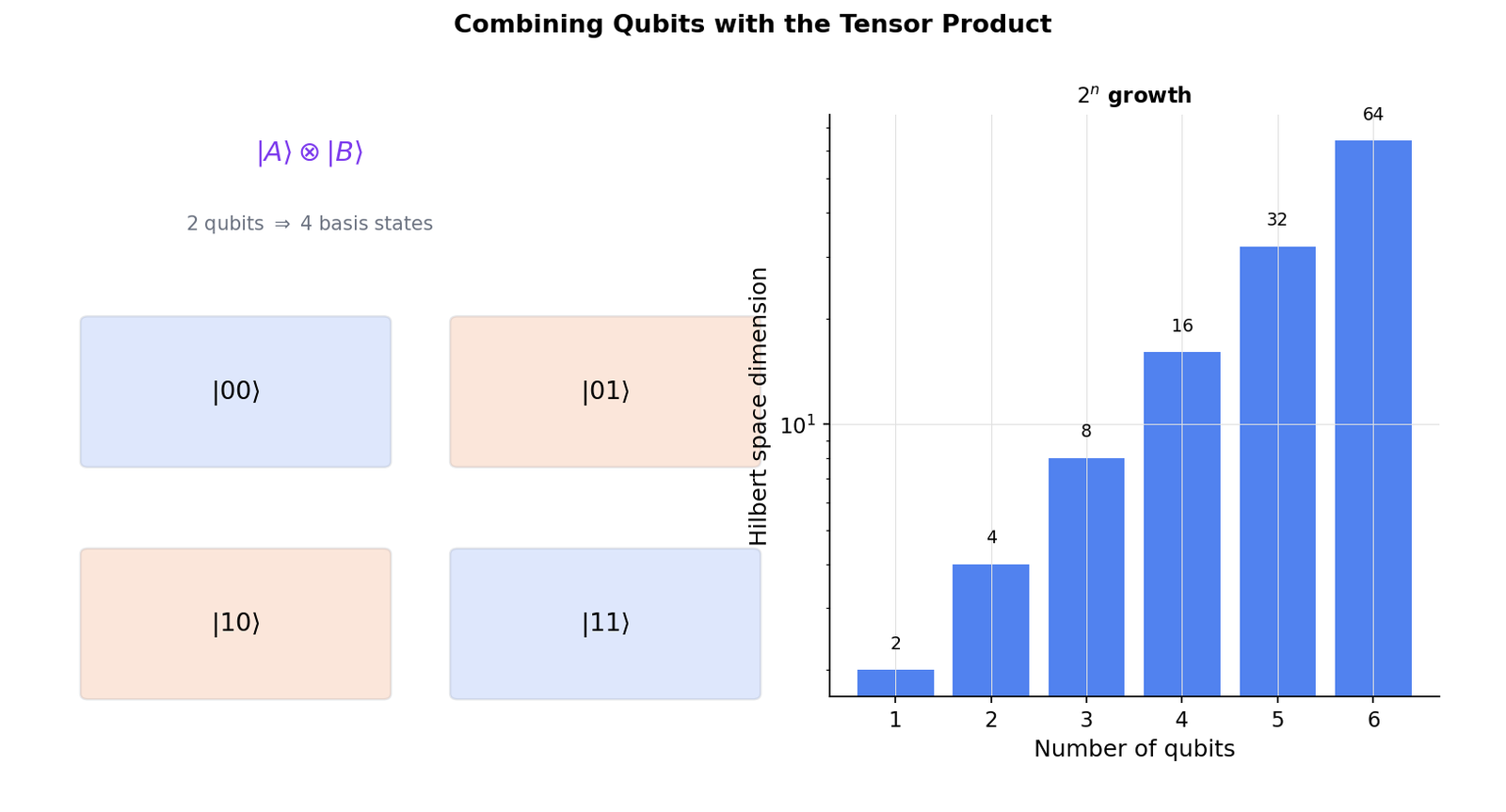
- The dimension of the state space for $n$ qubits grows exponentially as $2^n$, enabled by the tensor product.
- The tensor product is fundamental to understanding multi-qubit states, including entangled states.
- The order of the tensor product matters, as $|0\rangle \otimes |1\rangle$ is distinct from $|1\rangle \otimes |0\rangle$.
Why This Matters
When we combine two or more qubits, their individual states don't just add up; they form a larger, exponentially more complex system. The tensor product is the mathematical operation that allows us to describe this combination, creating a joint state space for multiple qubits.
Understanding the tensor product is absolutely critical for multi-qubit quantum computing. It's the tool that lets us build up the state of a two-qubit system from two individual qubits, and it's the foundation for understanding phenomena like entanglement, where qubits become deeply correlated.
By the end of this topic, you will grasp the intuition behind the tensor product, understand how it combines vector spaces, and see why it leads to the exponential growth in complexity that makes quantum computers so powerful.
Core Intuition
Imagine you're choosing an outfit. You have 2 shirt options (red, blue) and 3 pant options (jeans, khakis, shorts). How many unique outfits can you make? You multiply the options: $2 \times 3 = 6$ outfits. The tensor product is like creating a new, larger list that contains *all possible combinations* of your choices from two independent systems.
Another analogy: describing a point in a 2D room (with coordinates $x, y$) and a separate 1D height (with coordinate $z$). To describe a point in 3D space, you combine these into $(x, y, z)$. The tensor product is a formal way to combine the 'descriptive spaces' of two independent systems into a single, larger descriptive space for the combined system. It's not just adding the dimensions; it's creating a new space whose dimensions are the *product* of the original dimensions.
For qubits, if one qubit has 2 possible states ($|0\rangle, |1\rangle$) and another has 2 possible states, their combined system has $2 \times 2 = 4$ possible basis states (like $|00\rangle, |01\rangle, |10\rangle, |11\rangle$). The tensor product is the mathematical operation that generates these combined states.
Visualization
Technical Explanation
The tensor product, denoted by $\otimes$, is a mathematical operation that combines two vector spaces (or vectors) to create a new, larger vector space. For quantum states, it's how we combine the state vectors of individual qubits to form the state vector of a multi-qubit system.
If we have two single-qubit states, $|\psi_A\rangle = \begin{pmatrix} \alpha_0 \\ \alpha_1 \end{pmatrix}$ for qubit A and $|\psi_B\rangle = \begin{pmatrix} \beta_0 \\ \beta_1 \end{pmatrix}$ for qubit B, their combined state is given by the tensor product: $$|\psi_A\rangle \otimes |\psi_B\rangle = \begin{pmatrix} \alpha_0 \\ \alpha_1 \end{pmatrix} \otimes \begin{pmatrix} \beta_0 \\ \beta_1 \end{pmatrix}$$
To compute this, you take each component of the first vector and multiply it by the *entire* second vector: $$|\psi_A\rangle \otimes |\psi_B\rangle = \begin{pmatrix} \alpha_0 \begin{pmatrix} \beta_0 \\ \beta_1 \end{pmatrix} \\ \alpha_1 \begin{pmatrix} \beta_0 \\ \beta_1 \end{pmatrix} \end{pmatrix} = \begin{pmatrix} \alpha_0\beta_0 \\ \alpha_0\beta_1 \\ \alpha_1\beta_0 \\ \alpha_1\beta_1 \end{pmatrix}$$
The resulting vector is a 4-dimensional column vector, representing the combined state of the two qubits. Its components are the complex amplitudes for the four possible basis states of a two-qubit system: $|00\rangle, |01\rangle, |10\rangle, |11\rangle$.
Dimension Expansion: A key feature of the tensor product is how it expands the dimension of the state space. If a single qubit lives in a 2-dimensional space, then:
- 1 qubit: $2^1 = 2$ dimensions
- 2 qubits: $2^2 = 4$ dimensions
- 3 qubits: $2^3 = 8$ dimensions
- $n$ qubits: $2^n$ dimensions
This exponential growth in state space is why quantum computers can store and process vastly more information than classical computers. The tensor product is the mathematical operation that formalizes this growth and allows us to describe multi-qubit states, including entangled states.