Multi-Qubit Systems
Multi-qubit states use tensor products, yielding a 2^n dimensional space that grows exponentially with qubit count
Source: mortalapps.com- Multi-qubit systems are represented in circuits by stacking multiple quantum wires vertically.
- The joint state of multiple qubits is represented mathematically using the tensor product.
- An n-qubit system has a state space of 2^n dimensions, growing exponentially with the number of qubits.
- The computational basis states for an n-qubit system are represented by binary strings of length n.
- Independent gates acting on parallel wires are combined using the tensor product of their matrices.
- If a qubit wire has no gate applied to it, it is mathematically treated as having the Identity gate (I) applied.
- The order of qubits in the tensor product must be consistently maintained to avoid state representation errors.
Why This Matters
To unlock the true power of quantum computing, we must move beyond single qubits. A single qubit provides a two-dimensional state space, but a quantum computer with $n$ qubits operates in a state space of $2^n$ dimensions. This exponential growth is where quantum speedups originate. To represent these systems in circuit diagrams, we stack multiple quantum wires vertically.
In this topic, you will learn how to represent and manipulate multi-qubit states mathematically and visually. We will introduce the tensor product, the mathematical tool used to combine individual qubit states into a single, unified multi-qubit state vector. You will learn how to write down the computational basis states for multi-qubit systems and how to track independent operations acting on parallel wires.
By the end of this section, you will understand how to construct and manipulate state vectors for systems of two, three, or more qubits, laying the essential foundation for understanding multi-qubit gates and entanglement.
Core Intuition
Imagine a single light switch that can be either UP ($|0\rangle$) or DOWN ($|1\rangle$). If you have one switch, you have 2 possible configurations. If you add a second switch, you now have 4 possible configurations: UP-UP, UP-DOWN, DOWN-UP, and DOWN-DOWN. With three switches, you have 8 configurations. Each switch you add doubles the number of possible states.
In the classical world, the switches can only be in one of these configurations at a time. In the quantum world, however, the system can exist in a simultaneous superposition of all these configurations at once. A 3-qubit system can track 8 complex amplitudes simultaneously; a 300-qubit system can track more amplitudes than there are atoms in the observable universe.
In a circuit diagram, each qubit gets its own horizontal wire. Even if the qubits do not interact, we must treat them mathematically as a single, joint system. The tensor product is the mathematical glue that binds these individual wires into a single, multi-dimensional state space.
Visualization
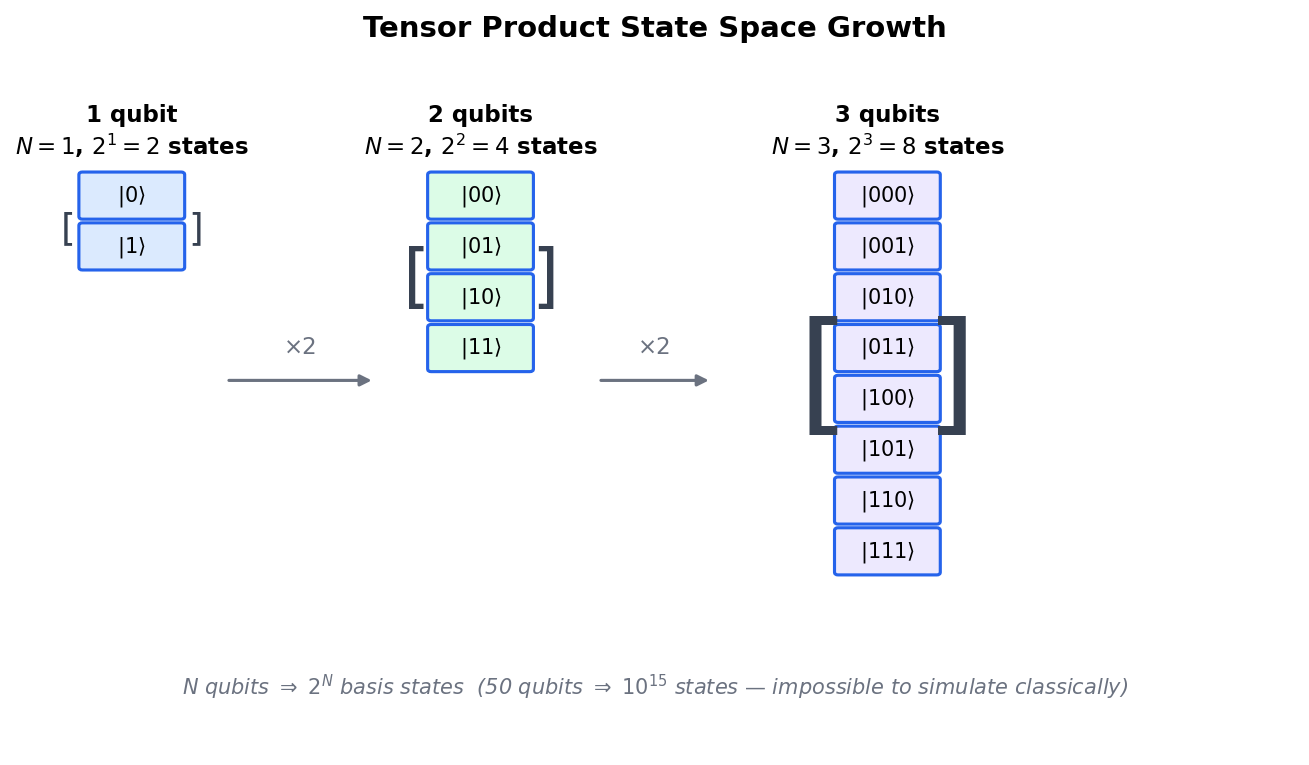
Technical Explanation
To combine $n$ independent qubits into a single joint state, we use the tensor product (denoted by $\otimes$). If qubit 0 is in state $|\psi\rangle = a|0\rangle + b|1\rangle$ and qubit 1 is in state $|\phi\rangle = c|0\rangle + d|1\rangle$, the joint state $|\Psi\rangle = |\psi\rangle \otimes |\phi\rangle$ (often written simply as $|\psi\rangle|\phi\rangle$ or $|\psi\phi\rangle$) is:
$$|\Psi\rangle = \begin{pmatrix} a \\ b \end{pmatrix} \otimes \begin{pmatrix} c \\ d \end{pmatrix} = \begin{pmatrix} a \begin{pmatrix} c \\ d \end{pmatrix} \\ b \begin{pmatrix} c \\ d \end{pmatrix} \end{pmatrix} = \begin{pmatrix} ac \\ ad \\ bc \\ bd \end{pmatrix}$$
The computational basis states for a 2-qubit system are: $$|00\rangle = \begin{pmatrix} 1 \\ 0 \\ 0 \\ 0 \end{pmatrix}, \quad |01\rangle = \begin{pmatrix} 0 \\ 1 \\ 0 \\ 0 \end{pmatrix}, \quad |10\rangle = \begin{pmatrix} 0 \\ 0 \\ 1 \\ 0 \end{pmatrix}, \quad |11\rangle = \begin{pmatrix} 0 \\ 0 \\ 0 \\ 1 \end{pmatrix}$$
If we apply gate $A$ to qubit 0 and gate $B$ to qubit 1 simultaneously, the joint operation is represented by the tensor product of the matrices, $A \otimes B$. For example, if we apply $H$ to the first qubit and $I$ (Identity, doing nothing) to the second qubit, the joint operator is:
$$H \otimes I = \frac{1}{\sqrt{2}} \begin{pmatrix} 1 & 1 \\ 1 & -1 \end{pmatrix} \otimes \begin{pmatrix} 1 & 0 \\ 0 & 1 \end{pmatrix} = \frac{1}{\sqrt{2}} \begin{pmatrix} 1 & 0 & 1 & 0 \\ 0 & 1 & 0 & 1 \\ 1 & 0 & -1 & 0 \\ 0 & 1 & 0 & -1 \end{pmatrix}$$