Careers in Quantum Computing
The quantum industry needs physicists, software engineers, and systems architects, and many roles do not require a PhD
Source: mortalapps.com- The quantum industry is highly interdisciplinary, requiring physicists, engineers, and computer scientists.
- You do not need a PhD to work in quantum; there is a growing demand for quantum-literate software and systems engineers.
- Key roles include Hardware Physicists, Control Engineers, QEC Specialists, Algorithm Researchers, and Software Developers.
- Learning open-source frameworks like Qiskit, Cirq, or PennyLane is the best way to build practical skills.
- Contributing to open-source projects and participating in hackathons are highly valued by quantum employers.
- The quantum job market spans tech giants, venture-backed startups, national laboratories, and academic research hubs.
Why This Matters
You have now mastered the technical foundations of quantum computing, from the mathematics of qubits to the engineering of error correction and the ethics of deployment. You are no longer just an observer; you are ready to participate. The quantum industry is growing rapidly, creating a diverse range of career opportunities that span physics, computer science, engineering, and business. In this topic, we will map out the professional landscape and show you how to build a career in this frontier field.
Core Intuition
To understand the quantum career landscape, imagine being a software engineer in the mid-1970s. The personal computer was just being invented. There were no standard operating systems, no web developers, and no app stores. If you wanted to work in computing, you had to understand both the hardware (how to solder chips) and the software (how to write assembly code). Quantum computing is at that exact same foundational stage today.
Another analogy is joining the early aviation industry. You don't just need pilots (algorithm researchers); you also need aerospace engineers to design the wings (hardware physicists), mechanics to maintain the engines (quantum engineers), and air traffic controllers to manage the flights (software developers). A single breakthrough by a single person in any of these roles can reshape the entire industry, making it a uniquely exciting time to enter the field.
Visualization
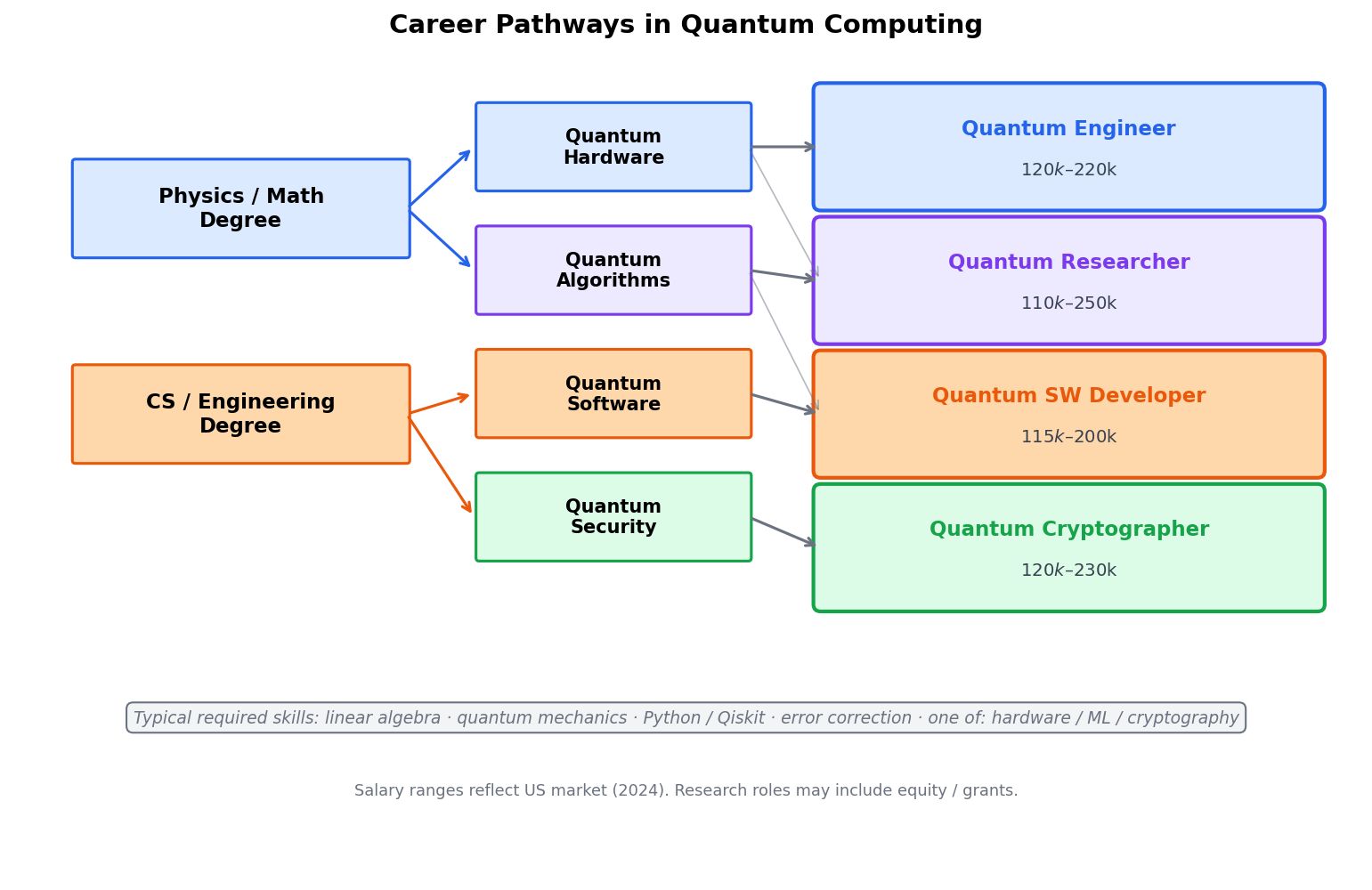
Technical Explanation
The quantum computing workforce is highly interdisciplinary, requiring a combination of physics, mathematics, computer science, and engineering. The industry has moved beyond requiring a PhD in physics for every role; there is a growing demand for software engineers, systems engineers, and product managers who can bridge the gap between quantum theory and practical application.
Key professional roles in the quantum ecosystem include: 1. Quantum Hardware Physicist: Focuses on designing, fabricating, and testing physical qubits (superconducting, trapped ions, etc.). Requires deep knowledge of solid-state physics, cryogenics, and microwave engineering. 2. Quantum Engineer: Bridges the gap between physics and engineering, designing the control systems, lasers, and microwave electronics that manipulate qubits. Requires skills in electrical engineering and FPGA programming. 3. Quantum Error Correction (QEC) Specialist: Designs and implements error-correcting codes (like surface codes) on physical hardware. Requires advanced knowledge of coding theory and quantum information theory. 4. Quantum Algorithm Researcher: Develops new quantum algorithms and maps them to specific hardware architectures. Requires a strong background in computer science, complexity theory, and mathematics. 5. Quantum Software Developer: Builds the software compilers, SDKs (like Qiskit or Cirq), and cloud platforms that allow users to program quantum computers. Requires standard software engineering skills (Python, C++) combined with quantum literacy.