Neutral Atom Systems
Neutral atoms in optical tweezers form dense 2D and 3D arrays that can be entangled via switchable Rydberg interactions
Source: mortalapps.com- Neutral atom qubits are individual atoms suspended in a vacuum using focused laser beams (optical tweezers).
- Because they have no charge, neutral atoms can be packed into dense 2D and 3D arrays without electrostatic repulsion.
- Qubits are stored in stable hyperfine ground states, offering long coherence times.
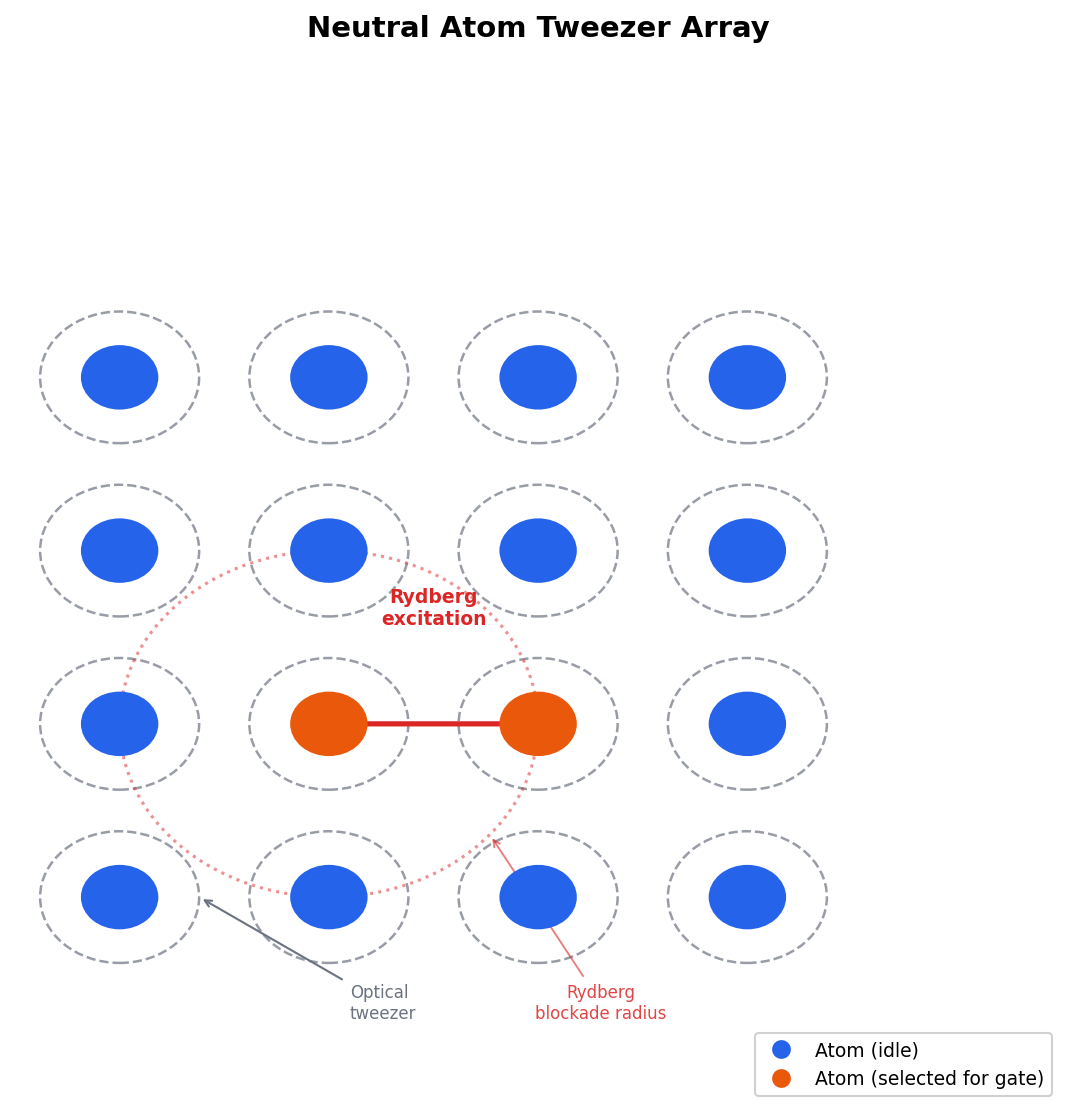
- Two-qubit gates utilize the Rydberg blockade, where exciting one atom to a high-energy state blocks the excitation of its neighbors.
- The Rydberg blockade radius defines the physical distance within which multi-qubit interactions can occur.
- Neutral atom arrays offer reconfigurable connectivity, allowing qubits to be physically moved during a computation.
Why This Matters
Neutral atom quantum computing is a rapidly growing architecture that combines the best features of trapped ions and solid-state systems. Instead of using charged ions, this platform uses neutral atoms (such as Rubidium or Cesium) trapped in a grid of highly focused laser beams called optical tweezers. Because the atoms are neutral, they do not repel each other, allowing them to be packed tightly together into dense two- and three-dimensional arrays. By exciting these atoms to highly energetic 'Rydberg states', we can turn on strong, temporary interactions to perform high-fidelity entangling gates.
Core Intuition
To understand neutral atom quantum computing, imagine a massive grid of tiny tractor beams from a sci-fi movie. Each tractor beam is a highly focused laser (an optical tweezer) that holds a single neutral atom suspended in a vacuum. Because the atoms have no net charge, they sit quietly next to each other in a perfect 2D grid, completely ignoring their neighbors.
To perform a single-qubit gate, we shine a laser on an atom, flipping its internal spin. To perform a two-qubit gate, we must make two neighboring atoms talk. We do this by shining a specific laser pulse that blows up one of the atom's electron clouds to a massive size, hundreds of times larger than normal. This highly excited state is called a Rydberg state. When an atom is in this state, its giant electron cloud acts like a massive shield. If a neighboring atom also tries to enter the Rydberg state, the first atom's shield physically blocks it. This phenomenon, called the Rydberg blockade, is the physical mechanism we use to entangle the qubits.
Visualization
Technical Explanation
In neutral atom systems, atoms are trapped using optical tweezers, which are created by focusing laser beams through high-numerical-aperture lenses. The electric field gradient of the laser light polarizes the atom, drawing it to the intensity maximum of the beam (dipole trapping). Qubits are typically encoded in the hyperfine ground states of the atoms (e.g., $^{87}\text{Rb}$).
To perform two-qubit gates, we excite the atoms to a Rydberg state, which is a highly excited state with a very large principal quantum number $n$ (typically $n \approx 70$). The radius of a Rydberg atom scales as $n^2$, and its electric dipole-dipole interaction strength scales as $n^{11}$. This massive interaction creates the Rydberg blockade.
Mathematically, the Hamiltonian of two atoms driven by a laser with Rabi frequency $\Omega$ and detuning $\Delta$ is: $$H = \sum_{i=1}^2 \left( \frac{\hbar \Omega}{2} |g\rangle_i\langle r| + \text{h.c.} - \hbar \Delta |r\rangle_i\langle r| \right) + V_{rr} |rr\rangle\langle rr|$$ where $|g\rangle$ is the ground state, $|r\rangle$ is the Rydberg state, and $V_{rr} = C_6 / R^6$ is the van der Waals interaction energy between two Rydberg atoms separated by distance $R$.
If the atoms are close together, the interaction energy $V_{rr}$ is extremely large. If we apply a laser pulse tuned to the ground-to-Rydberg transition ($\Delta = 0$), the state $|gr\rangle$ and $|rg\rangle$ are easily excited, but the double-excited state $|rr\rangle$ is shifted out of resonance by $V_{rr}$. The excitation of the second atom is blocked if the distance $R$ is less than the Rydberg blockade radius: $$R_b = \left( \frac{C_6}{\hbar \Omega} \right)^{1/6}$$ This blockade is used to implement a Controlled-Phase (CZ) gate: if the control atom is excited, the target atom cannot undergo its transition, accumulating a phase of $\pi$ only if both qubits were in the $|1\rangle$ state.
Key hardware parameters for neutral atoms:
- T1 (Energy Relaxation): Seconds (for ground states)
- T2 (Dephasing): Milliseconds to seconds
- Gate Fidelity: Single-qubit $\sim 99.9\%$, Two-qubit $\sim 99.5\%$
- Connectivity: Reconfigurable (atoms can be physically moved during computation)
- Operating Temperature: Room temperature vacuum chamber (atoms cooled to $\sim 10\ \mu\text{K}$)
- Gate Speed: $1 - 10\ \mu\text{s}$