Identity Gate
The identity gate leaves any qubit state unchanged and serves as a placeholder and algebraic reference in circuit design
Source: mortalapps.com- The Identity Gate (I) leaves any quantum state completely unchanged.
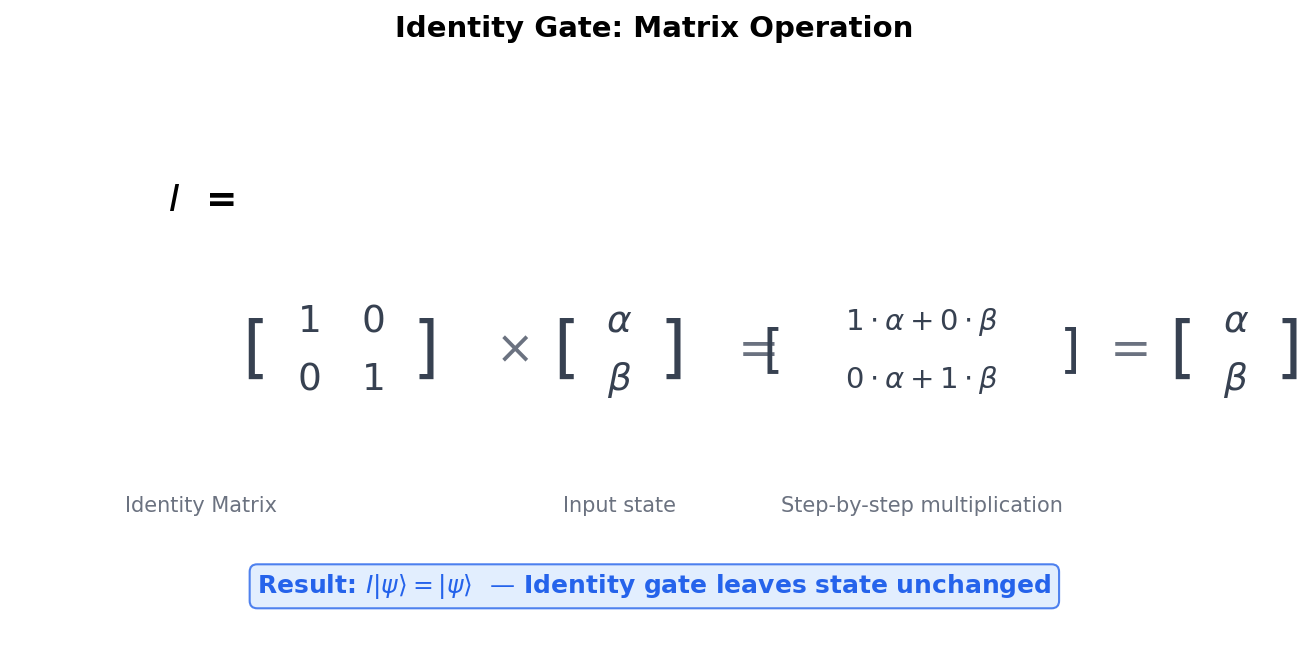
- Its matrix representation is the standard 2x2 identity matrix.
- Applying the Identity gate is mathematically equivalent to multiplying by 1.
- Geometrically, it represents a 0-radian rotation on the Bloch sphere.
- In physical hardware, it represents an idle clock cycle or delay.
- It is essential for circuit synchronization and noise characterization.
Why This Matters
The Identity Gate, denoted as $I$, is the quantum equivalent of 'doing nothing' to a qubit. While it may seem trivial or even useless at first glance, the Identity Gate is a fundamental mathematical and physical building block in quantum computing. It serves as the identity element in gate algebra, acts as a placeholder in multi-qubit circuits, and represents the idle state of a qubit over a specific duration of time. Understanding the Identity Gate is crucial for mastering gate composition and analyzing noise in real quantum hardware.
Core Intuition
Think of the Identity Gate as a perfectly clear pane of glass. When light passes through it, the light's direction, color, and intensity remain completely unaltered. In classical arithmetic, multiplying any number by 1 leaves that number unchanged; the Identity Gate is the matrix equivalent of multiplying by 1. In a physical quantum computer, applying an Identity Gate to a qubit means leaving it alone for a single clock cycle, allowing time to pass while other qubits undergo active operations.
Visualization
Technical Explanation
The Identity Gate is represented by the $2 \times 2$ identity matrix: $I = \begin{pmatrix} 1 & 0 \\ 0 & 1 \end{pmatrix}$. When applied to an arbitrary qubit state $|\psi\rangle = \alpha|0\rangle + \beta|1\rangle$, the matrix multiplication yields: $I|\psi\rangle = \begin{pmatrix} 1 & 0 \\ 0 & 1 \end{pmatrix} \begin{pmatrix} \alpha \\ \beta \end{pmatrix} = \begin{pmatrix} 1\cdot\alpha + 0\cdot\beta \\ 0\cdot\alpha + 1\cdot\beta \end{pmatrix} = \begin{pmatrix} \alpha \\ \beta \end{pmatrix} = |\psi\rangle$. The conjugate transpose of the identity matrix is itself, $I^\dagger = I$, which trivially satisfies the unitary condition $I^\dagger I = I I = I$. Geometrically, the Identity Gate corresponds to a rotation of $\theta = 0$ radians around any axis on the Bloch sphere. Its eigenvalues are both $\lambda = 1$, meaning every quantum state is an eigenstate of the Identity Gate with an eigenvalue of 1.