Vectors and States
A qubit's state is a 2D complex column vector whose components are probability amplitudes for measuring 0 or 1
Source: mortalapps.com- A vector is an ordered list of numbers (components) that represents a quantity with both magnitude and direction.
- In quantum computing, a qubit's state is represented by a 2-dimensional column vector, with complex amplitudes as its components.
- Vector addition combines vectors by adding their corresponding components, following the parallelogram rule geometrically.
- Scalar multiplication scales a vector's magnitude and can change its direction or phase.
- The 'length' or magnitude of a quantum state vector is crucial for ensuring proper normalization.
- Vectors provide a unified mathematical object to describe the complete state of a quantum system.
Why This Matters
To fully describe a quantum state, especially one in superposition, we need more than just individual numbers; we need a way to represent quantities that have both magnitude and direction in a mathematical space. This is precisely what vectors provide. In quantum computing, the state of a qubit is represented by a vector, where its components are the complex amplitudes we just learned about.
Vectors allow us to package all the information about a qubit's superposition into a single, coherent mathematical object. This structure is essential for understanding how quantum states exist in a multi-dimensional space and how they evolve under quantum operations.
By the end of this topic, you will understand what vectors are, how to represent them, and why they are the fundamental mathematical objects used to describe the states of qubits.
Core Intuition
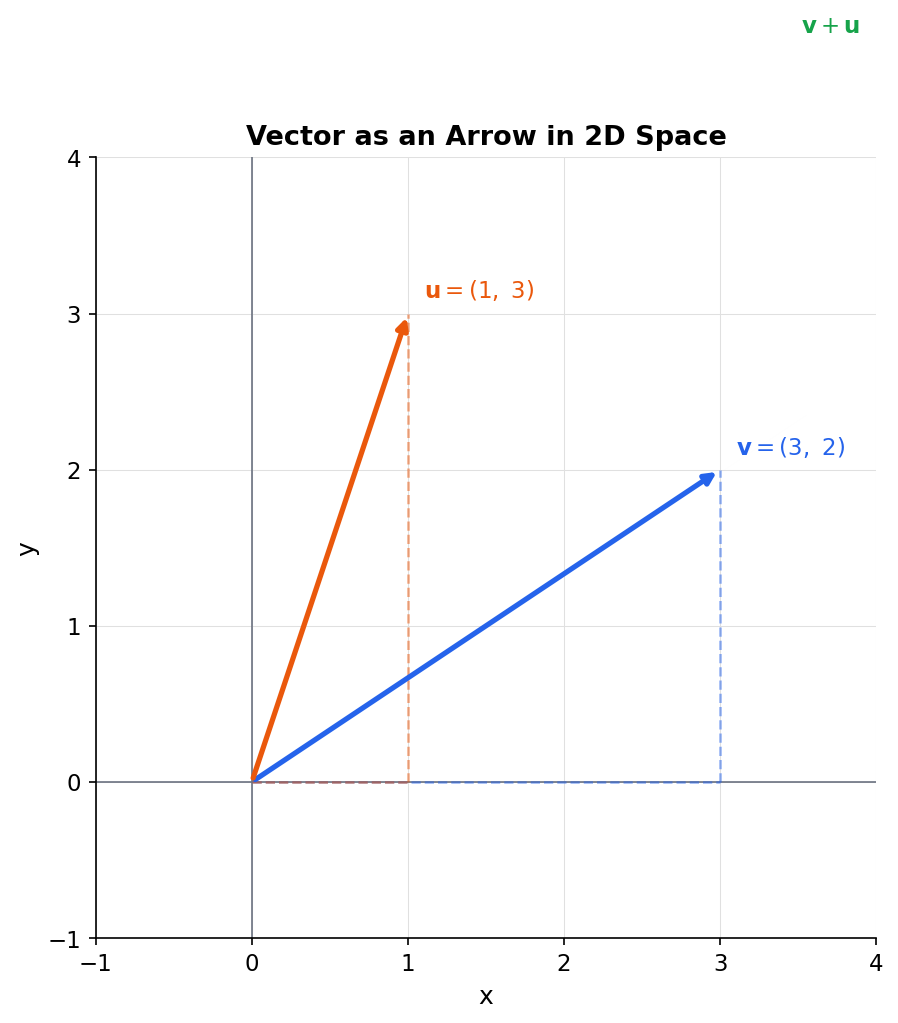
Imagine you're trying to describe a journey. You could say 'go 5 miles East' and then 'go 3 miles North.' These are individual instructions. A vector is like combining these into a single instruction: 'go 5 miles East and 3 miles North.' It's a single arrow pointing from your start to your end point, encapsulating both the distance and the overall direction.
Think of an arrow drawn on a piece of paper or in 3D space. This arrow has a specific length (magnitude) and points in a specific direction. That's the core intuition of a vector. It's not just a single number; it's a quantity that needs multiple numbers to fully describe it, telling you 'how much' and 'in what direction.'
In quantum mechanics, a qubit's state isn't just a single value; it's a combination of possibilities. A vector allows us to represent this combination as a single mathematical 'arrow' in a conceptual space, where the 'direction' of the arrow tells us about the qubit's superposition, and its 'length' (which we'll normalize later) relates to the total probability.
Visualization
Technical Explanation
Mathematically, a vector is an ordered list of numbers, often written as a column. For a single qubit, which has two possible basis states ($|0\rangle$ and $|1\rangle$), its state is represented by a 2-dimensional column vector. For example, a general qubit state $|\psi\rangle$ is written as: $$|\psi\rangle = \begin{pmatrix} \alpha \\ \beta \end{pmatrix}$$ Here, $\alpha$ and $\beta$ are the complex probability amplitudes for measuring $|0\rangle$ and $|1\rangle$ respectively. These are the complex numbers we discussed in the previous topic.
Vectors can exist in different dimensions. A 2D vector has two components, a 3D vector has three, and so on. The 'dimension' of the vector space for $n$ qubits is $2^n$. For a single qubit, it's a 2-dimensional complex vector space.
We can perform operations on vectors:
- Vector Addition: To add two vectors, you add their corresponding components. Geometrically, this is like placing the tail of the second vector at the head of the first, and the sum is the vector from the first tail to the second head (parallelogram rule).
- Scalar Multiplication: To multiply a vector by a scalar (a single number, real or complex), you multiply each component of the vector by that scalar. Geometrically, this stretches or shrinks the vector, and can reverse its direction if the scalar is negative.