Why Quantum Hardware is Difficult
Hardware must meet the DiVincenzo criteria, requiring isolation from noise while allowing precise external control
Source: mortalapps.com- Physical quantum hardware must balance the conflicting requirements of perfect isolation from the environment and strong coupling for control and interaction.
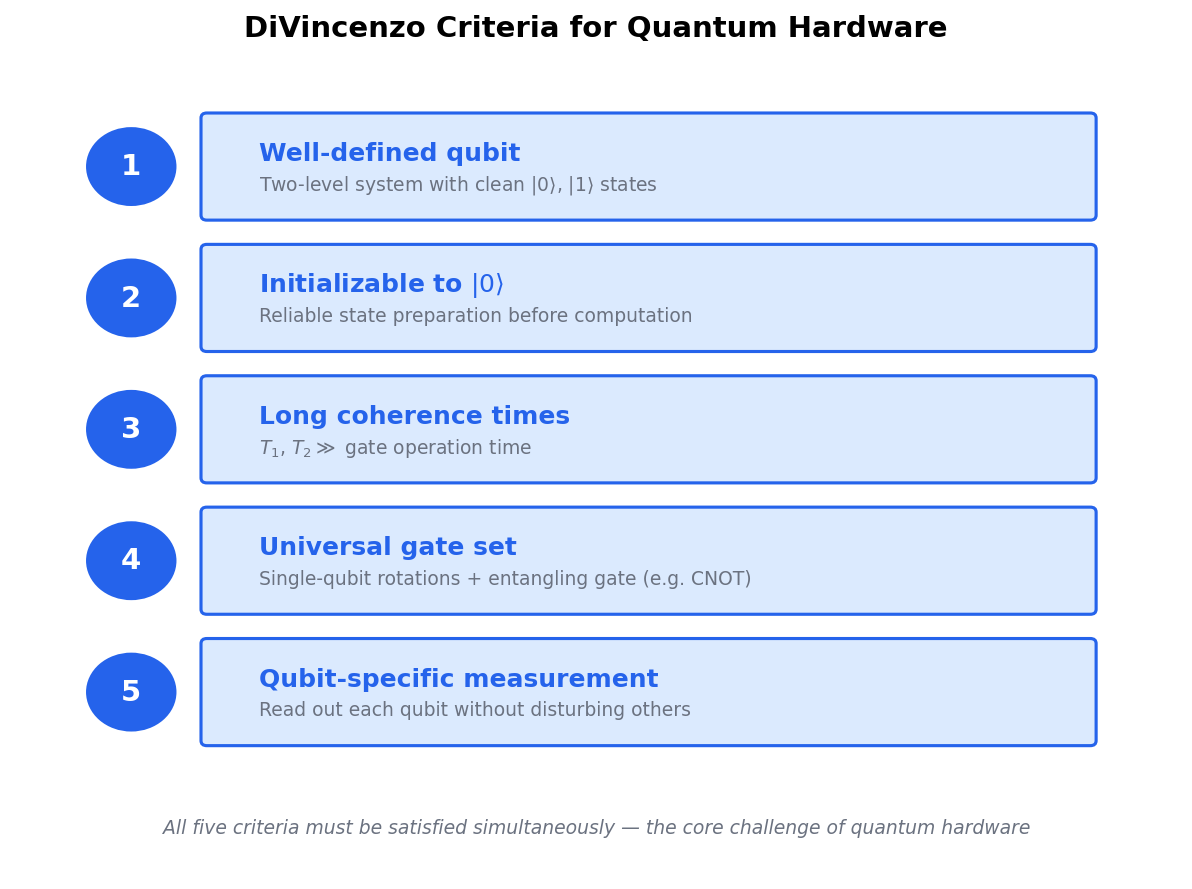
- The DiVincenzo criteria define the five fundamental physical requirements that any hardware platform must satisfy to build a viable quantum computer.
- Thermal noise ($k_B T$) must be significantly smaller than the qubit transition energy ($\hbar \omega$) to prevent spontaneous thermal excitation and decay.
- The total Hamiltonian of a physical qubit includes control terms for gate operations and environmental terms that cause decoherence.
- Different hardware platforms (superconducting, trapped ions, photonics, neutral atoms) represent different engineering trade-offs between gate speed, coherence time, and scalability.
- No single hardware platform has yet satisfied all DiVincenzo criteria at a scale sufficient for fault-tolerant quantum computing.
Why This Matters
Building a physical quantum computer is arguably one of the most demanding engineering challenges of the modern era. In previous sections, we treated qubits as clean, mathematical vectors living in a pristine Hilbert space, and gates as perfect unitary matrices. In the physical world, however, we must construct these systems out of real matter, control them with real electromagnetic fields, and protect them from an incredibly noisy environment. This topic explores the fundamental physical reasons why translating quantum theory into physical hardware is so extraordinarily difficult.
Core Intuition
To understand the difficulty of building quantum hardware, imagine trying to balance a sharp pencil on its tip in the middle of a hurricane while people are jumping on the floor around you. The delicate balance of the pencil represents the fragile superposition state of a qubit, and the hurricane represents the thermal and electromagnetic noise of the surrounding environment. Any interaction with the outside world, no matter how small, knocks the pencil over, destroying the quantum information instantly.
Another helpful analogy is a house of cards built on a vibrating table. Each card represents a physical qubit, and the entire structure represents an entangled multi-qubit state. If you try to add more cards (scale up the system) or adjust a card in the middle (perform a gate operation), the vibrations of the table (environmental noise) or your own shaky hands (control errors) threaten to collapse the entire structure. The fundamental paradox of quantum hardware is that we must isolate qubits perfectly from the environment to prevent decay, yet couple them strongly to control signals and to each other to perform computations.
Visualization
Technical Explanation
The physical requirements for a viable quantum computer were formalized by David DiVincenzo in 2000. The DiVincenzo criteria state that a physical system must possess: (1) a scalable physical system with well-characterized qubits, (2) the ability to initialize the state of the qubits to a simple fiducial state, (3) long relevant coherence times, (4) a universal set of quantum gates, and (5) a qubit-specific measurement capability. Two additional criteria address quantum communication: (6) the ability to interconvert stationary and flying qubits, and (7) the ability to faithfully transmit flying qubits between specified locations.
To understand the physical challenge, consider a physical two-level system governed by a Hamiltonian $H = H_0 + H_{\text{control}}(t) + H_{\text{env}}(t)$, where $H_0$ is the bare qubit Hamiltonian, $H_{\text{control}}(t)$ represents our control fields, and $H_{\text{env}}(t)$ represents unwanted environmental coupling. The bare Hamiltonian of a simple two-level system can be written as $H_0 = -\frac{\hbar}{2}\omega_q \sigma_z$, where $\omega_q$ is the transition frequency between the ground state $|0\rangle$ and excited state $|1\rangle$, and $\sigma_z$ is the Pauli-Z operator. To perform a gate, we apply a control field $H_{\text{control}}(t) = \Omega(t) \cos(\omega_d t + \phi) \sigma_x$, where $\Omega(t)$ is the pulse envelope, $\omega_d$ is the drive frequency, and $\phi$ is the phase.
For high-fidelity operations, we require the drive frequency to match the qubit transition frequency precisely (resonance: $\omega_d = \omega_q$). However, the environmental term $H_{\text{env}}(t) = \sum_k g_k (b_k^\dagger + b_k) \sigma_z$ couples the qubit to a bath of environmental harmonic oscillators (represented by creation and annihilation operators $b_k^\dagger$ and $b_k$ with coupling strengths $g_k$). This coupling causes the transition frequency $\omega_q$ to fluctuate randomly over time, leading to dephasing. Furthermore, if the environment can absorb energy at frequency $\omega_q$, it induces transitions from $|1\rangle$ to $|0\rangle$, causing energy relaxation. Minimizing $H_{\text{env}}(t)$ while keeping $H_{\text{control}}(t)$ strong and precise is the central engineering conflict of quantum hardware.