Hybrid Classical-Quantum Systems
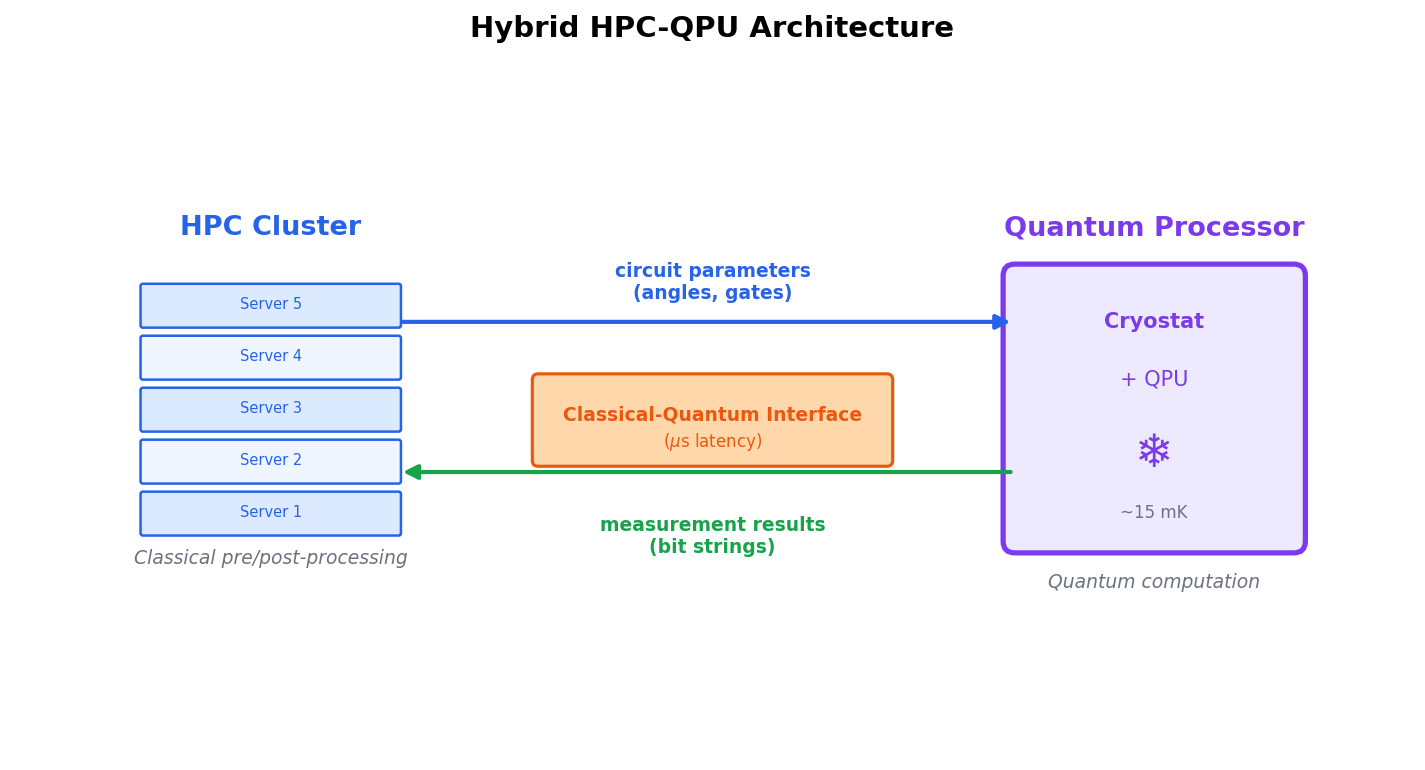
Quantum processors act as co-processors inside a classical HPC stack, handling only quantum-amenable subroutines
Source: mortalapps.com- Quantum computers operate as specialized co-processors (QPUs) within a larger classical computing architecture.
- Hybrid Classical-Quantum Systems combine the unique physics of QPUs with the robust logic and optimization of classical HPCs.
- Variational Quantum Algorithms (VQAs) use an iterative classical-quantum feedback loop to solve complex problems.
- In VQE, the QPU measures molecular energies, while the classical computer runs optimization algorithms to update circuit parameters.
- Low-latency communication between the HPC and the QPU is essential to prevent communication delays from dominating execution time.
- Classical computers are required at every level of the quantum stack, from compilation and scheduling to error mitigation and decoding.
- The future of quantum computing lies in quantum-accelerated supercomputing centers, not standalone quantum machines.
Why This Matters
In our final topic of this section, we explore the ultimate integration of quantum technology into the broader computing landscape: Hybrid Classical-Quantum Systems. A quantum computer is not a standalone replacement for your laptop or a classical supercomputer. Instead, it acts as a highly specialized co-processor, analogous to a Graphics Processing Unit (GPU) or a Tensor Processing Unit (TPU), designed to accelerate specific, mathematically intractable subroutines within a larger classical workflow.
This hybrid architecture is the operational standard for all modern quantum computing. By combining the unique superposition and entanglement capabilities of a Quantum Processing Unit (QPU) with the massive storage, high-speed logic, and optimization algorithms of a classical High-Performance Computing (HPC) cluster, we can solve complex problems that neither system could handle alone. This tight integration is essential for both near-term NISQ algorithms and long-term fault-tolerant applications.
In this topic, we will analyze the architecture of hybrid systems. We will explore Variational Quantum Algorithms (VQAs), such as the Variational Quantum Eigensolver (VQE), to see how the classical-quantum feedback loop operates. We will examine the latency requirements for real-time hybrid execution and understand how classical supercomputers orchestrate, optimize, and error-mitigate quantum workflows. This topic will complete your bridge from abstract quantum theory to practical, industrial-scale computing.
Core Intuition
To understand hybrid classical-quantum systems, think about how a modern computer handles graphics-heavy video games. The main processor (the CPU) is excellent at handling general logic, managing files, and running the game's rules. However, calculating the physics of light reflecting off millions of surfaces in real-time is too mathematically intensive for the CPU. To solve this, the CPU offloads those specific geometric calculations to a specialized Graphics Processing Unit (GPU). The GPU solves the math in parallel and sends the results back to the CPU, which renders the final frame. The CPU and GPU work as a tight, hybrid team.
In a quantum-accelerated supercomputer, we do the exact same thing. The classical supercomputer (the CPU/HPC) handles the overall database management, classical physics simulations, and heavy optimization math. When it encounters a specific, highly complex quantum chemistry or optimization problem, it packages that specific calculation into a 'quantum circuit' and sends it to the QPU (the quantum co-processor). The QPU runs the circuit, measures the quantum states, and sends the raw data back to the classical supercomputer, which updates its parameters and continues the calculation. The QPU is the ultimate mathematical accelerator.
Another helpful analogy is a manager and an expert consultant. The manager (the classical computer) has a broad view of the company's goals and manages all the logistics, but lacks the highly specialized knowledge to solve a complex chemical formula. The manager writes down the specific question, hands it to the expert consultant (the quantum computer), and waits for the answer. Once the consultant delivers the result, the manager uses that data to make the next strategic decision. Neither can run the company alone, but together they are highly successful.
Visualization
Technical Explanation
The mathematical framework of hybrid systems is best illustrated by Variational Quantum Algorithms (VQAs), such as the Variational Quantum Eigensolver (VQE). VQE is designed to find the ground state energy of a molecular Hamiltonian $H$. This is achieved by parameterizing a quantum circuit with a set of classical angles $\vec{\theta} = (\theta_1, \theta_2, ...)$, preparing the state $|\Psi(\vec{\theta})\rangle$, and measuring the expectation value of the energy:
$$E(\vec{\theta}) = \langle\Psi(\vec{\theta})| H |\Psi(\vec{\theta})\rangle$$
The hybrid execution loop operates as follows:
1. Classical Initialization: The classical computer selects an initial set of parameters $\vec{\theta}_0$ and compiles the corresponding quantum circuit. 2. Quantum Execution: The classical computer sends the circuit instructions to the QPU. The QPU prepares the state $|\Psi(\vec{\theta})\rangle$, measures the observables, and returns the raw measurement data. 3. Classical Expectation Estimation: The classical computer processes the raw data to calculate the expectation value $E(\vec{\theta})$. 4. Classical Optimization: A classical optimization algorithm (such as COBYLA, SPSA, or Nelder-Mead) running on the HPC cluster analyzes $E(\vec{\theta})$ and calculates a new, optimized set of parameters $\vec{\theta}_{k+1}$ designed to minimize the energy:
$$\vec{\theta}_{k+1} = \text{Optimizer}\left(\vec{\theta}_k, E(\vec{\theta}_k)\right)$$
5. Iteration: The loop repeats until the energy converges to a minimum value, which represents the ground state energy of the molecule.
This hybrid loop minimizes the coherence time required of the QPU, as the quantum circuits are kept relatively shallow, while the heavy optimization and data processing are offloaded to the robust classical supercomputer.