Circuit Optimization
Circuit optimization reduces gate count and depth through cancellation and commutation while preserving exact behavior
Source: mortalapps.com- Circuit optimization rewrites circuits to minimize gate count and depth while preserving mathematical behavior.
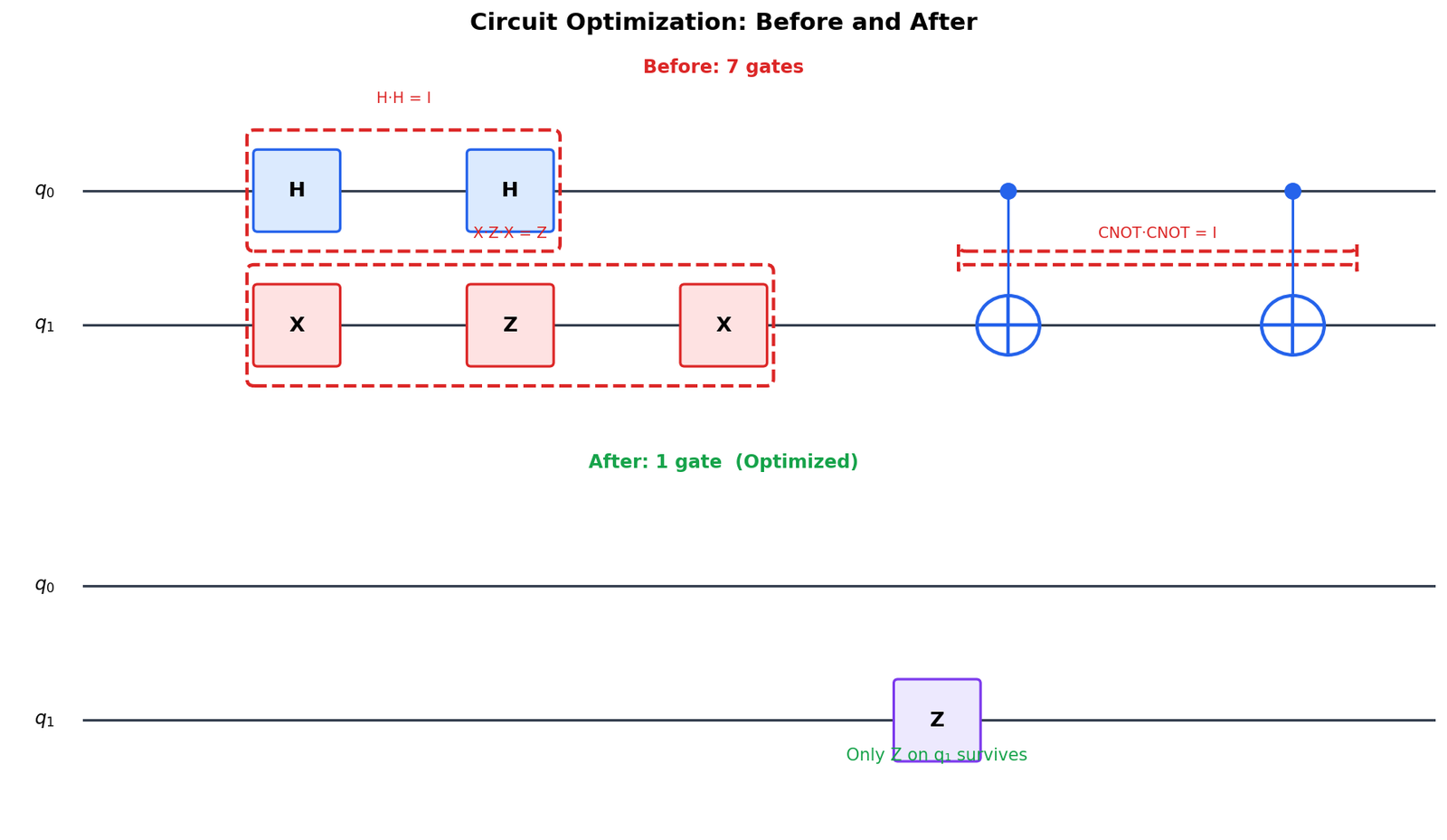
- Gate cancellation uses the property UU^dagger = I to remove redundant adjacent gates.
- Commutation relations allow us to swap the order of gates to find cancellation or parallelization opportunities.
- Consecutive rotations around the same axis can be merged into a single physical rotation.
- Compilers represent circuits as Directed Acyclic Graphs (DAGs) to analyze topological optimizations.
- Transpilation translates logical circuits into the native physical gates of a specific hardware chip.
- Optimizing circuits is the most cost-effective way to improve the success rate of quantum computations today.
Why This Matters
Designing a logically correct quantum circuit is only the first step. Before we can run it on real, noisy hardware, we must optimize it. Circuit optimization (or compilation) is the process of rewriting a quantum circuit to minimize its gate count, depth, and sensitivity to noise, while preserving its exact mathematical behavior.
In this topic, we will explore the techniques used to optimize quantum circuits. You will learn about gate cancellation (such as $X$ followed by $X$ simplifying to the Identity), commutation relations (which allow us to reorder gates to enable parallelization), and template matching.
By the end of this topic, you will be able to manually optimize small circuits, understand how compilers automate this process, and appreciate how mathematical symmetries are used to make quantum algorithms physically runnable.
Core Intuition
Imagine you are writing an essay, and your first draft is full of redundant phrases like 'in my personal opinion, I think.' An editor will go through and simplify this to 'I think,' removing words without changing your meaning. This makes your essay stronger and easier to read.
Similarly, a quantum compiler is an editor for quantum circuits. It looks for redundant sequences of gates. For example, if a circuit says 'rotate 90 degrees, then rotate -90 degrees,' the compiler removes both gates entirely (gate cancellation).
If the circuit says 'apply a gate to Alice, then apply a gate to Bob,' the compiler realizes these can be done at the same time (parallelization). By cleaning up the 'draft' circuit, the compiler creates a lean, efficient version that has the best possible chance of running successfully on noisy hardware.
Visualization
Technical Explanation
Circuit optimization relies on the algebraic properties of unitary matrices. The primary optimization techniques are:
1. Gate Cancellation: Using the fact that unitary gates are reversible, any gate followed by its inverse simplifies to the Identity: $U U^\dagger = I$. For self-inverse gates (like H, X, Y, Z), $U^2 = I$. 2. Commutation Relations: If two gates $A$ and $B$ commute ($AB = BA$), we can swap their order in the circuit. This allows us to move gates around to find cancellation opportunities or to parallelize them. For example, two control dots on different CNOT gates commute: $CX_{01} CX_{02} = CX_{02} CX_{01}$. 3. Gate Merging: Consecutive rotations around the same axis can be merged into a single rotation: $R_z(\theta_1) R_z(\theta_2) = R_z(\theta_1 + \theta_2)$. 4. K-Qubit Synthesis: Any sequence of single-qubit gates can be mathematically synthesized into a single general rotation $U = e^{i\alpha} R_z(\beta) R_y(\gamma) R_z(\delta)$, which can be implemented in at most three physical pulses.
Compilers represent circuits as Directed Acyclic Graphs (DAGs), where nodes are gates and edges are qubits. This graph representation makes it easy to identify topological optimization opportunities that are hard to see in a standard 2D diagram.