Why Physics Matters in Computing
All computing is a physical process, and quantum mechanics unlocks computational regimes classical physics cannot reach
Source: mortalapps.com- All computing is ultimately a physical process, whether classical or quantum.
- Classical computers abstract away complex physics, treating bits as simple 0s or 1s.
- As classical components shrink, quantum mechanical effects become unavoidable and problematic for classical designs.
- Quantum computing embraces these quantum effects, using them as a resource for computation.
- Concepts like superposition and entanglement, derived from quantum physics, are the foundation of quantum computing.
- By directly leveraging quantum physics, quantum computers can process information in fundamentally new ways, overcoming classical limits.
Why This Matters
In the previous topic, we explored the boundaries of classical computing, realizing that even our most powerful machines hit a wall when faced with certain complex problems. This isn't just about making faster chips; it's about a fundamental limitation in how classical computers process information. So, where do we turn for a breakthrough?
The answer lies in a realm often considered abstract and distant from everyday technology: the fundamental laws of physics. Specifically, the bizarre and counter-intuitive rules that govern the universe at its smallest scales – the realm of quantum mechanics.
This topic will reveal why understanding these deep physical principles is not just for scientists in labs, but is absolutely essential for building the next generation of computers. You'll see how the very fabric of reality, when harnessed correctly, can unlock computational power previously unimaginable.
Core Intuition
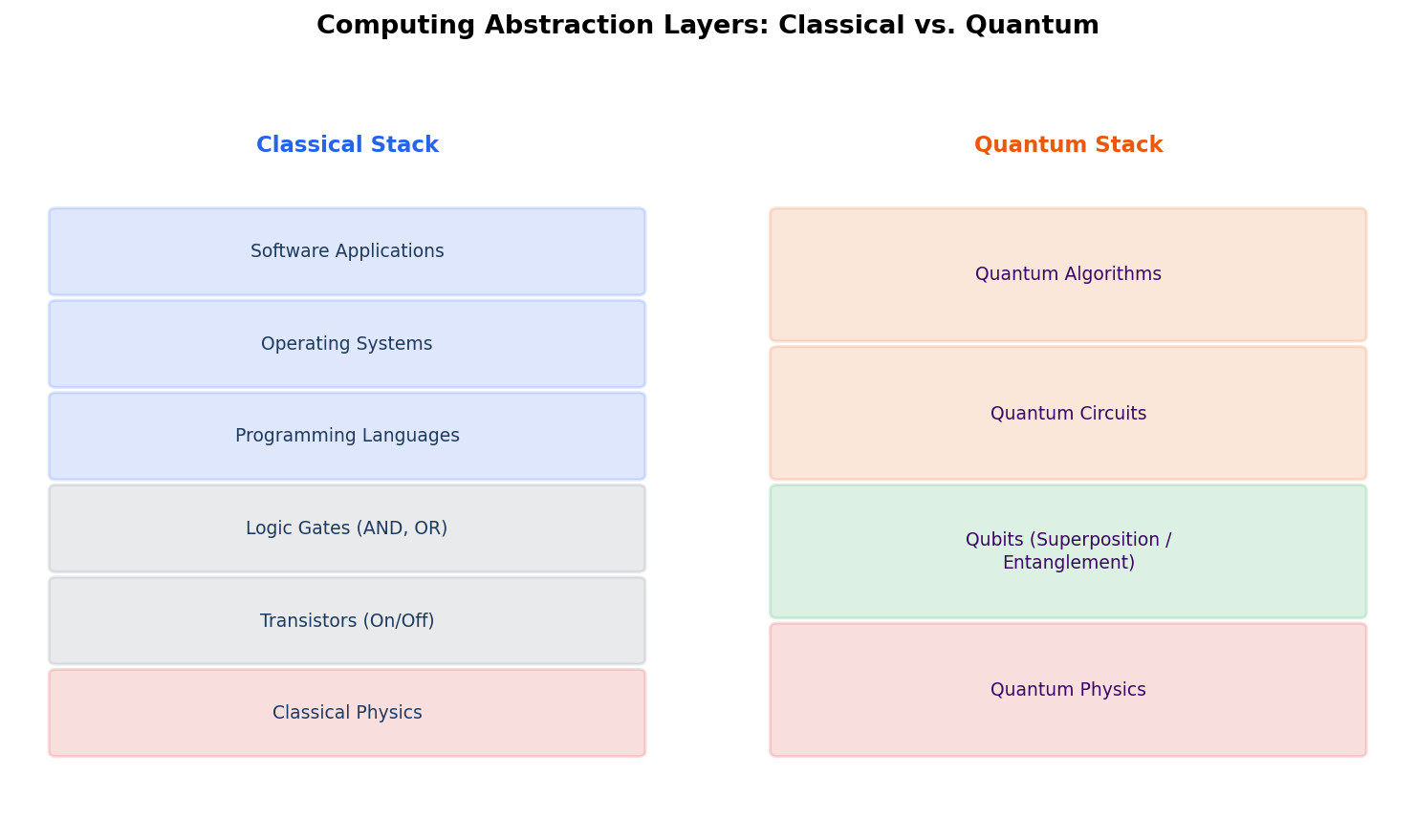
Imagine you're building a house. You start with the foundation (physics), then build the walls (materials), then add the plumbing and electricity (engineering), and finally decorate the rooms (software). For a long time, classical computing focused on improving the 'rooms' and 'plumbing' without really questioning the 'foundation.'
Classical computers are built on a simplified view of physics, where things are either 'on' or 'off,' 'here' or 'there.' This works great for most everyday tasks. But at the tiny scale of atoms and electrons, the world doesn't behave like that. It's much weirder, with particles existing in multiple places at once or being mysteriously linked.
Think of it like this: if you're trying to simulate a complex weather system, a classical computer tries to track every single raindrop and gust of wind individually. It's an impossible task. But what if you could tap into the underlying 'rules' of how weather itself forms, using the very principles of fluid dynamics and thermodynamics directly? Quantum computing aims to do something similar, but for information processing. It leverages the fundamental, 'weird' rules of nature to compute.
Visualization
Technical Explanation
At its heart, all computing is a physical process. Whether it's the flow of electrons in a transistor or the magnetic state of a hard drive, information is always encoded in and manipulated by physical systems. For classical computers, we've largely abstracted away the underlying physics. We treat bits as ideal 0s and 1s, ignoring the complex quantum mechanics happening within the silicon.
However, as transistors shrink to atomic scales, the 'classical' approximations of physics break down. Electrons no longer behave like tiny billiard balls; they start exhibiting quantum properties. This is both a challenge for classical computing (leading to issues like quantum tunneling, where electrons 'leak' through barriers) and an opportunity for quantum computing.
Quantum mechanics is the branch of physics that describes the behavior of matter and energy at the atomic and subatomic levels. It introduces concepts that are profoundly different from our everyday experience, such as superposition (a particle existing in multiple states simultaneously) and entanglement (two particles being mysteriously linked, no matter the distance between them).
Instead of fighting these quantum phenomena, quantum computing seeks to harness them. By designing computing devices that operate directly on these quantum principles, we can encode and process information in entirely new ways. This means that the 'bits' of a quantum computer, called 'qubits,' are not limited to just 0 or 1. They can exist in a combination of both, or be linked to other qubits in ways that classical bits cannot.
This direct engagement with quantum physics allows quantum computers to explore vast computational spaces simultaneously, or to model natural systems (like molecules) with an accuracy that is impossible for classical machines. It's a paradigm shift: instead of building computers that *ignore* quantum physics, we build computers that *are* quantum physics.