Rotations and Transformations
Quantum gates correspond to Bloch sphere rotations, rotation matrices preserve vector length while changing orientation
Source: mortalapps.com- Rotation matrices are linear transformations that change a vector's orientation without changing its length.
- A 2D rotation matrix $R(\theta)$ uses $\cos\theta$ and $\sin\theta$ to define rotation by angle $\theta$.
- Quantum gates like $R_x(\theta)$, $R_y(\theta)$, $R_z(\theta)$ perform rotations on a qubit's state on the Bloch sphere.
- Rotation matrices preserve vector length, ensuring quantum state normalization is maintained.
- The composition of rotations is achieved by multiplying their respective rotation matrices.
- Precise control over rotations is essential for manipulating qubit superpositions and phases in quantum algorithms.
Why This Matters
Many fundamental quantum gates, like the Pauli gates and various rotation gates, physically correspond to rotating a qubit's state in a conceptual space. This space is often visualized as the Bloch sphere, where any point on the surface represents a valid qubit state. Understanding rotations mathematically is key to precisely manipulating qubits and designing quantum algorithms.
Rotation matrices are a special type of linear transformation that change the orientation of a vector without changing its length. This property is vital for quantum gates, as they must preserve the normalization of a qubit's state.
By the end of this topic, you will understand how rotation matrices work, how they are parameterized by angles, and why they are essential for controlling the evolution of quantum states.
Core Intuition
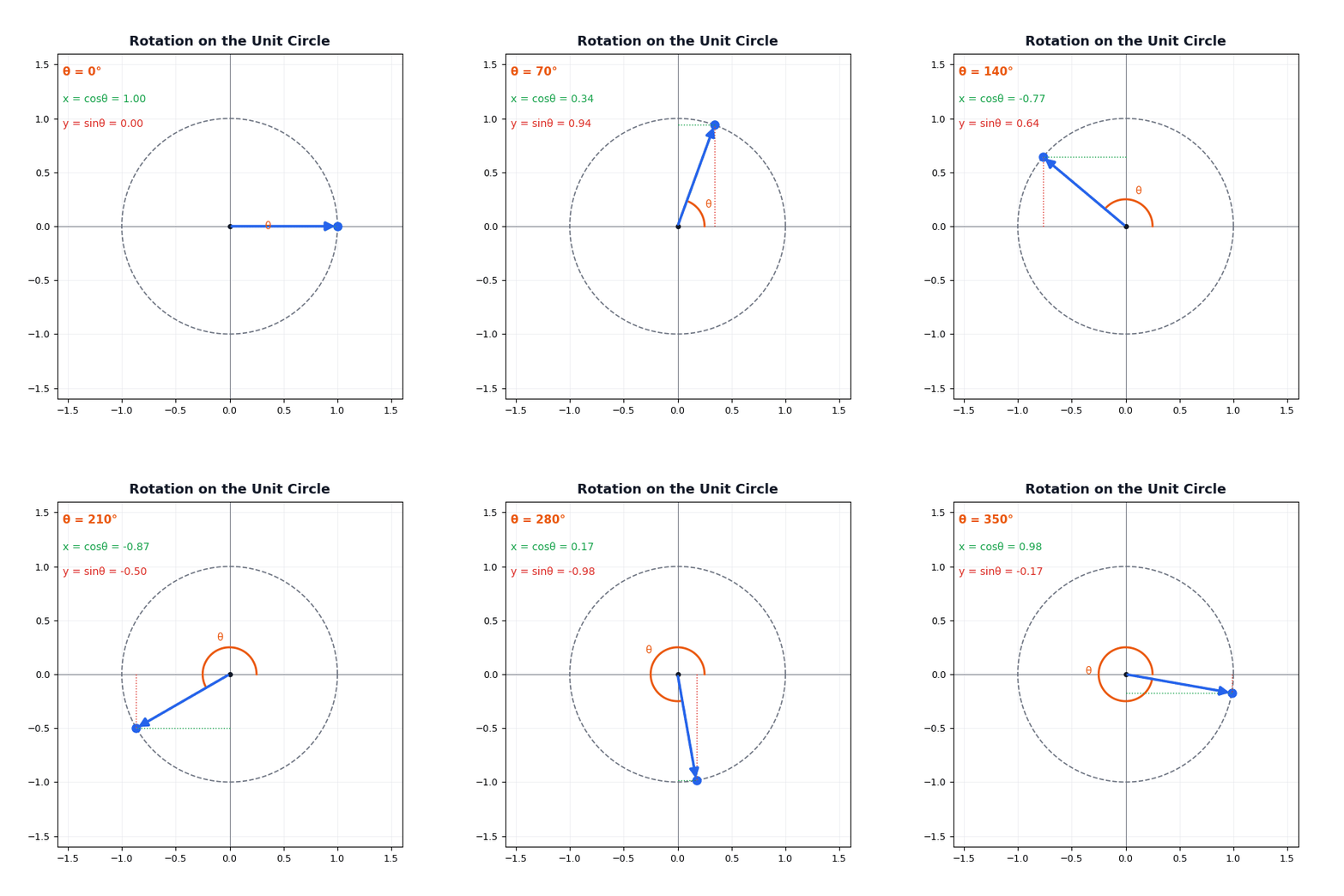
Imagine you have a compass needle. You can turn it to point North, East, South, or anywhere in between. When you turn it, its length doesn't change; only its direction does. This turning action is a rotation. A rotation matrix is the mathematical instruction that tells you how to perform such a turn.
Think of a clock hand. It rotates around a fixed center. The position of the hand changes, but its length remains constant. The angle of rotation is the key parameter. Rotation matrices use trigonometric functions (sine and cosine) to encode these angles, allowing us to specify exactly how much to turn.
In quantum computing, a qubit's state can be thought of as a point on a sphere (the Bloch sphere). Applying a rotation gate is like physically rotating that point on the sphere. The angle of rotation and the axis around which it rotates are the parameters we control to manipulate the qubit's state.
Visualization
Technical Explanation
A rotation matrix is a special type of linear transformation matrix that rotates a vector in a coordinate system without changing its length. For 2D rotations in a real plane, a rotation matrix $R(\theta)$ that rotates a vector counter-clockwise by an angle $\theta$ is given by: $$R(\theta) = \begin{pmatrix} \cos\theta & -\sin\theta \\ \sin\theta & \cos\theta \end{pmatrix}$$ When this matrix acts on a 2D vector $\vec{v} = \begin{pmatrix} x \\ y \end{pmatrix}$, the new vector $\vec{v}' = R(\theta)\vec{v}$ is: $$\vec{v}' = \begin{pmatrix} x\cos\theta - y\sin\theta \\ x\sin\theta + y\cos\theta \end{pmatrix}$$
Properties of Rotation Matrices:
- Preserves Length: The magnitude of the vector remains unchanged ($|\vec{v}'| = |\vec{v}|$). This is crucial for quantum gates, as they must preserve the normalization of qubit states.
- Determinant is 1: For a 2D rotation, $\det(R(\theta)) = \cos^2\theta - (-\sin^2\theta) = \cos^2\theta + \sin^2\theta = 1$.
- Composition of Rotations: Applying two rotations sequentially is equivalent to multiplying their rotation matrices. For example, $R(\theta_2)R(\theta_1) = R(\theta_1 + \theta_2)$.
Quantum Connection: In quantum computing, many single-qubit gates are rotation matrices. While the qubit state space is complex, these rotations are often visualized on the Bloch sphere, a 3D sphere where any point on its surface represents a pure qubit state. Gates like $R_x(\theta)$, $R_y(\theta)$, and $R_z(\theta)$ perform rotations around the X, Y, and Z axes of the Bloch sphere by an angle $\theta$. For example, the Pauli-X gate is equivalent to an $R_x(\pi)$ rotation (180 degrees around the X-axis). These rotations allow us to precisely control the superposition and phase of a qubit.