Scaling Challenges
Scaling to millions of qubits requires solving the wiring bottleneck, thermal budget, and classical control bandwidth
Source: mortalapps.com- Scaling to millions of physical qubits is required for commercially valuable, fault-tolerant quantum computing.
- The wiring bottleneck arises from the physical space and thermal conduction of running individual cables to every qubit.
- Fourier's Law of heat conduction limits the number of cables we can run into a dilution refrigerator before overwhelming its cooling power.
- Rent's Rule implies we must move from a 1:1 wiring ratio to integrated, on-chip multiplexing.
- Fabrication yield decays exponentially with qubit count on a single chip, making modular architectures essential.
- Modularity involves connecting smaller, high-yield quantum chips using quantum communication links.
Why This Matters
We are currently in the 'Noisy Intermediate-Scale Quantum' (NISQ) era, where quantum computers have dozens to hundreds of physical qubits. However, solving commercially valuable problems (such as cracking RSA encryption or simulating complex drug molecules) will require fault-tolerant systems with hundreds of thousands, or even millions, of physical qubits. Scaling up from our current systems is not a simple matter of manufacturing larger chips; it requires overcoming fundamental physical and engineering bottlenecks that threaten to stall progress.
Core Intuition
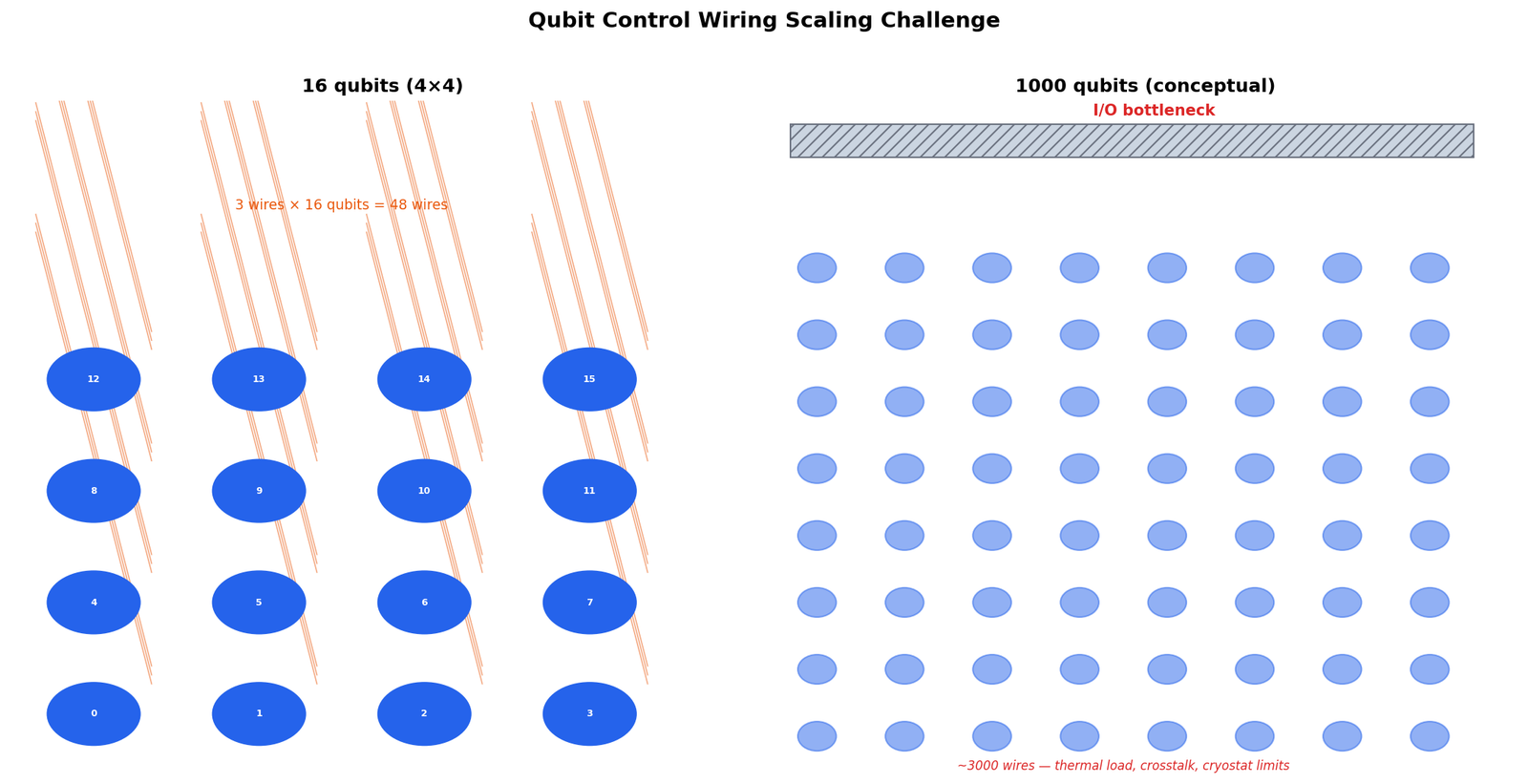
To understand the scaling challenge, imagine trying to build a massive, complex city. If you only have to build ten houses, you can easily run individual water pipes and electrical wires from a central station to each house. But if you want to scale the city to hold ten million houses, you cannot simply run ten million individual pipes from the central station. The streets would be completely choked with pipes, and the central station would collapse under the weight.
This is the wiring bottleneck in quantum computing. Currently, every superconducting qubit requires its own dedicated coaxial cables running from room temperature to the chip. If we try to build a million-qubit system this way, the dilution refrigerator would be completely filled with cables, leaving no room for the qubits, and the heat conducted down those cables would instantly melt the system. Scaling requires us to completely redesign how we route signals, moving from individual 'plumbing' to integrated, on-chip multiplexing.
Visualization
Technical Explanation
The scaling challenges of quantum hardware can be mathematically analyzed through several key engineering constraints:
1. The Wiring and Thermal Bottleneck: The heat load conducted by $N$ coaxial cables from room temperature ($300\text{ K}$) to the mixing chamber ($10\text{ mK}$) is given by Fourier's Law of heat conduction: $$\dot{Q}_{\text{cond}} = N \frac{A}{L} \int_{10\text{ mK}}^{300\text{ K}} \kappa(T) dT$$ where $A$ is the cross-sectional area of the cable, $L$ is the length, and $\kappa(T)$ is the temperature-dependent thermal conductivity of the cable material. For copper, this integral is massive. Even using superconducting NbTi cables, scaling $N$ to $10^5$ would introduce a heat load that exceeds the cooling power of any dilution refrigerator by orders of magnitude.
2. Rent's Rule and Multiplexing: In classical microelectronics, Rent's Rule describes the relationship between the number of external connection pins $P$ and the number of internal logic gates $G$: $$P = c G^p$$ where $c$ is a scaling constant and $p$ is the Rent exponent ($0.5 < p < 0.7$). In current quantum computers, $p = 1$, meaning we have a 1:1 ratio of control lines to qubits. To scale, we must achieve $p < 1$ by implementing on-chip multiplexing (such as frequency-division multiplexing, where a single coaxial cable carries control signals for multiple qubits at different frequencies).
3. Fabrication Yield and Variability: For solid-state qubits, the probability of fabricating a chip with $N$ working qubits is $Y_{\text{chip}} = y^N$, where $y$ is the yield of a single qubit. If $y = 99\%$, the probability of a 100-qubit chip working perfectly is $0.99^{100} \approx 36.6\%$. For a 1000-qubit chip, it drops to $0.004\%$. This exponential decay of yield requires either near-perfect fabrication or modular architectures where smaller, high-yield chips are networked together.