Basis Vectors
The computational basis vectors |0> and |1> form the coordinate axes of qubit state space, spanning all superpositions
Source: mortalapps.com- Basis vectors are fundamental, linearly independent vectors that span a vector space.
- For a single qubit, the computational basis consists of $|0\rangle = \begin{pmatrix} 1 \\ 0 \end{pmatrix}$ and $|1\rangle = \begin{pmatrix} 0 \\ 1 \end{pmatrix}$.
- Any quantum state can be expressed as a unique linear combination of basis vectors, with complex amplitudes as coefficients.
- Basis vectors in quantum mechanics are typically orthonormal, meaning they are perpendicular and have unit length.
- Different bases (e.g., computational, Hadamard) provide different 'coordinate systems' for the same quantum state space.
- The choice of basis is critical for defining measurement outcomes and understanding quantum transformations.
Why This Matters
Just as we describe any location on a map using fundamental directions like North/South and East/West, we describe any quantum state as a combination of fundamental 'basis' states. For a single qubit, these are typically the $|0\rangle$ and $|1\rangle$ states. These basis states are represented mathematically by special vectors called basis vectors.
Understanding basis vectors is crucial because they form the 'coordinate system' for our quantum states. Any qubit state, no matter how complex its superposition, can be expressed as a unique combination of these fundamental building blocks. This provides a structured way to analyze and manipulate quantum information.
By the end of this topic, you will understand what basis vectors are, how they define a vector space, and how any quantum state can be written as a linear combination of these fundamental states.
Core Intuition
Imagine you're trying to describe any color. You don't need an infinite list of colors; you can describe almost any color as a mix of a few 'primary' colors (like red, green, and blue). These primary colors are like basis vectors – they are fundamental, independent building blocks.
Another analogy is directions on a grid. To get anywhere on a 2D grid, you only need two fundamental directions: 'move right' and 'move up.' Any path can be broken down into a series of rightward and upward steps. These 'move right' and 'move up' instructions are your basis vectors. They are independent, and together they allow you to reach any point in that 2D space.
In quantum mechanics, $|0\rangle$ and $|1\rangle$ are our fundamental 'directions.' Any qubit state, even one in superposition, can be thought of as a specific 'mix' or 'path' composed of these two fundamental states. The complex amplitudes tell us 'how much' of each basis state is in the mix.
Visualization
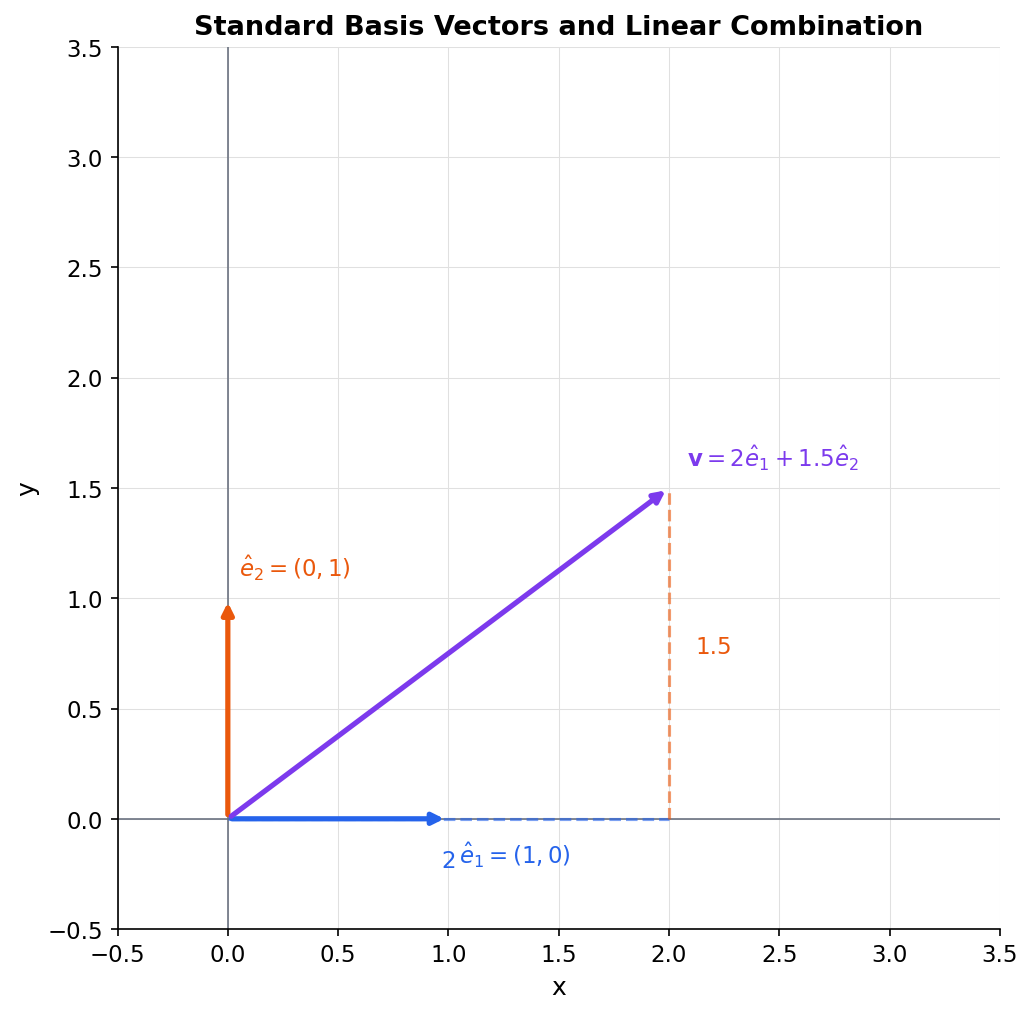
Technical Explanation
A basis for a vector space is a set of linearly independent vectors that can be used to express any other vector in that space as a unique linear combination. For a single qubit, the most common basis is the computational basis, consisting of the states $|0\rangle$ and $|1\rangle$.
Mathematically, these basis states are represented as column vectors:
- The $|0\rangle$ state is represented by the vector $\begin{pmatrix} 1 \\ 0 \end{pmatrix}$.
- The $|1\rangle$ state is represented by the vector $\begin{pmatrix} 0 \\ 1 \end{pmatrix}$.
Any general single-qubit state $|\psi\rangle$ can be written as a linear combination of these basis vectors: $$|\psi\rangle = \alpha|0\rangle + \beta|1\rangle = \alpha\begin{pmatrix} 1 \\ 0 \end{pmatrix} + \beta\begin{pmatrix} 0 \\ 1 \end{pmatrix} = \begin{pmatrix} \alpha \\ 0 \end{pmatrix} + \begin{pmatrix} 0 \\ \beta \end{pmatrix} = \begin{pmatrix} \alpha \\ \beta \end{pmatrix}$$ Here, $\alpha$ and $\beta$ are the complex probability amplitudes. They are the 'coordinates' of the state vector $|\psi\rangle$ with respect to the computational basis.
An important property of basis vectors in quantum mechanics is that they are typically orthonormal. This means:
- Orthogonal: They are 'perpendicular' to each other, meaning their inner product (a concept we'll cover later, but intuitively, their 'overlap') is zero. For $|0\rangle$ and $|1\rangle$, this means $\langle 0|1\rangle = 0$.
- Normalized: Each basis vector has a magnitude (length) of 1. This means $\langle 0|0\rangle = 1$ and $\langle 1|1\rangle = 1$.
Another common basis is the Hadamard basis, consisting of $|+\rangle = \frac{1}{\sqrt{2}}(|0\rangle + |1\rangle)$ and $|-\rangle = \frac{1}{\sqrt{2}}(|0\rangle - |1\rangle)$. Any state can also be expressed in this basis. The choice of basis is crucial for defining measurement outcomes.