State Normalization
A valid quantum state vector must have unit length, ensuring all measurement outcome probabilities sum exactly to 1
Source: mortalapps.com- All physically valid quantum state vectors must be normalized.
- Normalization ensures that the sum of probabilities for all possible measurement outcomes equals 1.
- Mathematically, a state vector is normalized if the sum of the squared magnitudes of its amplitudes is 1.
- A normalized vector is also known as a unit vector, meaning its overall magnitude (length) is 1.
- To normalize an unnormalized vector, divide each of its components by its total magnitude.
- Normalization scales the vector without changing the relative proportions or phases of its amplitudes.
Why This Matters
For any physically meaningful quantum state, the sum of the probabilities of all possible measurement outcomes must always be exactly 1. This is a fundamental principle: something *must* happen when you measure a qubit. Mathematically, this translates to a condition called 'normalization' for the state vector.
Normalization ensures that our mathematical description of a quantum state is consistent with the laws of probability. It means that the 'length' or magnitude of our state vector must always be 1. If it's not, we need to scale it appropriately.
By the end of this topic, you will understand why quantum states must be normalized, how to calculate the normalization factor, and how to apply it to any given state vector to make it physically valid.
Core Intuition
Imagine you have a pie chart representing different categories. The slices must always add up to 100% of the pie. If you draw a pie chart where the slices only add up to 80%, it's incomplete. Or if they add up to 120%, it's impossible. Normalization is like ensuring your pie chart always adds up to exactly 100%.
Another way to think about it is a recipe. If a recipe calls for a certain proportion of ingredients, but you accidentally use too much or too little of everything, you need to scale all ingredients proportionally to get the right balance. Normalization is that scaling process for quantum amplitudes, ensuring the 'total amount' of probability is always correct.
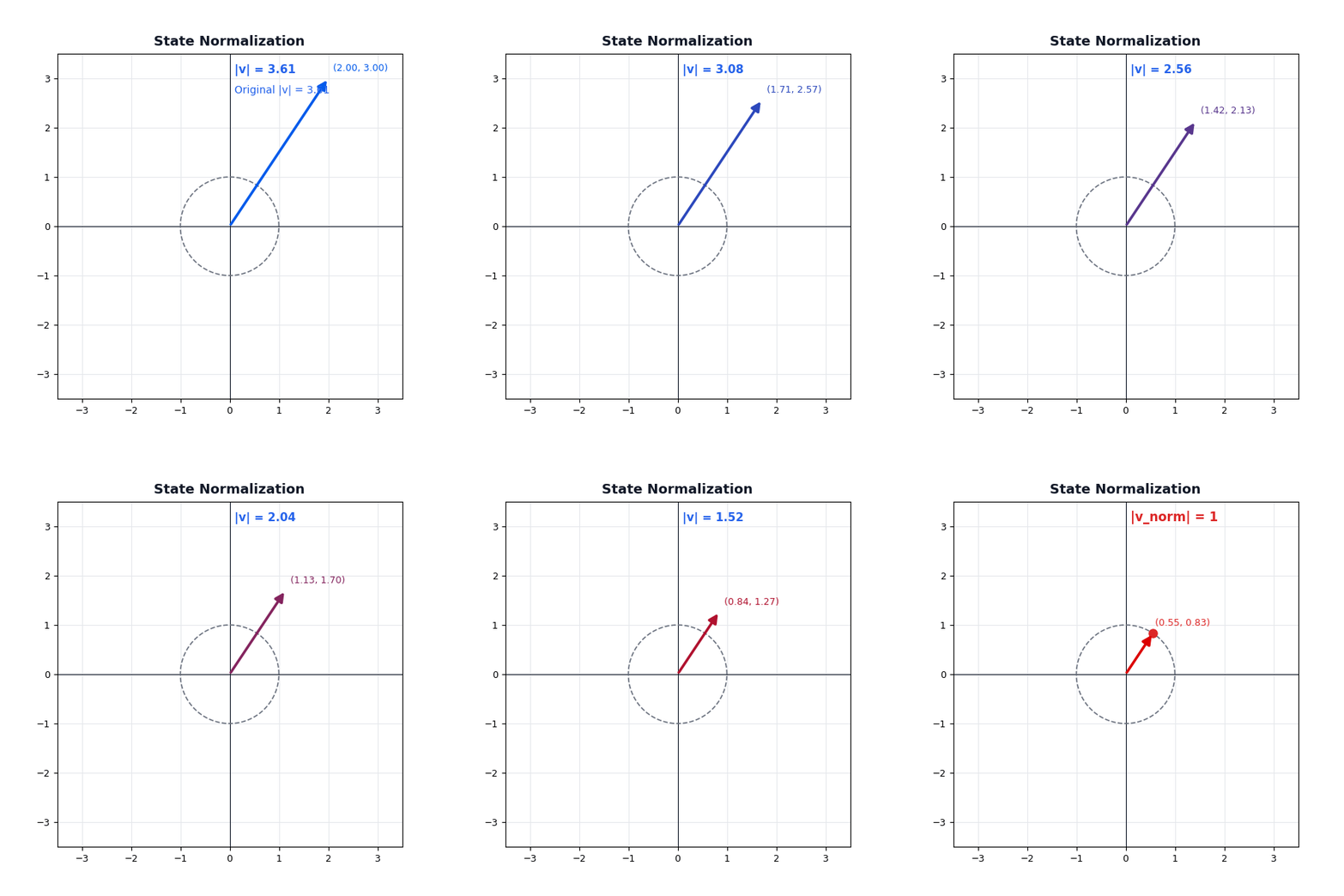
For vectors, normalization means making its 'length' exactly 1. Think of a compass needle: it always points in a direction, but its length is fixed. A normalized quantum state vector is like that compass needle – it points in a specific 'direction' in the state space, but its overall 'strength' or 'length' is always standardized to 1.
Visualization
Technical Explanation
A quantum state vector $|\psi\rangle = \begin{pmatrix} \alpha \\ \beta \end{pmatrix}$ is said to be normalized if the sum of the probabilities of measuring $|0\rangle$ and $|1\rangle$ equals 1. Using the Born rule, this means: $$|\alpha|^2 + |\beta|^2 = 1$$ Geometrically, this means the magnitude (or 'length') of the state vector itself must be 1. Such a vector is called a unit vector.
If a given state vector is not normalized (i.e., $|\alpha|^2 + |\beta|^2 \neq 1$), we can normalize it by dividing each of its components by a normalization factor. This factor is the magnitude of the unnormalized vector. Let's say we have an unnormalized state $|\phi\rangle = \begin{pmatrix} c_0 \\ c_1 \end{pmatrix}$.
1. Calculate the squared magnitude sum: Find $S = |c_0|^2 + |c_1|^2$. 2. Calculate the normalization factor: The normalization factor is $N = \sqrt{S} = \sqrt{|c_0|^2 + |c_1|^2}$. 3. Divide each component by the factor: The normalized state $|\psi\rangle$ is then: $$|\psi\rangle = \frac{1}{N} |\phi\rangle = \frac{1}{\sqrt{|c_0|^2 + |c_1|^2}} \begin{pmatrix} c_0 \\ c_1 \end{pmatrix} = \begin{pmatrix} c_0 / \sqrt{|c_0|^2 + |c_1|^2} \\ c_1 / \sqrt{|c_0|^2 + |c_1|^2} \end{pmatrix}$$
This process scales the vector without changing its 'direction' in the complex vector space, ensuring that the total probability of all outcomes is 1. All valid quantum states must be normalized.