Quantum Measurement
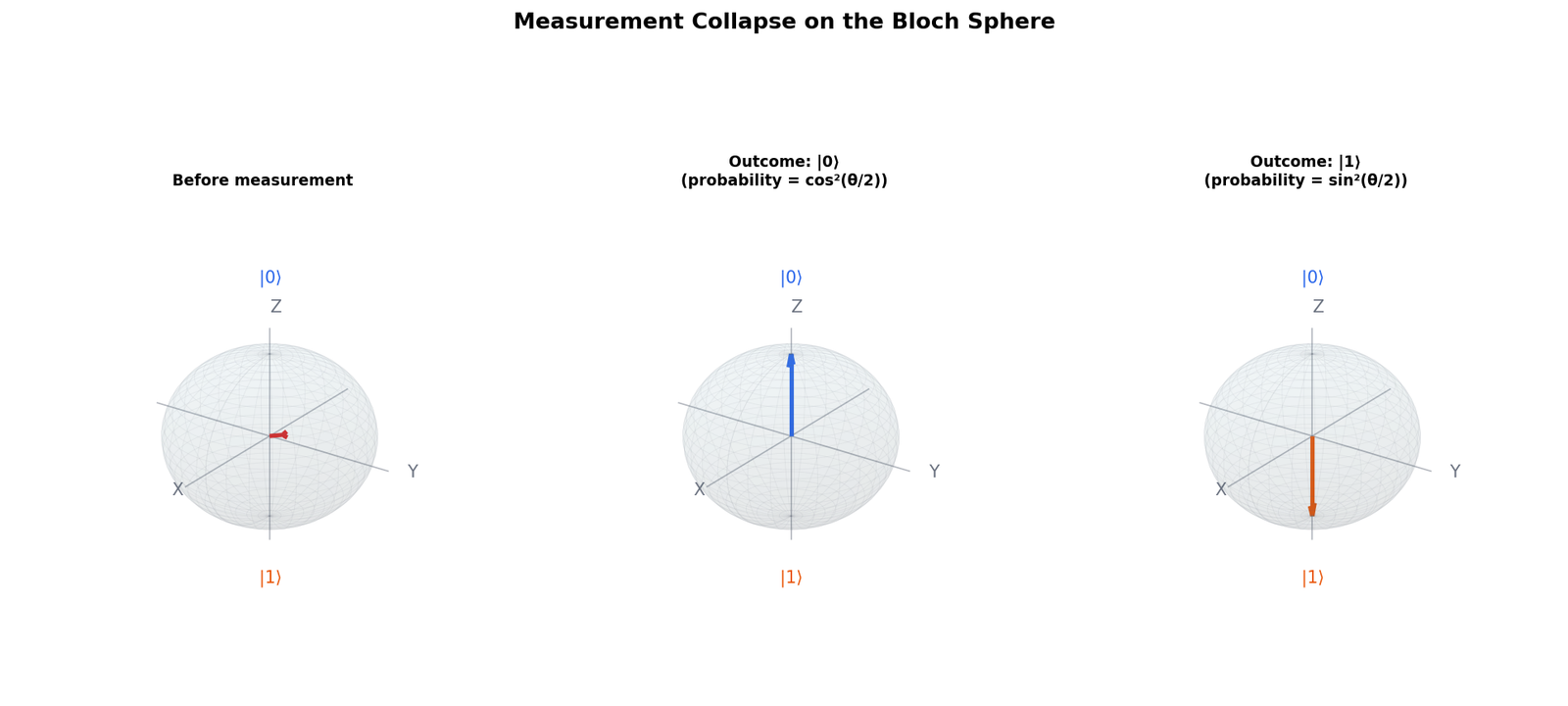
Measuring a qubit irreversibly collapses its superposition into a definite basis state according to the Born Rule
Source: mortalapps.com- Quantum measurement is an active, disruptive, and irreversible process.
- Measurement forces a qubit in superposition to collapse into one of the basis states.
- The probability of each outcome is determined by the Born Rule.
- Mathematically, measurement is described by projection operators (P₀ and P₁).
- Immediately after measurement, the qubit's state is exactly the basis state corresponding to the outcome.
- Subsequent measurements of the collapsed qubit will yield the same result with 100% certainty.
Why This Matters
In classical physics, measurement is a passive act. You can look at a car to determine its speed, or read a thermometer to find the temperature, without altering the state of the car or the air. In the quantum world, however, measurement is an active, disruptive, and irreversible intervention. It is the moment where the quantum world meets the classical world, forcing a system in superposition to abandon its rich possibilities and collapse into a single, definite reality.
In this topic, we will explore the physics and mathematics of quantum measurement. We will study the Measurement Postulate, which dictates how a state collapses upon interaction with a macroscopic device. We will analyze what happens to the state vector during and after measurement, and explore the profound philosophical and practical implications of this non-deterministic process.
By the end of this topic, you will understand the mathematical projection operators that describe measurement, calculate post-measurement states, and explain why quantum measurement is a one-way street that permanently destroys the pre-measurement superposition.
Core Intuition
Imagine you are reading a choose-your-own-adventure book. Before you make a choice, all possible endings exist in a state of potential. The story could go anywhere. But the moment you turn to page 42 and read the outcome, all other paths vanish. The story collapses into a single, definite plotline. You cannot un-read the page to restore the other possibilities. This is the essence of quantum measurement.
Another analogy is a soap bubble. While it is floating in the air, it is a beautiful, shimmering sphere reflecting light in complex patterns. But the moment you touch it to measure its properties, the bubble pops, collapsing into a single, simple droplet of soapy water. The act of measurement has completely and irreversibly altered the system.
When a qubit is in a superposition state like $|+\rangle$, it is physically in that coherent state. But when we measure it, our classical measurement apparatus forces it to choose. It must project itself onto either $|0\rangle$ or $|1\rangle$. Once it makes that choice, the original superposition is completely destroyed. If we measure the qubit again immediately after, we will get the exact same result with 100% certainty.
Visualization
Technical Explanation
Mathematically, a measurement in the computational basis is described by a set of projection operators, $P_0$ and $P_1$, which project the state vector onto the subspaces corresponding to the outcomes 0 and 1:
$$P_0 = |0\rangle\langle 0| = \begin{pmatrix} 1 \\ 0 \end{pmatrix} \begin{pmatrix} 1 & 0 \end{pmatrix} = \begin{pmatrix} 1 & 0 \\ 0 & 0 \end{pmatrix}$$ $$P_1 = |1\rangle\langle 1| = \begin{pmatrix} 0 \\ 1 \end{pmatrix} \begin{pmatrix} 0 & 1 \end{pmatrix} = \begin{pmatrix} 0 & 0 \\ 0 & 1 \end{pmatrix}$$
When we measure a qubit in state $|\psi\rangle = \alpha|0\rangle + \beta|1\rangle$, the probability of obtaining outcome $m \in \{0, 1\}$ is:
$$P(m) = \langle\psi|P_m|\psi\rangle$$
If we obtain outcome 0, the state of the qubit immediately *after* the measurement collapses to the normalized projection of the state onto the $|0\rangle$ subspace:
$$|\psi_{\text{post}}\rangle = \frac{P_0|\psi\rangle}{\sqrt{P(0)}} = \frac{\alpha|0\rangle}{|\alpha|} = e^{i\phi_0}|0\rangle \approx |0\rangle$$
Similarly, if we obtain outcome 1, the state collapses to $|1\rangle$. This collapse is discontinuous and non-unitary (it cannot be described by a smooth rotation, and it is irreversible). The pre-measurement state $|\psi\rangle$ is completely lost, replaced by the definite basis state.