Complex Numbers
Complex numbers extend the real line into a 2D plane, capturing magnitude and phase needed to describe quantum states
Source: mortalapps.com- Complex numbers extend real numbers into a 2D plane, allowing representation of both magnitude and phase.
- A complex number $z = a + bi$ has a real part $a$ and an imaginary part $b$, where $i = \sqrt{-1}$.
- The magnitude (or modulus) of $z$ is $|z| = \sqrt{a^2 + b^2}$, representing its length from the origin.
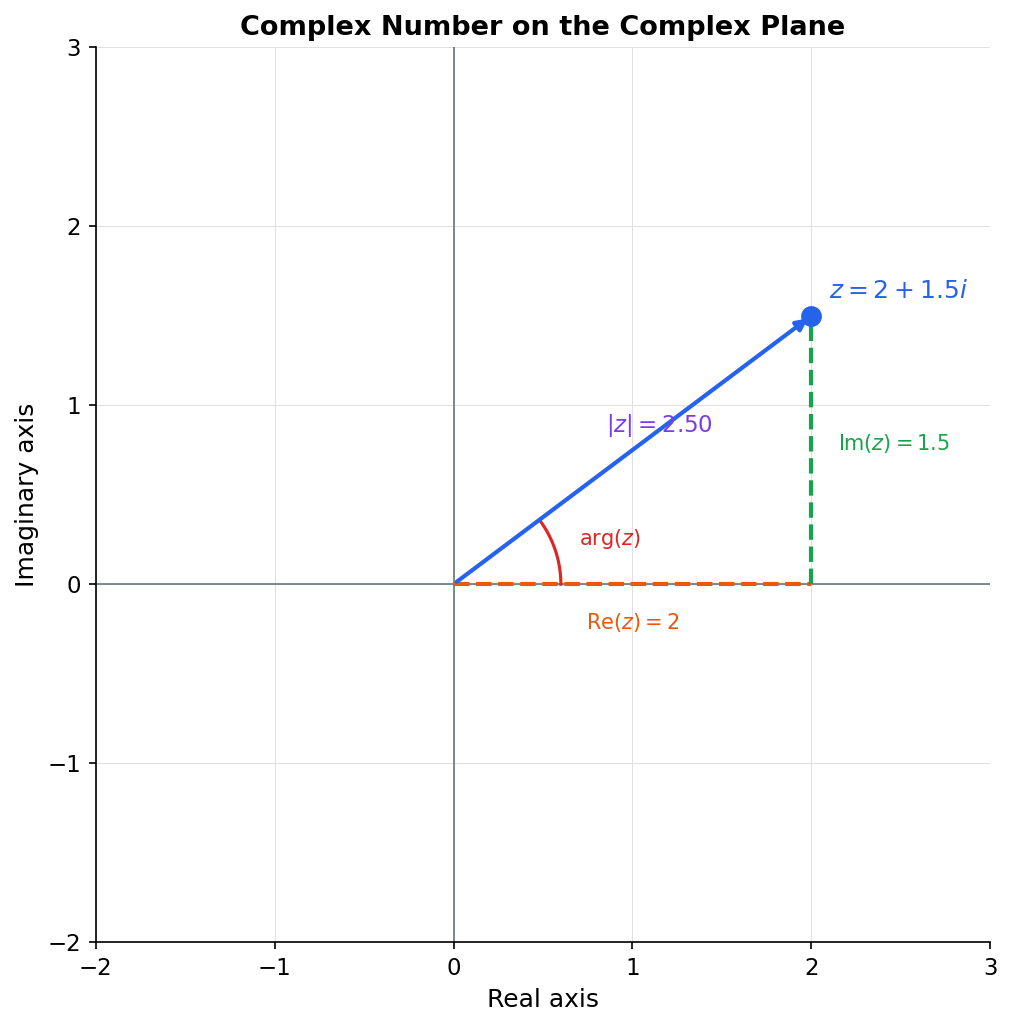
- The phase (or argument) of $z$ is the angle it makes with the positive real axis on the complex plane.
- Euler's formula, $e^{i\theta} = \cos\theta + i\sin\theta$, connects complex exponentials to circular motion.
- In quantum computing, complex numbers are used as probability amplitudes, determining measurement probabilities and enabling quantum interference.
Why This Matters
To describe a qubit in superposition, we need a number system that can capture both magnitude and phase (or direction) simultaneously. Real numbers, which you're familiar with, only allow for magnitude along a single line. However, quantum states often involve a 'direction' in a mathematical space that isn't just positive or negative, but can point anywhere in a plane.
This is where complex numbers become indispensable. They extend our familiar number line into a two-dimensional plane, allowing us to represent quantities that have both a 'real' component and an 'imaginary' component. This dual nature is perfectly suited for encoding the rich information contained within a quantum superposition.
By the end of this topic, you'll understand what complex numbers are, how to visualize them, and why their ability to represent both magnitude and phase is fundamental to describing the probabilistic and directional nature of quantum states.
Core Intuition
Imagine you're giving directions. If you only say 'go 5 miles,' that's like a real number – just a magnitude. But if you say 'go 5 miles North-East,' you've added a direction. Complex numbers do something similar for numbers themselves: they let us specify both a 'how much' (magnitude) and a 'which way' (direction or phase).
Think of a number line, stretching infinitely in two directions (positive and negative). Real numbers live on this line. Now, imagine that line is just the horizontal axis of a two-dimensional plane. We can add a vertical axis, which we'll call the 'imaginary' axis. Any point on this plane can be reached by moving a certain amount horizontally (real part) and a certain amount vertically (imaginary part).
This 'complex plane' allows us to represent numbers not just as points on a line, but as arrows originating from the center, pointing in a specific direction and having a specific length. This length is the number's magnitude, and the angle it makes with the horizontal axis is its phase. This geometric intuition is key to understanding their role in quantum mechanics.
Visualization
Technical Explanation
A complex number $z$ is typically written in the form $a + bi$, where $a$ is the 'real part' and $b$ is the 'imaginary part.' The crucial element here is $i$, which is defined as the imaginary unit, satisfying $i^2 = -1$. This means $i = \sqrt{-1}$, a concept impossible with real numbers alone.
We can visualize complex numbers on a 'complex plane,' where the horizontal axis represents the real part ($a$) and the vertical axis represents the imaginary part ($b$). A complex number $z = a + bi$ is then a point $(a, b)$ on this plane, or an arrow from the origin to that point. The length of this arrow is called the 'modulus' or 'magnitude' of the complex number, denoted $|z|$. It's calculated using the Pythagorean theorem: $$|z| = \sqrt{a^2 + b^2}$$
The angle this arrow makes with the positive real axis is called the 'argument' or 'phase,' denoted $\arg(z)$ or $\theta$. This phase is critical in quantum mechanics, as it encodes relative information between different parts of a quantum state. Another powerful way to express complex numbers is Euler's formula, which connects complex exponentials to trigonometry: $$e^{i\theta} = \cos\theta + i\sin\theta$$ Any complex number can also be written in polar form as $z = |z|e^{i\theta}$, which clearly separates its magnitude $|z|$ and its phase $\theta$. In quantum computing, the coefficients of our basis states (like $|0\rangle$ and $|1\rangle$) are complex numbers. These 'probability amplitudes' carry both magnitude (which determines the probability of measurement) and phase (which influences how the state evolves and interferes). For example, a qubit state might be described as $\alpha|0\rangle + \beta|1\rangle$, where $\alpha$ and $\beta$ are complex numbers.