Quantum Cloud Infrastructure
Physical QPUs sit in specialized data centers and are accessed via cloud APIs that queue, compile, and execute jobs
Source: mortalapps.com- Physical quantum computers are housed in specialized data centers and accessed remotely via cloud APIs.
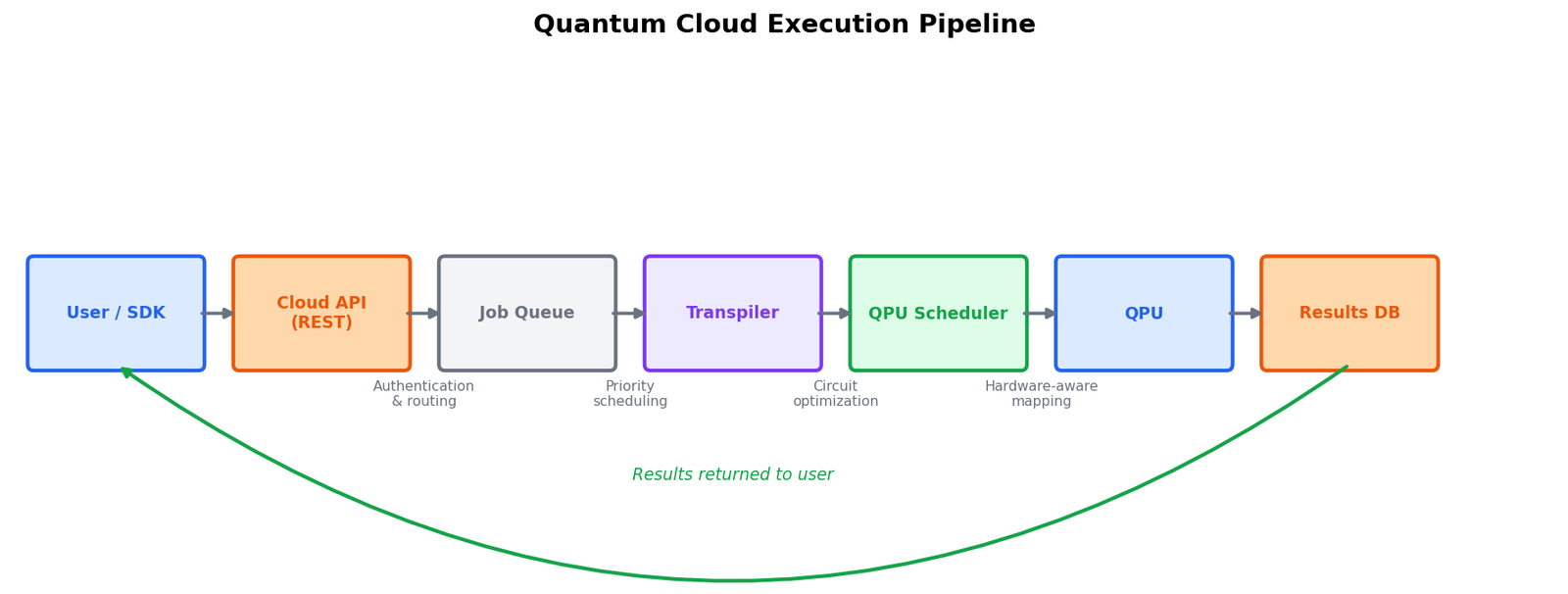
- The cloud execution pipeline includes API queueing, compilation, pulse generation, execution, and post-processing.
- Compilers use daily-updated calibration maps to route circuits around noisy physical qubits and couplers.
- Physical QPUs execute circuits asynchronously, requiring jobs to be queued and serialized.
- Hybrid runtimes co-locate classical CPUs and physical QPUs to eliminate internet latency in variational algorithms.
- Multi-hardware cloud platforms (like AWS Braket and Azure Quantum) allow users to compare different physical architectures using a single API.
Why This Matters
Almost no one owns a physical quantum computer. Because these machines require massive dilution refrigerators, ultra-precise laser systems, high-vacuum chambers, and specialized classical control racks, they are housed in highly secure, specialized data centers. Users access these physical QPUs remotely over the internet via cloud platforms. This topic explores the architecture of quantum cloud infrastructure, analyzing how a digital request is queued, compiled, executed on physical hardware, and returned to the user.
Core Intuition
To understand quantum cloud infrastructure, imagine booking time on a massive, shared scientific telescope. You do not buy the telescope and put it in your backyard; instead, you write a script specifying which coordinates to look at and what filters to use. You submit your script to a central server, which places it in a queue.
When your turn comes, the telescope's automated classical control systems point the mirror, capture the light, digitize the image, and send the data back to your laptop. Quantum cloud infrastructure works the exact same way. Your local computer does not become quantum; instead, it acts as a classical terminal that sends digital instructions to a remote quantum data center, where a physical machine executes the pulses and returns the classical measurement results.
Visualization
Technical Explanation
The quantum cloud execution pipeline consists of several highly coordinated classical and quantum steps:
1. API Request: The user writes a quantum program (e.g., in Qiskit) and submits it via an API call (such as HTTPS/WebSockets) to the cloud provider (e.g., IBM Quantum Platform or AWS Braket). 2. Authentication and Queueing: The cloud gateway authenticates the user, checks their access tier, and places the job into a priority queue. Because physical QPUs can only run one circuit at a time, jobs must be serialized. 3. Cloud Transpilation: The cloud server compiles the abstract circuit to match the target QPU's specific calibration map. This map, updated daily, contains the current $T_1, T_2$, gate error rates, and readout fidelities for every physical qubit on the chip. The compiler routes the circuit to use the highest-fidelity qubits and paths available at that exact moment. 4. Job Execution (The Pulse Barrier): The compiled circuit is sent to the data center's local controller. The digital instructions are loaded into the FPGAs, which generate the analog pulse sequences. The pulses are sent to the QPU, and the measurements are recorded. This step is repeated thousands of times (shots) to build up a probability distribution. 5. Post-Processing and Error Mitigation: The raw measurement counts are processed using classical error mitigation techniques (such as Readout Error Mitigation or Zero-Noise Extrapolation) to suppress physical hardware noise. 6. Result Return: The final classical probability distribution is packaged into a JSON object and sent back to the user's local terminal.
To minimize latency in hybrid algorithms (like VQE), cloud providers use hybrid runtimes (such as Qiskit Runtime or Amazon Braket Hybrid Jobs), where a classical CPU is co-located in the same data center as the QPU, allowing the classical-quantum optimization loop to run without internet communication latency.