Quantum Fourier Transform
The QFT maps basis states to distributed phase patterns and underpins Shor's algorithm and quantum phase estimation
Source: mortalapps.com- The QFT is the quantum version of the Discrete Fourier Transform.
- It maps computational basis states to distributed phase patterns.
- The QFT circuit requires $O(n^2)$ gates, compared to the classical FFT's $O(n 2^n)$ operations.
- It is constructed using Hadamard gates and controlled phase rotation gates.
- The output amplitudes cannot be read out directly; they must be used as an intermediate step in other algorithms.
Why This Matters
The Quantum Fourier Transform (QFT) is the quantum analogue of the classical Discrete Fourier Transform (DFT). It is not an algorithm designed to solve a standalone problem, but rather a powerful subroutine that underpins many of the most famous quantum algorithms, including Shor's factoring algorithm and Quantum Phase Estimation.
Core Intuition
Imagine a clock with a single hand. If you set the clock to 3 o'clock, that is a discrete, localized state. The classical Fourier transform takes a sequence of such positions and finds the underlying frequencies. The Quantum Fourier Transform does this directly on the state of qubits. Instead of representing a number $j$ as a binary string (like $|011\rangle$), the QFT encodes $j$ as a series of phase rotations on the qubits. Qubit 1 rotates by a half-turn, Qubit 2 by a quarter-turn, and Qubit 3 by an eighth-turn. By translating localized computational states into distributed phase patterns, the QFT allows us to detect periodic patterns in quantum states with exponential efficiency.
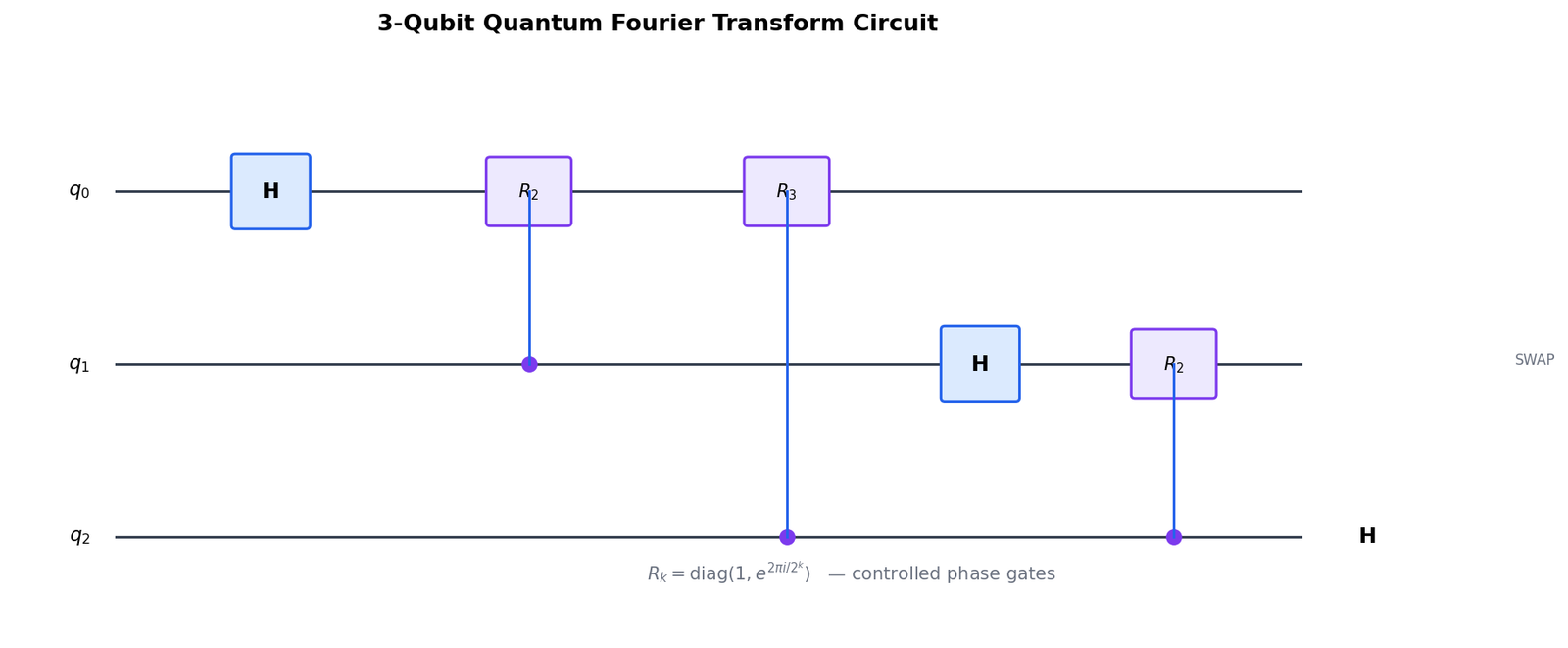
Visualization
Technical Explanation
The Discrete Fourier Transform (DFT) maps a vector of complex numbers $(x_0, \dots, x_{N-1})$ to $(y_0, \dots, y_{N-1})$ according to:
$$y_k = \frac{1}{\sqrt{N}} \sum_{j=0}^{N-1} x_j e^{2\pi i j k / N}$$
The Quantum Fourier Transform (QFT) performs this exact transformation on the amplitudes of a quantum state. It maps the basis state $|j\rangle$ to a superposition of basis states:
$$|j\rangle \mapsto \text{QFT}|j\rangle = \frac{1}{\sqrt{N}} \sum_{k=0}^{N-1} e^{2\pi i j k / N} |k\rangle$$
where $N = 2^n$.
Product Representation: To implement this as a circuit, we can rewrite the QFT state in a product form:
$$|j\rangle \mapsto \frac{1}{\sqrt{2^n}} \left( |0\rangle + e^{2\pi i 0.j_n} |1\rangle \right) \otimes \dots \otimes \left( |0\rangle + e^{2\pi i 0.j_1 j_2 \dots j_n} |1\rangle \right)$$
where $0.j_1 j_2 \dots j_n = \sum_{l=1}^n j_l 2^{-l}$ is binary fraction notation.
Complexity Comparison:
- Classical FFT: $O(N \log N) = O(n 2^n)$ operations.
- Quantum QFT: $O(n^2)$ gates.
Circuit Construction: The QFT circuit is constructed using Hadamard gates ($H$) and controlled phase rotation gates ($R_k$), where:
$$R_k = \begin{pmatrix} 1 & 0 \\ 0 & e^{2\pi i / 2^k} \end{pmatrix}$$
For each qubit $i$ (from $1$ to $n$): 1. Apply $H$ to qubit $i$. 2. For each remaining qubit $j > i$, apply a controlled-$R_{j-i+1}$ gate with qubit $j$ as control and qubit $i$ as target. 3. Reverse the order of the qubits at the end using SWAP gates.