Quantum Interference
Quantum algorithms use phase manipulation to amplify correct answer amplitudes and destructively cancel wrong ones
Source: mortalapps.com- Quantum interference is the process of using phase relationships to amplify or suppress probability amplitudes.
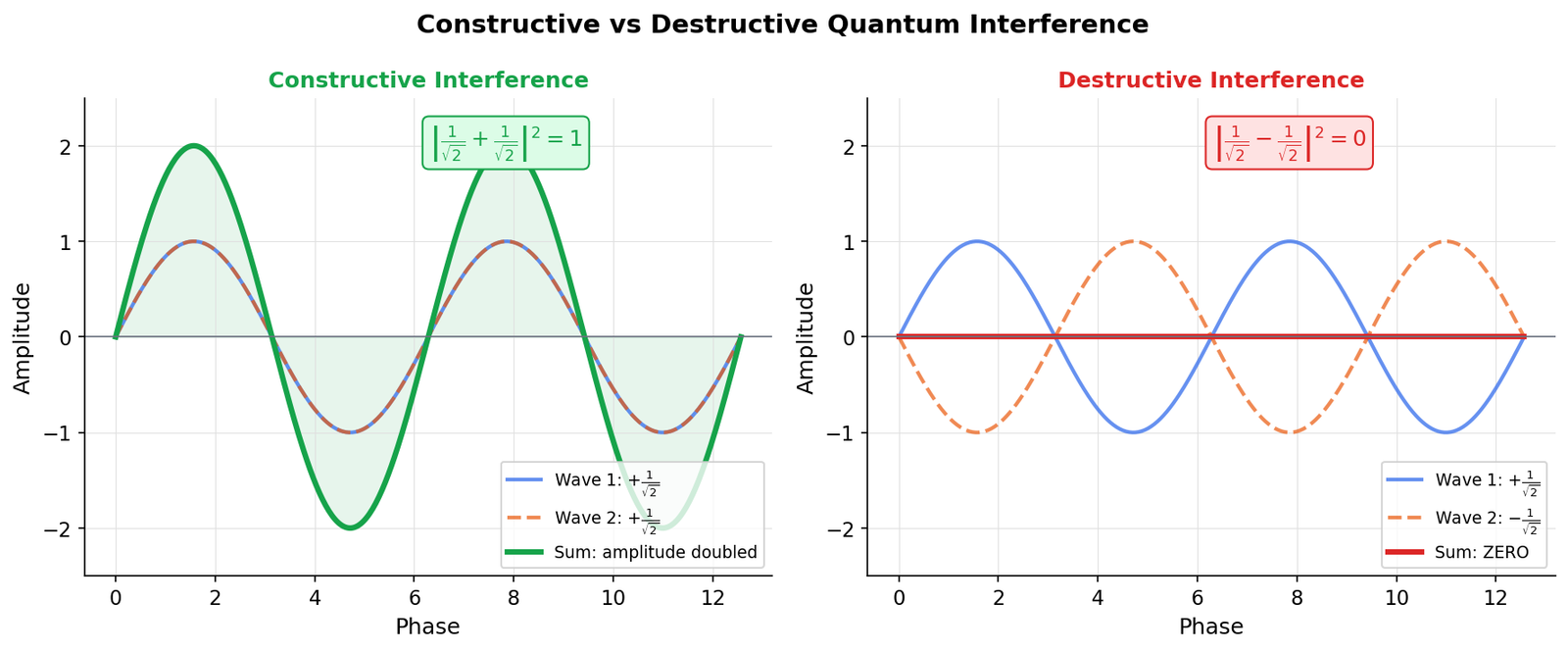
- Amplitudes add linearly; if they are in phase, they reinforce (constructive); if out of phase, they cancel (destructive).
- Phase shifts do not change measurement probabilities directly, but can be converted to probability changes using basis changes.
- The Hadamard gate is the fundamental tool for converting phase differences into measurable probability differences.
- Phase kickback is a phenomenon where a controlled gate transfers phase information from the target to the control qubit.
- All quantum speedups rely on designing circuits where incorrect answers interfere destructively and correct answers interfere constructively.
- Maintaining phase coherence is the primary engineering challenge for physical quantum hardware.
Why This Matters
Superposition and entanglement are powerful, but they are not enough to solve computational problems. If we simply create a massive superposition and measure it, we will get a completely random result, which is no better than classical guessing. To harness the power of quantum computing, we must use quantum interference.
In this topic, we will explore quantum interference in circuits. Interference is the process of manipulating the phases of quantum states so that the probability amplitudes of incorrect answers cancel each other out (destructive interference), while the amplitudes of correct answers add together (constructive interference).
By the end of this topic, you will understand how phase shifts are converted into probability changes, how the Hadamard gate acts as an interference engine, and how to trace the flow of phase information through a circuit to steer the system toward a desired outcome.
Core Intuition
Imagine you are trying to find the exit of a maze. In a classical search, you must try one path at a time. In a quantum search, you can explore all paths simultaneously in a superposition.
However, when you reach the end, you must measure the system. If all paths have equal probability, you will just pick a random path, likely a dead end. To prevent this, we use interference.
Think of each path as a wave. We design the circuit so that the waves traveling down dead-end paths are out of phase (crests meet troughs) and cancel each other out (destructive interference). Meanwhile, the waves traveling down the correct path are in phase (crests meet crests) and reinforce each other (constructive interference). When we measure, the probability of finding the correct path is amplified to nearly 100%.
Visualization
Technical Explanation
Quantum interference occurs because probability amplitudes are complex numbers, which have both a magnitude and a phase. When we combine states, their amplitudes add linearly. If we have two paths leading to the same state with amplitudes $a_1 = r_1 e^{i\theta_1}$ and $a_2 = r_2 e^{i\theta_2}$, the final amplitude is $a_{\text{final}} = a_1 + a_2$.
The resulting probability is the square of the magnitude: $$P = |a_1 + a_2|^2 = |a_1|^2 + |a_2|^2 + 2|a_1||a_2|\cos(\theta_1 - \theta_2)$$
The third term, $2|a_1||a_2|\cos(\theta_1 - \theta_2)$, is the interference term. If the phases are aligned ($\theta_1 = \theta_2$), then $\cos(0) = 1$, resulting in constructive interference (probability is maximized). If the phases are opposite ($\theta_1 - \theta_2 = \pi$), then $\cos(\pi) = -1$, resulting in destructive interference (probability is minimized).
The Hadamard gate is the primary tool for converting phase differences into probability differences. Recall that: $$H|+\rangle = |0\rangle, \quad H|-\rangle = |1\rangle$$
The state $|+\rangle = \frac{1}{\sqrt{2}}(|0\rangle + |1\rangle)$ has a relative phase of $0$ (constructive interference at $|0\rangle$). The state $|-\rangle = \frac{1}{\sqrt{2}}(|0\rangle - |1\rangle)$ has a relative phase of $\pi$ (destructive interference at $|0\rangle$, constructive at $|1\rangle$). By applying phase gates and then a Hadamard, we can steer the state between $|0\rangle$ and $|1\rangle$.