Hardware Tradeoffs
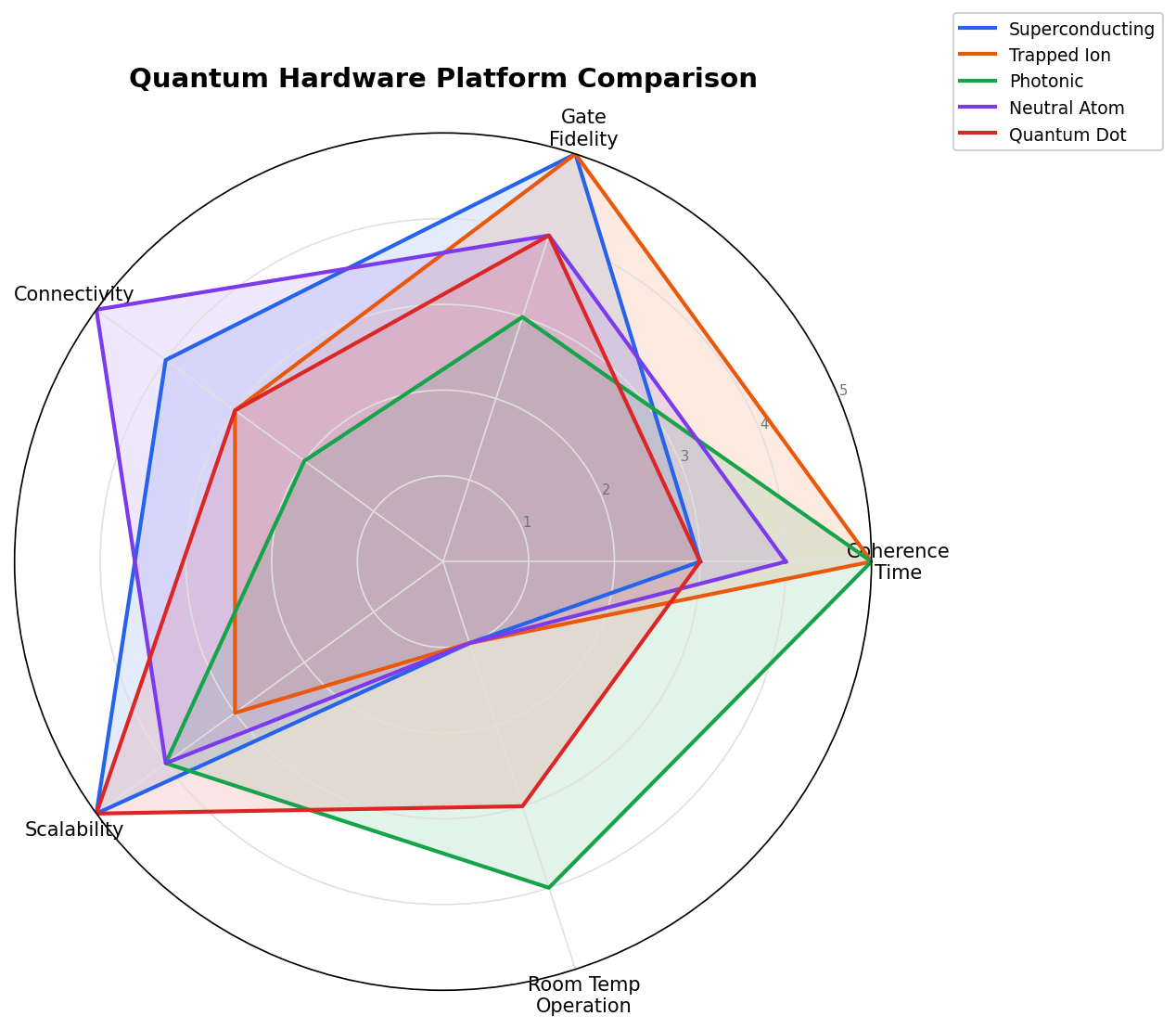
No hardware platform wins on all metrics, the coherence-to-gate-time ratio defines the maximum achievable circuit depth
Source: mortalapps.com- There is no single 'winning' quantum hardware platform; each represents a different set of physical trade-offs.
- The Coherence-to-Gate-Time Ratio ($T_2 / t_{\text{gate}}$) determines the maximum sequential circuit depth.
- Superconducting qubits offer fast gates but short coherence and nearest-neighbor connectivity.
- Trapped ions offer long coherence and all-to-all connectivity but suffer from slow gate speeds.
- Silicon spin qubits offer extreme physical density but face severe wiring and crosstalk challenges.
- Atomic platforms offer identical qubits but require complex vacuum and optical control systems.
Why This Matters
There is currently no 'perfect' quantum hardware platform. Every physical implementation of a qubit, whether superconducting, trapped ion, photonic, neutral atom, or quantum dot, excel in certain metrics while performing poorly in others. Building a quantum computer is a multi-dimensional optimization problem where engineers must make fundamental physical trade-offs. This topic explores these tradeoffs, analyzing how gate speed, coherence time, connectivity, and physical footprint interact to define the capabilities of each platform.
Core Intuition
To understand hardware trade-offs, imagine choosing a vehicle for a specific job. A dragster (representing superconducting qubits) is incredibly fast (nanosecond gates) but has a very short range and is highly fragile (short coherence times). A cargo train (representing trapped ions) is slow to start and move (microsecond gates) but is incredibly reliable, can travel massive distances without breaking down (long coherence times), and can easily connect any car to any other car (all-to-all connectivity).
Meanwhile, a fleet of delivery drones (representing photonic qubits) travels at the speed of light and doesn't need a specialized road network, but the drones can easily get lost in the wind (photon loss) and are hard to coordinate to work together. There is no single 'best' vehicle; the optimal choice depends entirely on the mission. In quantum computing, we must evaluate platforms across multiple competing dimensions to understand which is best suited for specific algorithms and scaling paths.
Visualization
Technical Explanation
We can quantitatively analyze hardware trade-offs using several key physical metrics:
1. The Coherence-to-Gate-Time Ratio: This dimensionless figure of merit, defined as: $$F_m = \frac{T_2}{t_{\text{gate}}}$$ measures the theoretical maximum number of gate operations that can be performed in sequence before coherence is lost. For superconducting qubits, $F_m \approx 100\ \mu\text{s} / 100\text{ ns} = 10^3$. For trapped ions, $F_m \approx 10\text{ s} / 100\ \mu\text{s} = 10^5$. This shows that despite slower gates, trapped ions can support much deeper circuits before decoherence dominates.
2. Connectivity vs. Gate Speed: Trapped ions offer all-to-all connectivity within a single module, meaning any qubit can interact directly with any other. However, this interaction is mediated by slow motional modes ($t_{\text{gate}} \sim 100\ \mu\text{s}$). Superconducting qubits have fast gates ($t_{\text{gate}} \sim 20\text{ ns}$) but are limited to nearest-neighbor connectivity on a 2D grid. To perform a gate between distant qubits, the compiler must insert SWAP gates, which adds latency and accumulates errors.
3. Physical Footprint vs. Control Complexity: Silicon spin qubits have an incredibly small physical footprint (nanometer scale), allowing for high density. However, this density makes routing individual control lines extremely difficult, leading to severe crosstalk. Trapped ions are larger and require complex, bulky optical laser systems to address each ion individually, trading chip-level simplicity for system-level optical complexity.
4. Identical Qubits vs. Fabrication Yield: Atomic platforms (ions and neutral atoms) use natural isotopes, which are absolutely identical by nature, eliminating fabrication variance. However, they require complex vacuum and laser systems. Solid-state platforms (superconducting and dots) can be fabricated using standard semiconductor processes, but suffer from fabrication variance, requiring individual calibration for every single qubit.