Grover's Search Algorithm
Grover's algorithm searches an N-item unsorted database in O(sqrt(N)) queries, a provable quadratic speedup classically
Source: mortalapps.com- Grover's algorithm searches an unstructured database of size $N$ in $O(\sqrt{N})$ queries.
- It achieves a provable quadratic speedup over the classical $O(N)$ limit.
- The algorithm uses two reflections (oracle and diffusion) to perform a geometric rotation.
- The optimal number of iterations is approximately $\frac{\pi}{4}\sqrt{N}$.
- Applying too many iterations causes over-rotation, reducing the success probability.
Why This Matters
Grover's Search Algorithm, developed by Lov Grover in 1996, is one of the cornerstones of quantum computing. Unlike the previous algorithms which require highly specific mathematical structures to achieve speedups, Grover's algorithm solves a completely unstructured problem: searching an unsorted database of $N$ items. It achieves a provable quadratic speedup, reducing the search time from $O(N)$ to $O(\sqrt{N})$.
Core Intuition
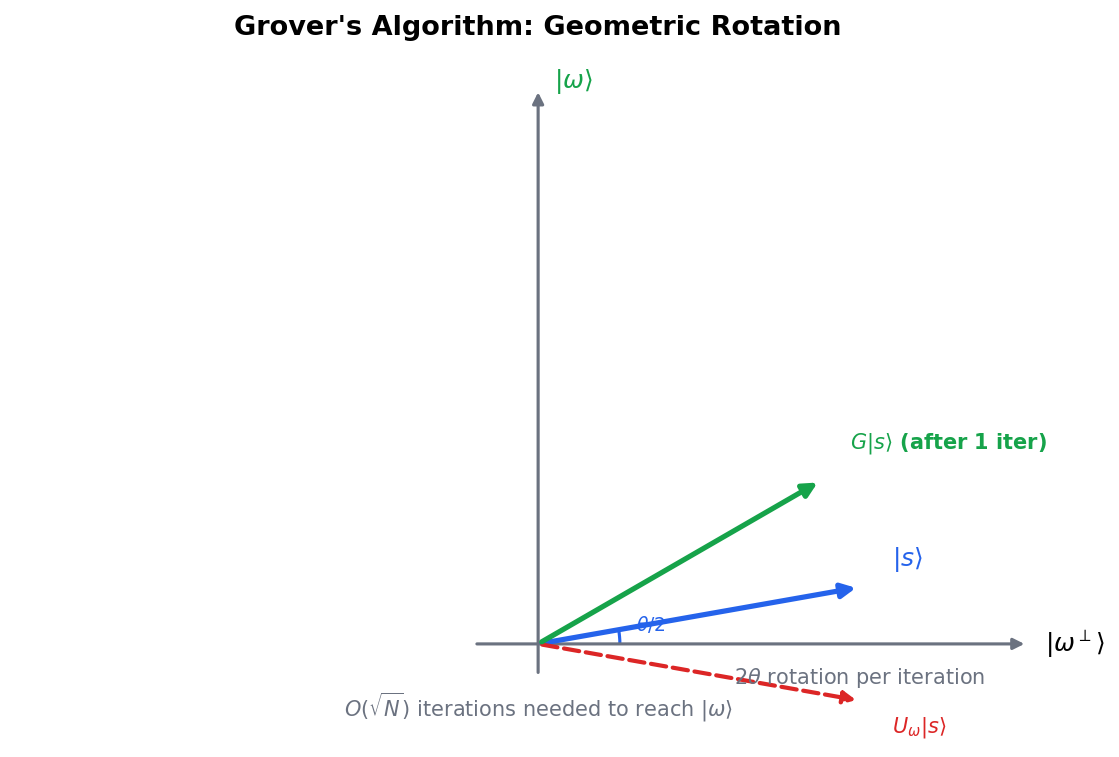
Imagine a massive ring of $N$ lightbulbs, all turned off except for one 'marked' bulb. Classically, you must unscrew each bulb one by one to find the marked one. On average, this takes $N/2$ steps. Grover's algorithm treats the state of the system as a vector in a 2D plane. Initially, the vector points almost entirely toward the 'unmarked' states. In each step, the algorithm performs two geometric reflections: first, it reflects the vector across the unmarked plane (using the oracle), and second, it reflects the vector across the starting superposition state (using the diffusion operator). Each double-reflection rotates the vector closer to the 'marked' state by a small angle. After approximately $\frac{\pi}{4}\sqrt{N}$ rotations, the vector points almost perfectly at the marked state, and a single measurement reveals the target with near-100% probability.
Visualization
Technical Explanation
Let $N = 2^n$ be the size of the search space. We have an oracle $U_\omega$ that marks a unique target state $|\omega\rangle$:
$$U_\omega |x\rangle = \begin{cases} -|x\rangle & \text{if } x = \omega \\ |x\rangle & \text{if } x \neq \omega \end{cases}$$
This can be written as $U_\omega = I - 2|\omega\rangle\langle\omega|$.
Classical Complexity: $O(N)$ queries. Quantum Complexity: $O(\sqrt{N})$ queries.
Grover Iteration: The algorithm starts by preparing a uniform superposition state $|s\rangle = \frac{1}{\sqrt{N}} \sum_{x=0}^{N-1} |x\rangle$. We define the Grover iteration operator $G$ as:
$$G = D \cdot U_\omega$$
where $D$ is the diffusion operator (or inversion about the mean), defined as:
$$D = 2|s\rangle\langle s| - I = H^{\otimes n} (2|0\rangle\langle0|^{\otimes n} - I) H^{\otimes n}$$
Geometric Derivation of Iterations: Let $|\omega^\perp\rangle = \frac{1}{\sqrt{N-1}} \sum_{x \neq \dots} |x\rangle$ be the uniform superposition of all non-target states. We can express the starting state $|s\rangle$ in the 2D orthonormal basis $\{|\omega^\perp\rangle, |\omega\rangle\}$:
$$|s\rangle = \cos(\theta/2)|\omega^\perp\rangle + \sin(\theta/2)|\omega\rangle$$
where $\sin(\theta/2) = \frac{1}{\sqrt{N}}$. For large $N$, $\theta \approx \frac{2}{\sqrt{N}}$.
1. Oracle Reflection ($U_\omega$): Reflects the state across the $|\omega^\perp\rangle$ axis, changing the sign of the $|\omega\rangle$ component. 2. Diffusion Reflection ($D$): Reflects the state across the $|s\rangle$ vector.
The combined action of these two reflections is a rotation in the 2D plane by an angle of exactly $\theta$. To rotate the state from its initial angle of $\theta/2$ to the target angle of $\pi/2$ (where it points entirely along $|\omega\rangle$), we require $R$ iterations:
$$R \cdot \theta + \frac{\theta}{2} \approx \frac{\pi}{2} \implies R \approx \frac{\pi}{4}\theta^{-1} \approx \frac{\pi}{4}\sqrt{N}$$
Applying $G$ more than $R$ times will over-rotate the state, causing the probability of measuring the target to decrease.