Current Challenges
Qubit decoherence, gate errors, and short coherence times are the main obstacles blocking scalable quantum computation
Source: mortalapps.com- Qubits are extremely fragile and prone to losing their quantum properties (decoherence) due to environmental noise.
- Decoherence limits the time available for quantum computations and introduces errors.
- Current quantum computers are 'noisy' and have high error rates, limiting circuit complexity.
- Scaling up to thousands or millions of high-quality qubits is a major engineering challenge.
- Controlling and connecting many qubits precisely without interference is very difficult.
- Many quantum computers require extreme conditions like cryogenic temperatures and ultra-high vacuum.
- Overcoming these challenges is essential for building fault-tolerant quantum computers capable of practical applications.
Why This Matters
We've explored the incredible potential of quantum computing and met the innovators driving its development. It's an exciting field, but like any revolutionary technology, it faces significant hurdles. Building and operating quantum computers is one of the most complex engineering challenges of our time.
This topic will provide a realistic look at the 'hard problems' within quantum computing itself. We'll discuss the major technical and scientific obstacles that researchers and engineers are working tirelessly to overcome, from the fragility of qubits to the difficulty of scaling up these intricate systems.
By the end of this topic, you'll understand that while quantum computing holds immense promise, it's still in its early stages, and there are substantial challenges that need to be addressed before its full potential can be realized.
Core Intuition
Imagine trying to build a house of cards on a vibrating table, in a room full of people talking loudly, while trying to keep the temperature perfectly stable. That's a bit like building a quantum computer.
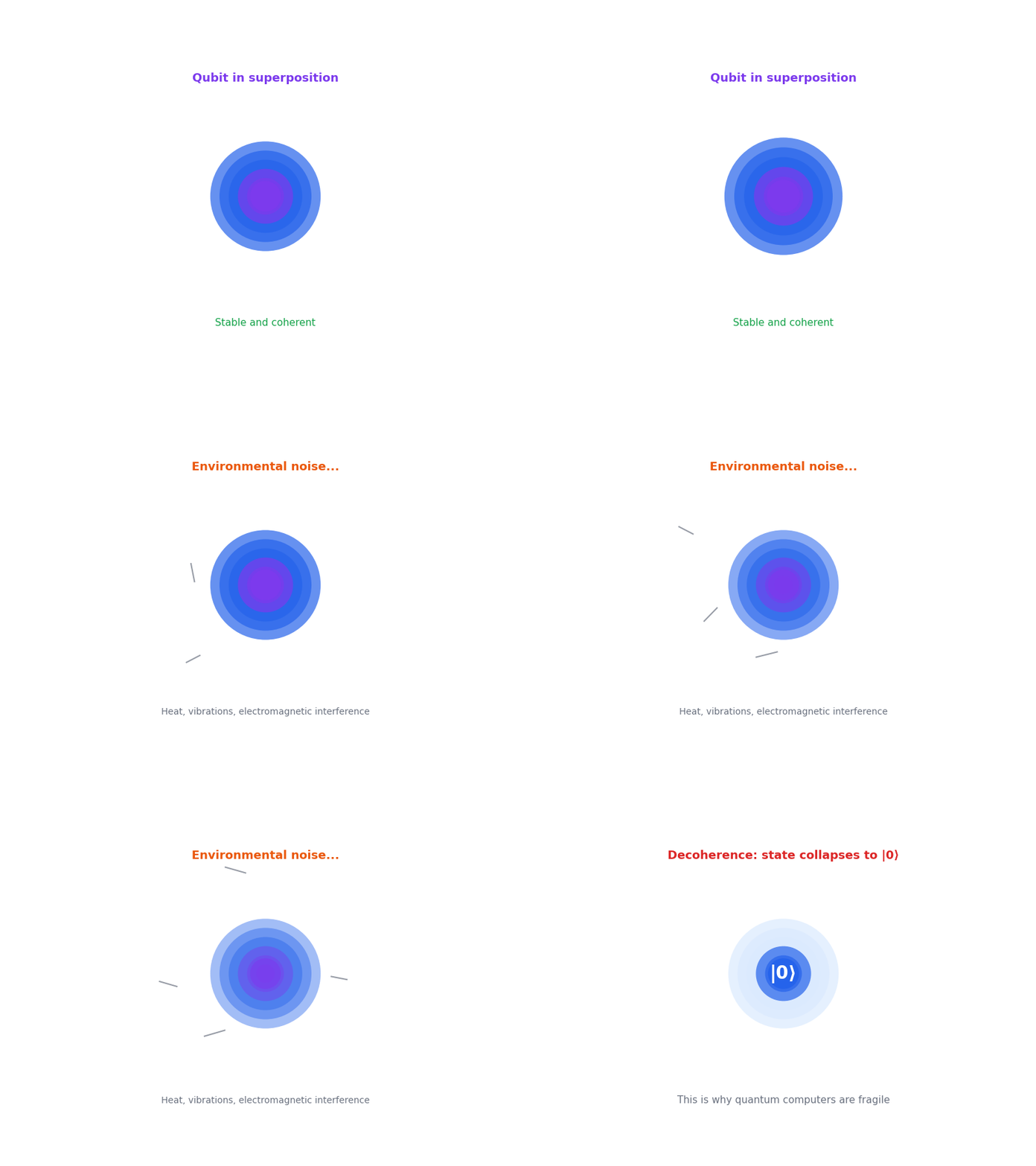
Qubits are incredibly delicate. Their quantum properties (superposition, entanglement) are easily destroyed by even the slightest interaction with their environment – a stray vibration, a tiny change in temperature, or an electromagnetic wave. This 'decoherence' is like the house of cards collapsing. Keeping qubits stable and isolated for long enough to perform a computation is extremely difficult.
Then, imagine you need to build not just one house of cards, but a thousand, all perfectly connected and stable. That's the 'scaling' challenge. We need many, many qubits to solve truly useful problems, but making them all work together without collapsing is a monumental engineering feat. It's like trying to conduct a symphony with instruments that constantly go out of tune or disappear entirely.
Visualization
Technical Explanation
Building and operating quantum computers presents several formidable challenges that researchers and engineers are actively working to overcome:
1. Qubit Fragility (Decoherence): Qubits are extremely sensitive to their environment. Any unwanted interaction with heat, stray electromagnetic fields, or even vibrations can cause them to lose their quantum properties (superposition and entanglement) and collapse into a classical state. This process is called decoherence. Maintaining qubits in their delicate quantum states for long enough to perform complex computations is a major hurdle, often requiring extreme isolation (e.g., near absolute zero temperatures, ultra-high vacuum).
2. Error Rates: Current quantum computers are 'noisy.' Qubit operations are not perfectly accurate, and decoherence leads to errors. These errors accumulate rapidly, limiting the depth and complexity of quantum circuits that can be run reliably. Unlike classical computers where errors are rare and easily corrected, quantum errors are more complex and require sophisticated techniques.
3. Scalability: To solve truly impactful problems, quantum computers will need hundreds, thousands, or even millions of stable, high-quality qubits. Current machines typically have tens or a few hundreds of qubits. Scaling up while maintaining qubit quality, connectivity, and control is an immense engineering challenge. It's not just about adding more qubits, but ensuring they all work together reliably.
4. Qubit Connectivity and Control: As the number of qubits increases, so does the complexity of controlling them individually and enabling them to interact (entangle) with specific other qubits. Each qubit often requires its own set of control signals (e.g., microwave pulses, laser beams), and routing these signals without interference becomes incredibly difficult.
5. Software and Algorithm Development: While quantum algorithms exist, developing new ones and optimizing existing ones for specific hardware architectures is an ongoing challenge. Bridging the gap between theoretical algorithms and practical implementations on noisy, limited hardware requires significant innovation in quantum software engineering.
6. Cryogenic and Vacuum Requirements: Many leading qubit technologies (e.g., superconducting qubits) require extreme cooling to temperatures colder than deep space (millikelvin range) and ultra-high vacuum environments. These requirements make the hardware bulky, expensive, and difficult to maintain, limiting their accessibility and deployment.
Overcoming these challenges is essential for moving quantum computing from its current 'Noisy Intermediate-Scale Quantum' (NISQ) era to a future of fault-tolerant, large-scale quantum computers capable of solving commercially relevant problems.