Noise Reduction Techniques
Physical noise has low-frequency structure suppressible via dynamical decoupling and pulse shaping at the hardware layer
Source: mortalapps.com- Noise Reduction Techniques operate at the physical hardware layer to shield qubits from environmental noise.
- Environmental noise often has low-frequency structures that can be actively canceled out using electromagnetic pulses.
- The Spin Echo (Hahn Echo) uses a single pi-pulse (X gate) to reverse phase dephasing caused by static field fluctuations.
- Dynamical Decoupling (DD) extends this concept by applying rapid, periodic sequences of pulses (e.g., CPMG, XY4).
- DD acts as a high-pass filter, letting high-frequency signals through while blocking low-frequency environmental noise.
- DD is an open-loop control technique, requiring no active measurements or feedback loops.
- Physical noise reduction is a crucial first line of defense, lowering raw error rates so that QEC can function efficiently.
Why This Matters
Before we apply complex software-level error correction or mitigation, we must first do everything possible to protect our physical qubits at the hardware level. Physical noise is not a completely random, white-noise process; it often has structure, correlation, and characteristic timescales. By understanding the physical nature of environmental noise, we can design active control techniques to shield our qubits and dramatically extend their coherence times.
These physical-level noise reduction techniques operate at the boundary of quantum physics and electrical engineering. Instead of changing the physical materials of the chip, they use carefully timed sequences of electromagnetic pulses to dynamically decouple the qubits from their noisy environments. This process actively cancels out low-frequency noise, effectively 'resetting' the qubit's phase before it can drift.
In this topic, we will explore the physics of noise reduction. We will analyze the Spin Echo effect, the foundational concept of dynamical decoupling, and examine modern Dynamical Decoupling (DD) pulse sequences like CPMG and XY4. You will learn how these physical-level techniques act as the first line of defense, lowering the raw physical error rate so that the upper layers of error correction can function efficiently.
Core Intuition
To understand dynamical decoupling, imagine you are driving a car down a highly bumpy, unpaved dirt road. The bumps represent environmental noise that constantly jolts your steering wheel, threatening to push your car off the road (analogous to phase dephasing destroying your qubit's state).
One way to handle this is to let the car drift, take photos of the tire tracks afterward, and mathematically calculate where the road was. This is like error mitigation. Another way is to build a massive, heavy-duty armored vehicle with 49 wheels that can absorb any bump. This is like error correction.
Dynamical decoupling is like a highly active, computerized suspension system. It constantly measures the vibrations of the wheels and applies rapid, opposite counter-forces to the chassis every millisecond. By actively fighting the bumps in real-time, the suspension keeps the car riding perfectly smooth and straight, despite the terrible road conditions. You never paved the road, but you actively neutralized the noise.
Another classic analogy is the 'Spin Echo' effect, which is like a race where runners start at the same line but run at slightly different speeds. After a few seconds, the runners are highly spread out (dephased). If the referee suddenly blows a whistle and commands everyone to turn around $180^{\circ}$ and run back at their same speeds, the faster runners will now be behind the slower ones. Exactly at the starting line, all runners will miraculously regroup and cross the line at the exact same instant. The dephasing has been completely reversed, and the 'echo' of the original state is recovered.
Visualization
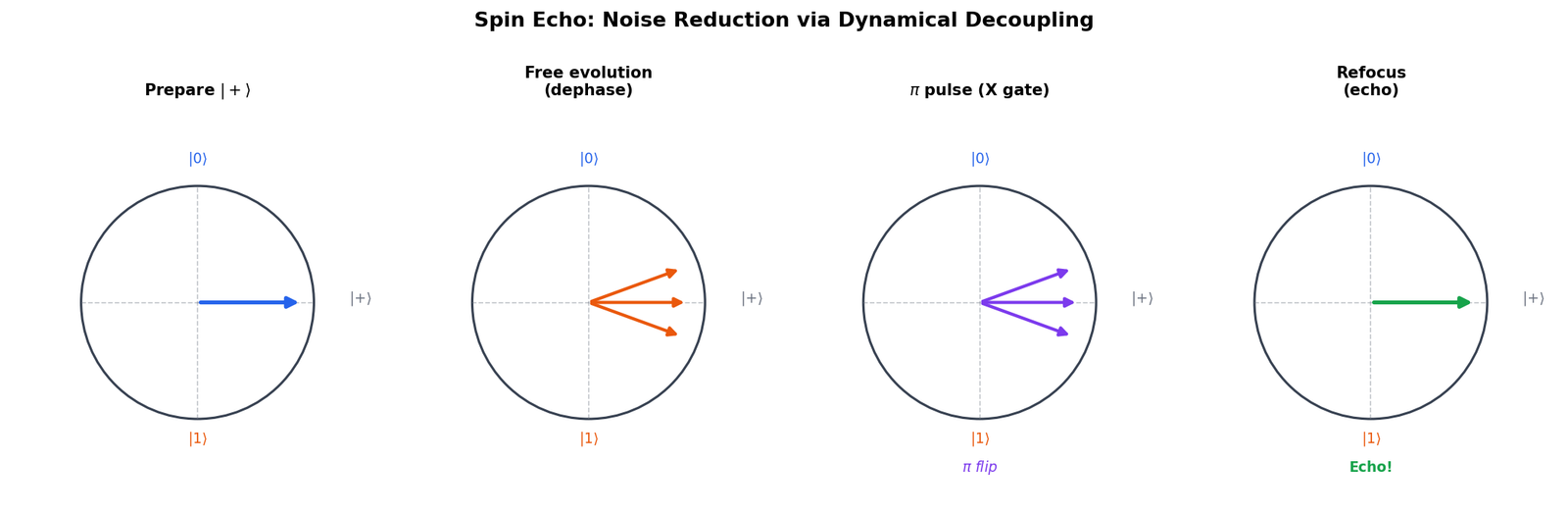
Technical Explanation
The foundational physical mechanism for noise reduction is the Spin Echo (or Hahn Echo), first discovered in nuclear magnetic resonance (NMR). Consider a qubit subject to low-frequency environmental phase noise, described by a time-varying Hamiltonian $H(t) = \frac{1}{2} [\omega_0 + \beta(t)] Z$, where $\omega_0$ is the qubit transition frequency and $\beta(t)$ represents slow fluctuations in the local magnetic field (dephasing noise).
If we initialize the qubit in the superposition state $|+\rangle = \frac{1}{\sqrt{2}}(|0\rangle + |1\rangle)$, the state will accumulate a random phase $\phi(t) = \int_0^t \beta(\tau) d\tau$ over time, causing the state vector to drift away from the x-axis on the Bloch sphere. This is transverse dephasing, limiting the coherence time $T_2$.
To reverse this drift, we apply a short, intense electromagnetic pulse, a $\pi$-pulse (or $X$ gate), at time $t = \tau$. This pulse rotates the state vector by $180^{\circ}$ around the x-axis, effectively mapping:
$$\alpha|0\rangle + \beta e^{i\phi}|1\rangle \xrightarrow{\pi\text{-pulse}} \beta e^{i\phi}|0\rangle + \alpha|1\rangle$$
If the noise $\beta(t)$ is slow and remains constant over the interval (quasi-static noise, where $\beta(t) \approx \beta_0$), the state will continue to accumulate phase at the same rate. At time $t = 2\tau$, the total accumulated phase is:
$$\phi(2\tau) = \int_0^{\tau} \beta_0 d\tau - \int_{\tau}^{2\tau} \beta_0 d\tau = \beta_0 \tau - \beta_0 \tau = 0$$
The random phase accumulation is perfectly canceled out, and the qubit state refocuses back to its original pure state at $t = 2\tau$. This is the spin echo. Modern Dynamical Decoupling (DD) sequences, such as the CPMG (Carr-Purcell-Meiboom-Gill) or XY4 sequences, repeat these $\pi$-pulses at high frequencies to filter out complex, high-frequency noise spectrums, effectively extending the coherence time from $T_2$ to $T_{2}^{\text{DD}}$, which can be orders of magnitude longer.