Open Research Problems
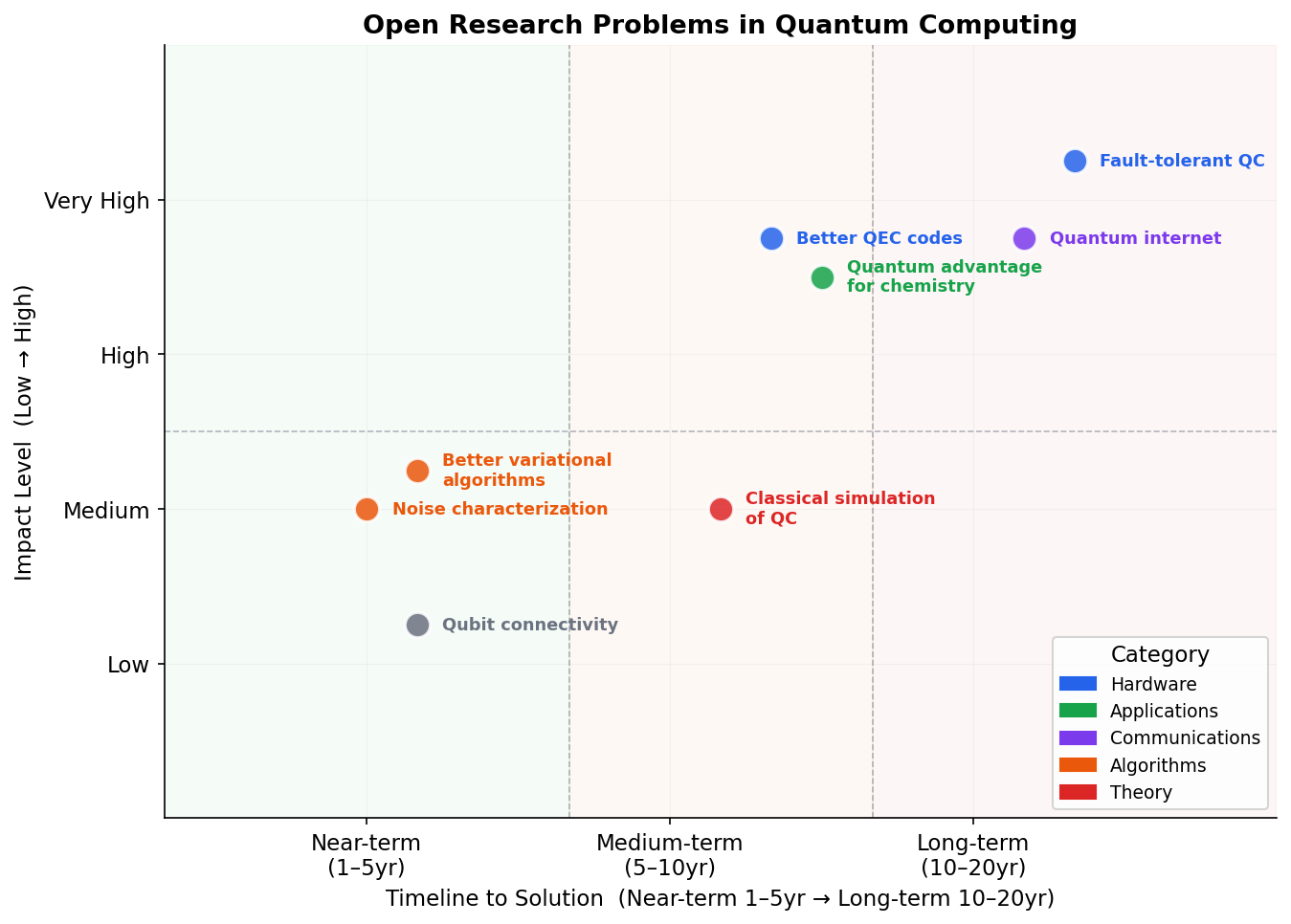
Open problems include QRAM design, coherence extension, magic state distillation overhead, and the BQP vs NP question
Source: mortalapps.com- The transition to utility-scale quantum computing requires solving deep scientific and engineering bottlenecks.
- QRAM is an unsolved hardware challenge required to load classical data into quantum states in superposition.
- Proving a practical 'NISQ Advantage' without error correction remains a major open goal for near-term systems.
- Error mitigation is a temporary bridge to fault tolerance, but it scales exponentially in classical post-processing cost.
- LDPC codes represent a major theoretical research area that could drastically reduce the physical qubit overhead.
- Each physical qubit platform (superconducting, ions, atoms, silicon) faces unique, unsolved scaling challenges.
Why This Matters
Despite the extraordinary breakthroughs of the past few years, quantum computing is still in its infancy. The transition from small-scale demonstrations to commercially viable, utility-scale systems requires solving some of the deepest scientific and engineering challenges ever faced by humanity. In this topic, we will explore the open research problems that define the current frontier of quantum information science.
Core Intuition
To understand the open problems in quantum computing, imagine trying to build a massive, multi-story skyscraper on a swamp. We have proven we can build a beautiful, small one-story cabin (our current NISQ devices) that stays dry. But if we try to stack fifty stories on top of it, the foundation will sink into the mud. We need to invent completely new types of deep-foundation pilings (quantum error correction and physical scaling) before we can build the skyscraper.
Another analogy is the early days of the internet. We had powerful computers, but we didn't have high-speed fiber optic cables or routers. If you wanted to share a file, you had to physically carry a floppy disk to another computer. In quantum computing, we have qubits, but we don't have an efficient way to load massive classical databases into quantum states. This is the 'QRAM' bottleneck, and solving it is like inventing the high-speed network cables of the quantum era.
Visualization
Technical Explanation
One of the most critical open research problems is the realization of Quantum Random Access Memory (QRAM). Many quantum algorithms, such as quantum search or machine learning, assume we can query a classical database of size $N$ in superposition:
$$\sum_{i=0}^{N-1} c_i |i\rangle |0\rangle \xrightarrow{\text{QRAM}} \sum_{i=0}^{N-1} c_i |i\rangle |x_i\rangle$$
However, physically building a QRAM architecture that can retrieve data in superposition without causing decoherence requires an active error-corrected routing tree. If the routing gates introduce even tiny amounts of noise, the superposition collapses, destroying the quantum advantage. Currently, no physical QRAM has ever been built, and some theorists argue that the hardware overhead of QRAM may negate any algorithmic speedup.
Another major challenge is proving a definitive 'NISQ Advantage' for a practical, real-world problem. While we have demonstrated quantum supremacy for artificial tasks like Random Circuit Sampling, we have yet to find a noisy, non-error-corrected algorithm that can beat classical supercomputers for a useful industrial task. Researchers are actively exploring whether error mitigation techniques, which use classical post-processing to estimate noise-free expectation values, can bridge the gap until full fault tolerance is achieved.