Quantum Phase
Relative phase between amplitudes drives quantum interference, while global phase is physically unobservable
Source: mortalapps.com- Phase is a complex angle that represents the wave-like timing of a quantum state.
- Global phase is a phase shift that affects the entire state vector equally.
- Global phase is physically unobservable and has no effect on measurement outcomes.
- Relative phase is the difference in phase between the |0⟩ and |1⟩ components of a qubit.
- Relative phase is physically real and determines how quantum states interfere.
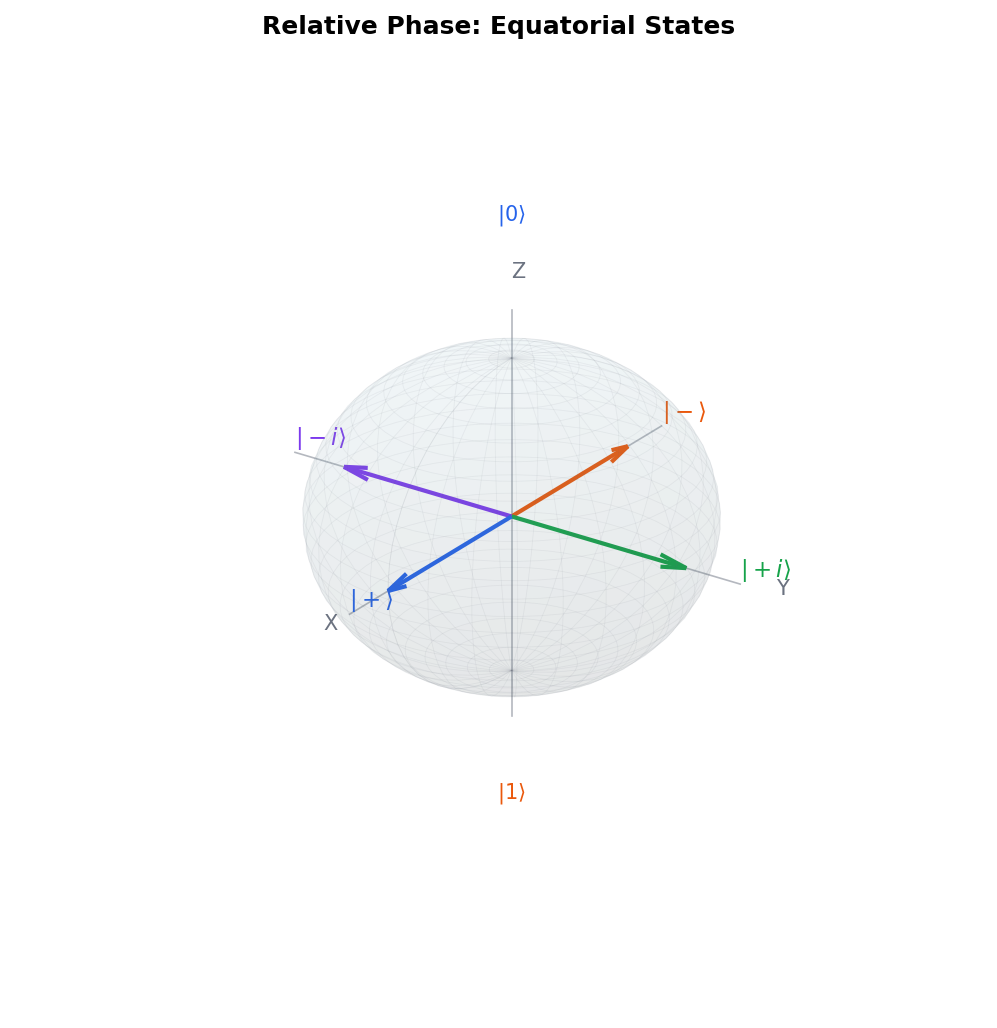
- On the Bloch Sphere, relative phase φ corresponds to the azimuthal angle (rotation around the z-axis).
Why This Matters
In our mathematical journey, we have seen that a qubit's state is described by complex numbers. While the magnitudes of these numbers dictate the probabilities we observe upon measurement, their angles, known as phases, hold the key to the true power of quantum computing. Phase is the engine of quantum interference, allowing computational paths to coordinate, reinforce, or cancel one another.
In this topic, we will demystify quantum phase. We will draw a sharp mathematical distinction between global phase (which has no physical effect) and relative phase (which completely alters a qubit's physical state). We will explore how relative phase is represented on the Bloch Sphere and analyze how it enables the wave-like interference that drives quantum algorithms.
By the end of this topic, you will be able to identify and discard global phases, calculate the relative phase of any qubit state, and explain why relative phase is a physically observable property that distinguishes quantum information from classical probability.
Core Intuition
Imagine two synchronized swimmers performing in a pool. If both swimmers jump up and down in perfect sync, they are 'in phase.' The waves they create add together to make larger waves. If one swimmer jumps up while the other dives down, they are 'out of phase.' Their waves cancel each other out, leaving the water calm. The timing of their movements is the phase.
Now, imagine you turn off the lights in the entire pool arena. It doesn't matter if the swimmers are in sync or out of sync; you can't see them. This is like global phase. If you shift the timing of *both* swimmers by the exact same amount, nothing about their relationship changes. To an outside observer, the performance looks identical. Global phase is a shift that affects the entire system equally, making it completely invisible.
But if you shift the timing of only *one* swimmer relative to the other, you have changed the relative phase. Now, when they perform, they might cancel each other out instead of adding together. This relative phase is highly visible because it changes the physical outcome of their interaction. In a qubit, relative phase is the difference in timing between the $|0\rangle$ wave and the $|1\rangle$ wave, and it dictates how they will interfere when they meet.
Visualization
Technical Explanation
Let us mathematically define global and relative phase. Suppose we have a qubit state:
$$|\psi\rangle = \alpha|0\rangle + \beta|1\rangle$$
If we multiply the entire state vector by a complex phase factor $e^{i\gamma}$ (where $\gamma$ is a real number), we get a new state:
$$|\psi'\rangle = e^{i\gamma}|\psi\rangle = e^{i\gamma}\alpha|0\rangle + e^{i\gamma}\beta|1\rangle$$
Here, $e^{i\gamma}$ is a global phase. Let us calculate the measurement probability of $|0\rangle$ for this new state using the Born Rule:
$$P'(0) = |e^{i\gamma}\alpha|^2 = (e^{i\gamma}\alpha)(e^{i\gamma}\alpha)^* = e^{i\gamma}e^{-i\gamma}\alpha\alpha^* = 1 \cdot |\alpha|^2 = |\alpha|^2$$
Because $e^{i\gamma}e^{-i\gamma} = 1$, the global phase completely cancels out. This is true for *any* measurement in *any* basis. Therefore, $|\psi\rangle$ and $e^{i\gamma}|\psi\rangle$ represent the exact same physical state.
Now, let us look at relative phase. We can write any normalized state vector by factoring out the phase of the $|0\rangle$ component, leaving:
$$|\psi\rangle = \cos\left(\frac{\theta}{2}\right)|0\rangle + e^{i\phi}\sin\left(\frac{\theta}{2}\right)|1\rangle$$
Here, the phase of the $|0\rangle$ component is real, and the phase factor $e^{i\phi}$ is attached solely to the $|1\rangle$ component. This angle $\phi$ is the relative phase.
To see why relative phase is physically observable, compare the states $|+\rangle$ (relative phase $\phi = 0$) and $|-\rangle$ (relative phase $\phi = \pi$):
$$|+\rangle = \frac{1}{\sqrt{2}}|0\rangle + \frac{1}{\sqrt{2}}|1\rangle, \quad |-\rangle = \frac{1}{\sqrt{2}}|0\rangle - \frac{1}{\sqrt{2}}|1\rangle$$
While they have the same probabilities in the computational basis, if we apply a Hadamard gate (which we will study in Section 4), $|+\rangle$ transforms to $|0\rangle$, while $|-\rangle$ transforms to $|1\rangle$. A subsequent measurement will yield completely different results, proving that relative phase is a physically real, observable property.