Amplitude Amplification
Amplitude amplification generalizes Grover's search to any start state, boosting success to near 1 in O(1/sqrt(p))
Source: mortalapps.com- Amplitude amplification generalizes Grover's search to arbitrary starting states.
- It boosts success probability from $p$ to nearly 1 in $O(1/\sqrt{p})$ steps.
- It achieves a quadratic speedup over classical repetition ($O(1/p)$).
- The algorithm performs geometric rotations in a 2D subspace.
- It requires a non-zero initial overlap with the target state.
Why This Matters
Amplitude Amplification is a general quantum search technique that generalizes Grover's algorithm. While Grover's algorithm starts from a uniform superposition, amplitude amplification can start from any arbitrary quantum state prepared by a unitary operator, systematically boosting the probability of finding a 'marked' target state.
Core Intuition
Imagine you have a quantum algorithm that prepares a state containing the correct answer, but only with a tiny probability (say, 1%). Classically, you would have to run the algorithm 100 times to find the answer. Amplitude amplification acts like a lens that focuses the quantum state. By repeatedly reflecting the state vector across the starting state and the target state, we can boost the success probability from 1% to nearly 100% in only $\sqrt{100} = 10$ steps. It is the quantum equivalent of tuning a radio to a weak signal until it becomes loud and clear.
Visualization
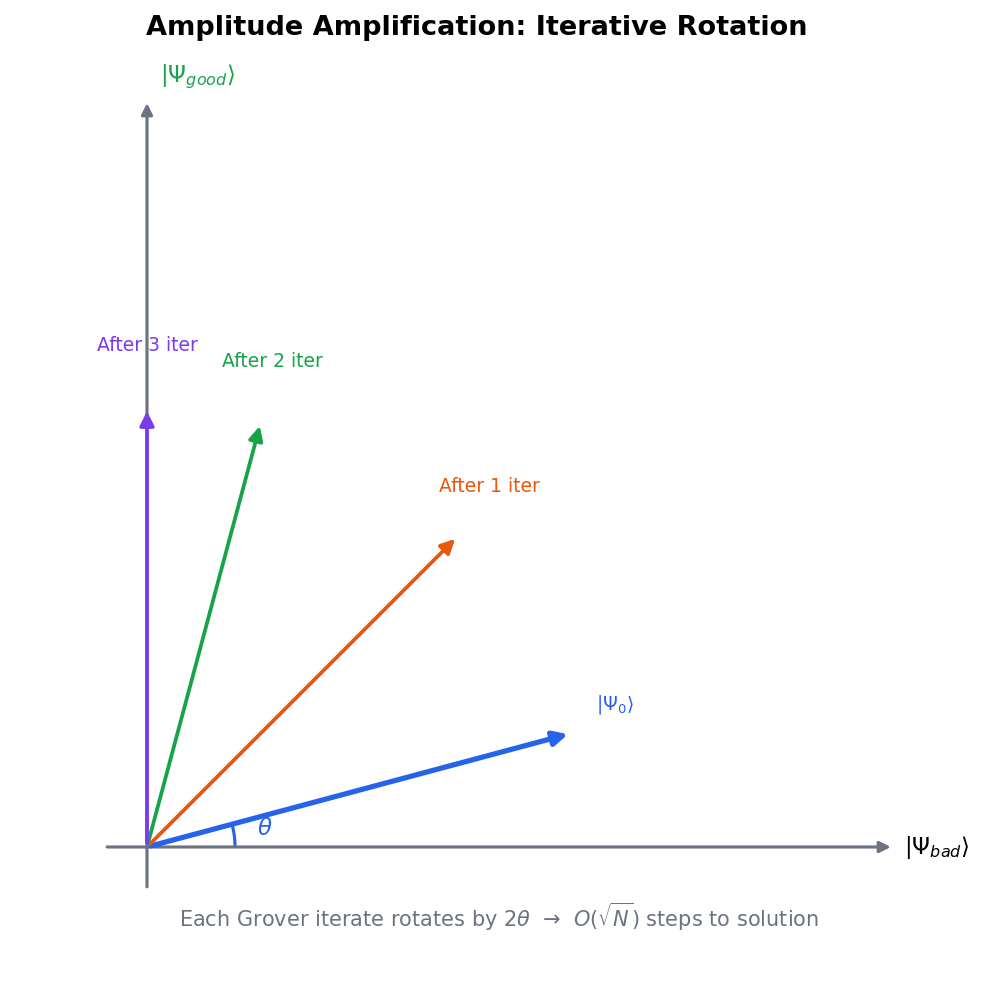
Technical Explanation
Let $A$ be a unitary operator that prepares a state $|\Psi\rangle = A|0\rangle^{\otimes n}$. We can decompose $|\Psi\rangle$ into a superposition of 'good' states (target states) and 'bad' states:
$$|\Psi\rangle = \sin(\theta) |\Psi_{\text{good}}\rangle + \cos(\theta) |\Psi_{\text{bad}}\rangle$$
where $|\Psi_{\text{good}}\rangle$ is the normalized projection of $|\Psi\rangle$ onto the target subspace, and $\sin^2(\theta) = p$ is the initial success probability.
We define the generalized Grover iteration operator $Q$ as:
$$Q = -A S_0 A^{-1} S_{\chi}$$
where:
- $S_{\chi} = I - 2\sum_{x \in \text{good}} |x\rangle\langle x|$ is the oracle that flips the sign of the good states.
- $S_0 = I - 2|0\rangle\langle0|^{\otimes n}$ is the phase shift operator that flips the sign of the all-zero state.
Each application of $Q$ rotates the state vector in the 2D subspace spanned by $\{|\Psi_{\text{bad}}\rangle, |\Psi_{\text{good}}\rangle\}$ by an angle of exactly $2\theta$.
To maximize the probability of measuring a good state, we apply $Q$ exactly $m$ times, where:
$$m = \left\lfloor \frac{\pi}{4\theta} \right\rfloor \approx \frac{\pi}{4\sqrt{p}}$$
This results in a quadratic speedup: instead of running the algorithm $O(1/p)$ times classically, we only need $O(1/\sqrt{p})$ quantum evaluations.