Superconducting Qubits
Superconducting qubits are macroscopic circuits with Josephson junctions isolating a two-level system near absolute zero
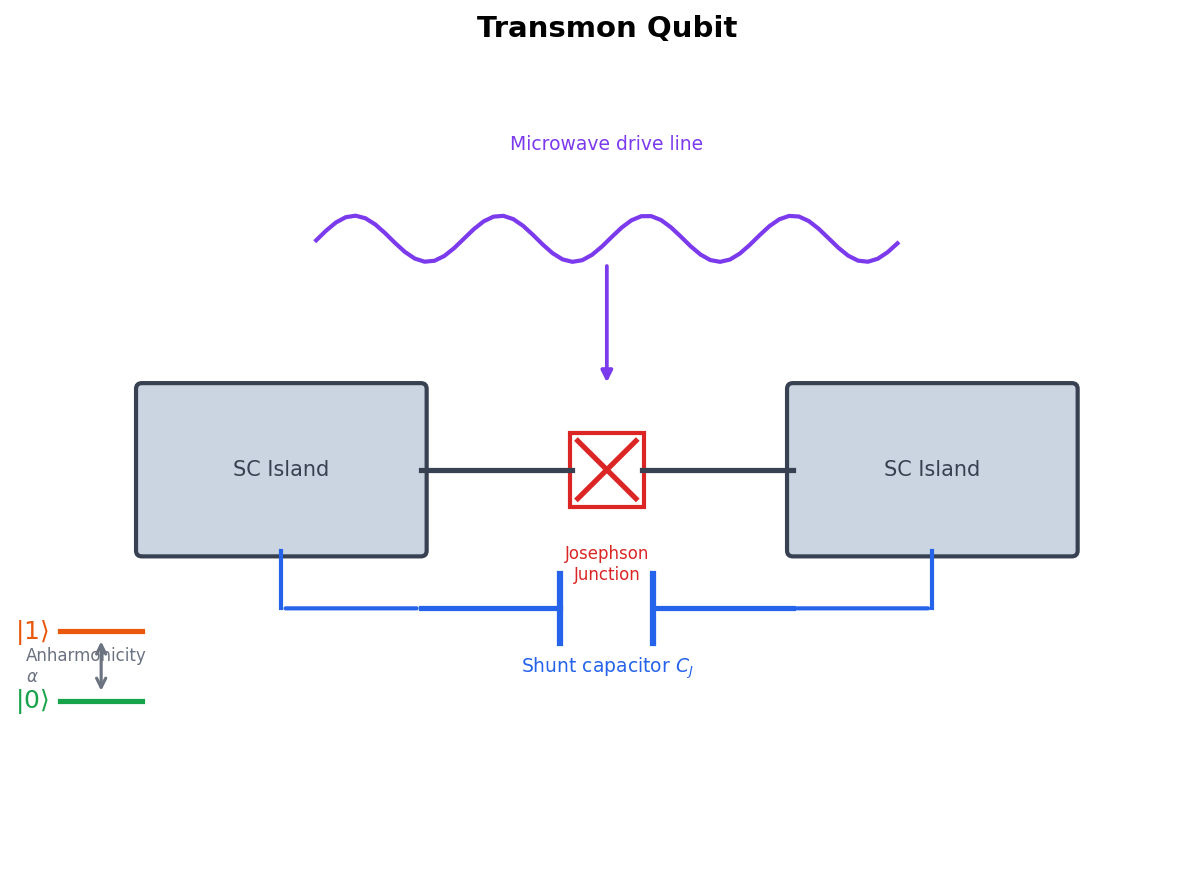
Source: mortalapps.com- Superconducting qubits are macroscopic artificial atoms fabricated on silicon chips.
- The Josephson junction acts as a non-linear inductor that breaks the harmonic energy ladder, allowing the isolation of a two-level qubit.
- The transmon design shunts the Josephson junction with a large capacitor to exponentially suppress charge noise.
- Anharmonicity is the energy difference between the |0> to |1> and |1> to |2> transitions, limiting gate speed.
- Superconducting qubits offer exceptionally fast gate speeds (20-100 ns) but suffer from relatively short coherence times (100-300 us).
- These systems must be cooled to 10-15 mK in dilution refrigerators to suppress thermal excitation.
Why This Matters
Superconducting qubits are currently the most widely adopted technology for building quantum computers, used by industry giants like IBM and Google. These qubits are not microscopic particles like atoms or electrons; instead, they are macroscopic electronic circuits fabricated on silicon chips using standard semiconductor manufacturing techniques. By cooling these circuits to near absolute zero, the current flows without resistance, allowing us to exploit quantum superposition and entanglement at a scale visible to the naked eye.
Core Intuition
To understand a superconducting qubit, start by imagining a standard radio tuner circuit consisting of an inductor (L) and a capacitor (C). This LC circuit acts like an electronic pendulum: energy swings back and forth between the capacitor (electric field) and the inductor (magnetic field) at a specific resonant frequency. However, a standard LC circuit is a harmonic oscillator, meaning its energy levels are perfectly evenly spaced, like the rungs of a ladder. If you try to drive the circuit from the ground state $|0\rangle$ to the first excited state $|1\rangle$, you will inevitably drive it to $|2\rangle$, $|3\rangle$, and so on. It cannot act as a qubit.
To fix this, we replace the standard inductor with a Josephson junction, a microscopic sandwich of two superconductors separated by an incredibly thin insulating barrier. The Josephson junction acts as a highly non-linear inductor. This non-linearity squashes the energy ladder, making the spacing between the first two rungs ($|0\rangle$ and $|1\rangle$) different from the spacing between all higher rungs. This allows us to isolate the $|0\rangle$ and $|1\rangle$ states using precise microwave pulses, creating an 'artificial atom' on a chip.
Visualization
Technical Explanation
The dominant design in modern superconducting quantum computing is the transmon qubit, which is a capacitively shunted charge qubit. The transmon consists of a Josephson junction in parallel with a large shunting capacitor. This design is engineered to suppress charge noise, which historically caused rapid decoherence in early superconducting qubits.
The Hamiltonian of a transmon qubit can be written as: $$H = 4 E_C (n - n_g)^2 - E_J \cos(\theta)$$ where $E_C = e^2 / (2 C_{\Sigma})$ is the charging energy, $E_J = I_c \Phi_0 / (2\pi)$ is the Josephson coupling energy, $n$ is the number of Cooper pairs on the island, $n_g$ is the offset charge, and $\theta$ is the phase difference across the junction. By engineering the ratio $E_J / E_C \gg 1$ (typically between 50 and 100), the qubit transition frequency becomes highly insensitive to fluctuations in the offset charge $n_g$, exponentially increasing the dephasing time $T_2$.
The non-linearity of the Josephson junction introduces anharmonicity, defined as: $$\alpha = E_{12} - E_{01} \approx -E_C$$ where $E_{01}$ is the transition energy between $|0\rangle$ and $|1\rangle$, and $E_{12}$ is the transition energy between $|1\rangle$ and $|2\rangle$. For a typical transmon, $E_{01} / 2\pi \approx 5\text{ GHz}$ and $\alpha / 2\pi \approx -300\text{ MHz}$. This anharmonicity is small but sufficient to allow single-qubit gates to be performed in $10-50\text{ ns}$ without leaking population to the $|2\rangle$ state.
Key hardware parameters for modern transmons:
- T1 (Energy Relaxation): $100 - 300\ \mu\text{s}$
- T2 (Dephasing): $50 - 200\ \mu\text{s}$
- Gate Fidelity: Single-qubit $\sim 99.99\%$, Two-qubit $\sim 99.9\%$
- Connectivity: Nearest-neighbor (planar grid or heavy-hex)
- Operating Temperature: $10 - 15\text{ mK}$
- Gate Speed: $20 - 100\text{ ns}$