Photonic Quantum Computing
Photonic qubits use single photons in waveguides, offering room-temperature operation but probabilistic two-qubit gates
Source: mortalapps.com- Photonic qubits are single particles of light (photons) traveling through optical waveguides.
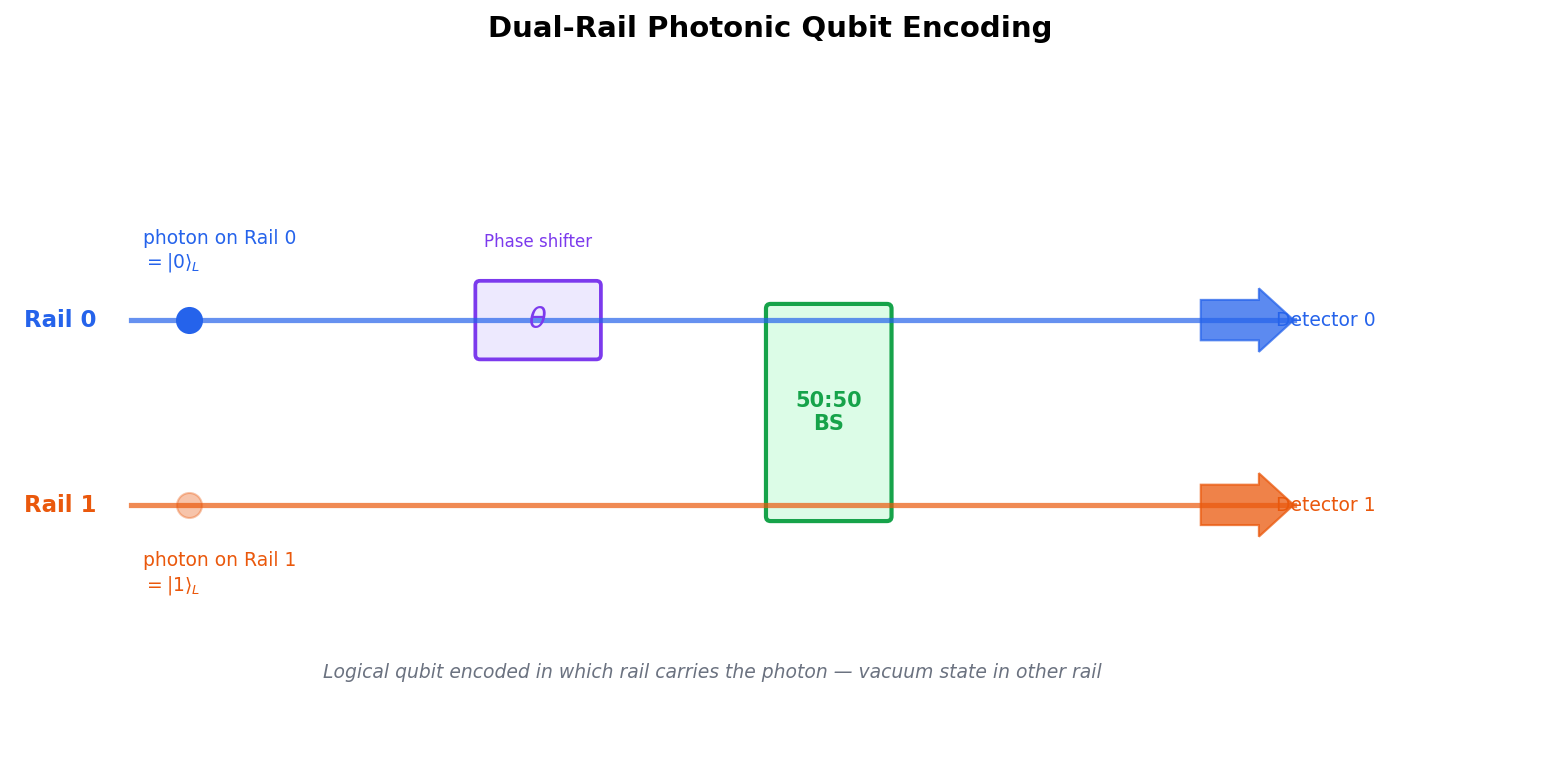
- Dual-rail encoding represents qubits by the presence of a photon in one of two parallel spatial paths.
- Single-qubit gates are performed using passive optical components like beamsplitters and phase shifters.
- Two-qubit gates require non-linear interactions, which are achieved using measurement-induced entanglement (KLM protocol).
- Measurement-Based Quantum Computing (MBQC) performs computation by sequentially measuring photons in a pre-prepared entangled cluster state.
- Photons do not suffer from thermal decoherence, but they are highly susceptible to loss (photons being absorbed or scattered).
Why This Matters
Photonic quantum computing is a unique architecture that uses single particles of light (photons) as qubits. Unlike superconducting circuits or trapped ions, which are stationary matter-based qubits, photons are 'flying qubits' that travel at the speed of light. Because photons do not have mass or charge, they do not easily interact with their environment, making them virtually immune to the decoherence that plagues other platforms. However, this same property makes getting photons to interact with *each other* to perform two-qubit gates one of the greatest challenges in physics.
Core Intuition
To understand photonic quantum computing, imagine a massive, ultra-precise marble run made of glass tubes. Instead of glass marbles, we release single photons into the maze. The tubes represent optical waveguides etched onto a silicon chip.
To encode a qubit, we use dual-rail encoding: we send a single photon down one of two parallel waveguides. If the photon goes through the top waveguide, we call it $|0\rangle$; if it goes through the bottom waveguide, we call it $|1\rangle$. If we send the photon through a special junction where the two waveguides run very close to each other (a directional coupler or beamsplitter), the photon can tunnel between them, entering a superposition of being in both paths simultaneously. This acts as a single-qubit gate. To perform a two-qubit gate, we must make two photons interact. Since light beams normally pass right through each other without touching, we must use highly specialized measurement-based tricks to force them to interact.
Visualization
Technical Explanation
In linear optical quantum computing (LOQC), qubits are typically encoded using dual-rail encoding, where the computational states are defined as: $$|0\rangle = |1, 0\rangle = a_1^\dagger |\text{vac}\rangle$$ $$|1\rangle = |0, 1\rangle = a_2^\dagger |\text{vac}\rangle$$ where $a_i^\dagger$ is the creation operator for a photon in spatial mode $i$, and $|\text{vac}\rangle$ is the vacuum state.
Single-qubit gates are easily implemented using linear optical components. A beamsplitter performs a unitary transformation on the spatial modes: $$\begin{pmatrix} a_1^\dagger \\ a_2^\dagger \end{pmatrix} \to \begin{pmatrix} \cos\theta & i\sin\theta \\ i\sin\theta & \cos\theta \end{pmatrix} \begin{pmatrix} a_1^\dagger \\ a_2^\dagger \end{pmatrix}$$ For $\theta = \pi/4$, the beamsplitter acts as a Hadamard-like gate, creating a spatial superposition.
Two-qubit gates require non-linear interactions. Because natural optical non-linearities (Kerr effect) are extremely weak at the single-photon level, LOQC relies on measurement-induced non-linearities. The classic example is the Knell-Laflamme-Milburn (KLM) protocol, which proved that universal quantum computation is possible using only linear optics (beamsplitters, phase shifters) and single-photon detectors. The interaction is mediated by the act of measurement: by mixing the qubit photons with auxiliary (ancilla) photons on beamsplitters and detecting the ancilla photons, the remaining qubits are projected into an entangled state conditional on a specific measurement outcome (heralded gates).
Modern photonic architectures have shifted to Measurement-Based Quantum Computing (MBQC). Instead of executing gates sequentially on physical qubits, MBQC starts by preparing a highly entangled multi-photon state called a cluster state (or graph state). The computation is then performed entirely by making sequential single-qubit measurements on the photons in a specific order and basis, destroying the photons but propagating the quantum information through the remaining cluster.