What Quantum Computers Are Good At
Quantum computers excel at simulating quantum systems, factoring large numbers, and searching unstructured data
Source: mortalapps.com- Quantum computers excel at problems where classical computers are fundamentally inefficient.
- They are uniquely suited for simulating complex quantum systems, like molecules and materials.
- Quantum computers can find optimal solutions for complex optimization problems more efficiently.
- Shor's algorithm allows quantum computers to factor large numbers, posing a threat to current encryption.
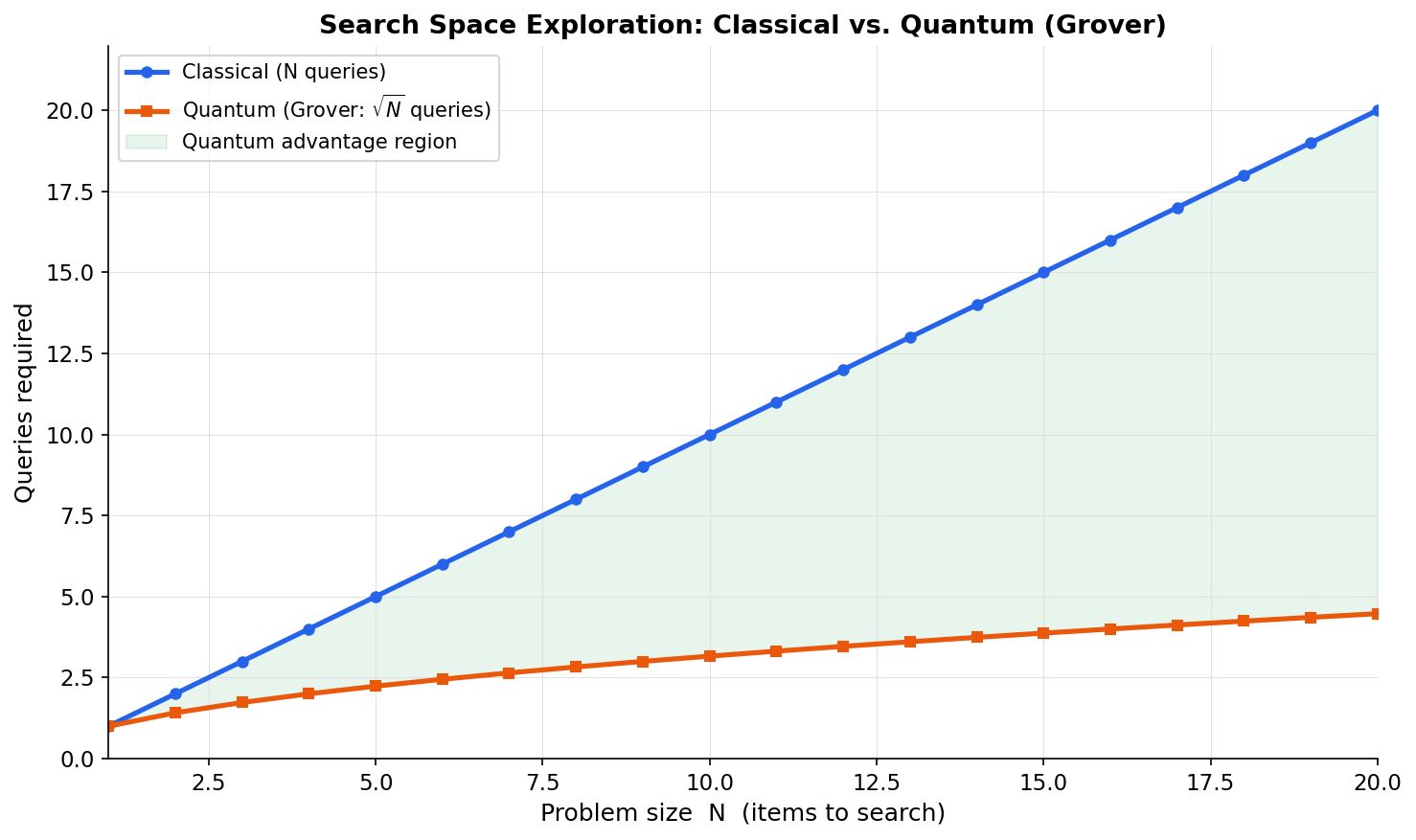
- Grover's algorithm offers speedups for unstructured search problems.
- Quantum machine learning is an emerging field with potential for enhanced AI capabilities.
- Quantum computers are specialized tools, not general-purpose replacements for classical computers.
Why This Matters
We've spent a lot of time understanding the fundamental differences between classical bits and quantum qubits, and the strange properties of superposition and entanglement. You now know *how* quantum information behaves. But the big question remains: what can we actually *do* with this quantum weirdness? What problems can quantum computers solve that classical ones can't?
This topic will answer that crucial question. We'll explore the specific categories of problems where quantum computers are expected to shine, leveraging their unique abilities to explore vast possibilities and simulate complex natural systems. It's where the theoretical power of quantum mechanics meets practical application.
By the end of this topic, you'll have a clear picture of the types of challenges quantum computers are uniquely suited to tackle, and why they represent a paradigm shift in computational capability.
Core Intuition
Imagine you're trying to find the shortest route through a maze with billions of possible paths. A classical computer is like a very fast explorer who tries one path at a time, marks dead ends, and eventually finds the shortest one. It's systematic but can take a very long time for a huge maze.
A quantum computer, thanks to superposition, is like being able to explore *all* paths in the maze simultaneously. It doesn't literally 'walk' every path, but its quantum state represents all of them at once. Then, using entanglement, it can 'interfere' these paths with each other, causing the wrong paths to cancel out and the correct (shortest) path to become much brighter, making it easier to 'see' when you finally look.
Think of it as having a magical map where all possible routes are drawn, and then you can shake the map in a special way that makes the best route glow brightly, while all the bad routes fade away. This isn't about being faster at individual steps; it's about a fundamentally different way of searching and processing information that leverages the quantum nature of reality.
Visualization
Technical Explanation
Quantum computers excel at specific types of problems that are computationally intractable for classical machines. These problems generally fall into categories where the number of possible solutions or states grows exponentially with the problem size, or where the problem itself involves simulating quantum mechanical systems.
1. Simulation of Quantum Systems: This is perhaps the most natural application. Since quantum computers operate on quantum principles, they are inherently well-suited to simulate the behavior of molecules, materials, and other quantum systems. Classical computers struggle because they have to approximate these quantum interactions. Quantum computers can model them directly, leading to breakthroughs in drug discovery, materials science, and chemistry. For example, simulating a complex protein or a new catalyst.
2. Optimization Problems: Many real-world challenges involve finding the 'best' solution among an enormous number of possibilities. Examples include finding the most efficient delivery routes, optimizing financial portfolios, scheduling complex tasks, or designing efficient power grids. Classical computers often rely on heuristics (good guesses) to find 'good enough' solutions. Quantum algorithms, leveraging superposition to explore many possibilities simultaneously and entanglement to find optimal connections, can potentially find truly optimal solutions much faster.
3. Factoring Large Numbers and Cryptography: One of the most famous quantum algorithms, Shor's algorithm, can efficiently factor large numbers. This is a problem that is extremely difficult for classical computers and forms the basis of much of modern internet security (e.g., RSA encryption). A sufficiently powerful quantum computer could break these encryption schemes, necessitating the development of 'post-quantum cryptography.'
4. Unstructured Search: For problems where you need to find a specific item in a vast, unsorted database, Grover's algorithm offers a quadratic speedup over classical search methods. While not an exponential speedup, it can still be significant for very large databases, making certain search tasks much more efficient.
5. Machine Learning: Quantum machine learning is an emerging field exploring how quantum computers can enhance machine learning tasks, such as pattern recognition, classification, and data analysis. Quantum algorithms might be able to process and analyze large datasets more efficiently, or find patterns that are hidden to classical algorithms, potentially leading to more powerful AI.
It's important to remember that quantum computers are not general-purpose speed-ups for all tasks. They are specialized tools designed to tackle these specific, incredibly hard problems by leveraging the unique properties of superposition and entanglement.