Quantum Advantage Explained
Quantum advantage is when a quantum computer solves a problem no classical supercomputer can match practically
Source: mortalapps.com- Quantum advantage is when a quantum computer solves a problem practically impossible for classical supercomputers.
- It's a qualitative leap in capability, not just a marginal speedup.
- The problem must be solvable by a quantum computer in a reasonable timeframe, while classical takes an unreasonable time.
- Quantum advantage leverages superposition to explore vast possibilities and entanglement for coordinated manipulation.
- Early demonstrations often use abstract problems like random circuit sampling to prove the principle.
- 'Useful quantum advantage' refers to solving real-world problems faster than classical machines.
- Achieving quantum advantage is a critical milestone, validating the power of quantum computing.
Why This Matters
You now understand what quantum computers are good at and what they are not. This leads us to a pivotal concept in the field: 'quantum advantage.' This term is often used, sometimes interchangeably with 'quantum supremacy,' and it represents the moment when a quantum computer truly demonstrates its unique power.
This topic will demystify quantum advantage. We'll define what it means, explain why it's such a significant milestone, and discuss the conditions under which it can be achieved. It's not just about being 'faster,' but about solving problems that are practically impossible for even the most powerful classical supercomputers.
By the end of this topic, you'll grasp the true meaning of quantum advantage and appreciate why its achievement marks a critical turning point in the journey towards useful quantum computing.
Core Intuition
Imagine you need to find the combination to a combination lock with a billion possible codes. A classical computer tries each combination one after another, methodical but slow. Even at a billion tries per second, some problems would take longer than the age of the universe.
Now imagine a quantum computer. Instead of trying combinations sequentially, it can set up a quantum state that encodes all possible combinations at once, then use interference to make the wrong answers cancel out and the correct answer emerge. It's not just a faster safe-cracker, it's a fundamentally different way of approaching the search that exploits the structure of the problem itself.
This is the essence of quantum advantage: not simply doing the same thing faster, but using superposition and interference to reach answers that are practically unreachable by any classical approach. The advantage is qualitative, not merely quantitative.
Visualization
Technical Explanation
Quantum advantage (sometimes referred to as quantum supremacy) is achieved when a quantum computer performs a computational task that is practically impossible for even the fastest classical supercomputers to complete within a reasonable timeframe. This isn't about solving *any* problem faster, but about demonstrating a clear, undeniable computational superiority for a specific, carefully chosen problem.
The key here is 'practically impossible.' This means that a classical supercomputer would take thousands, millions, or even billions of years to solve the problem, while a quantum computer can do it in minutes or hours. It's a qualitative leap in capability, not just a marginal speedup.
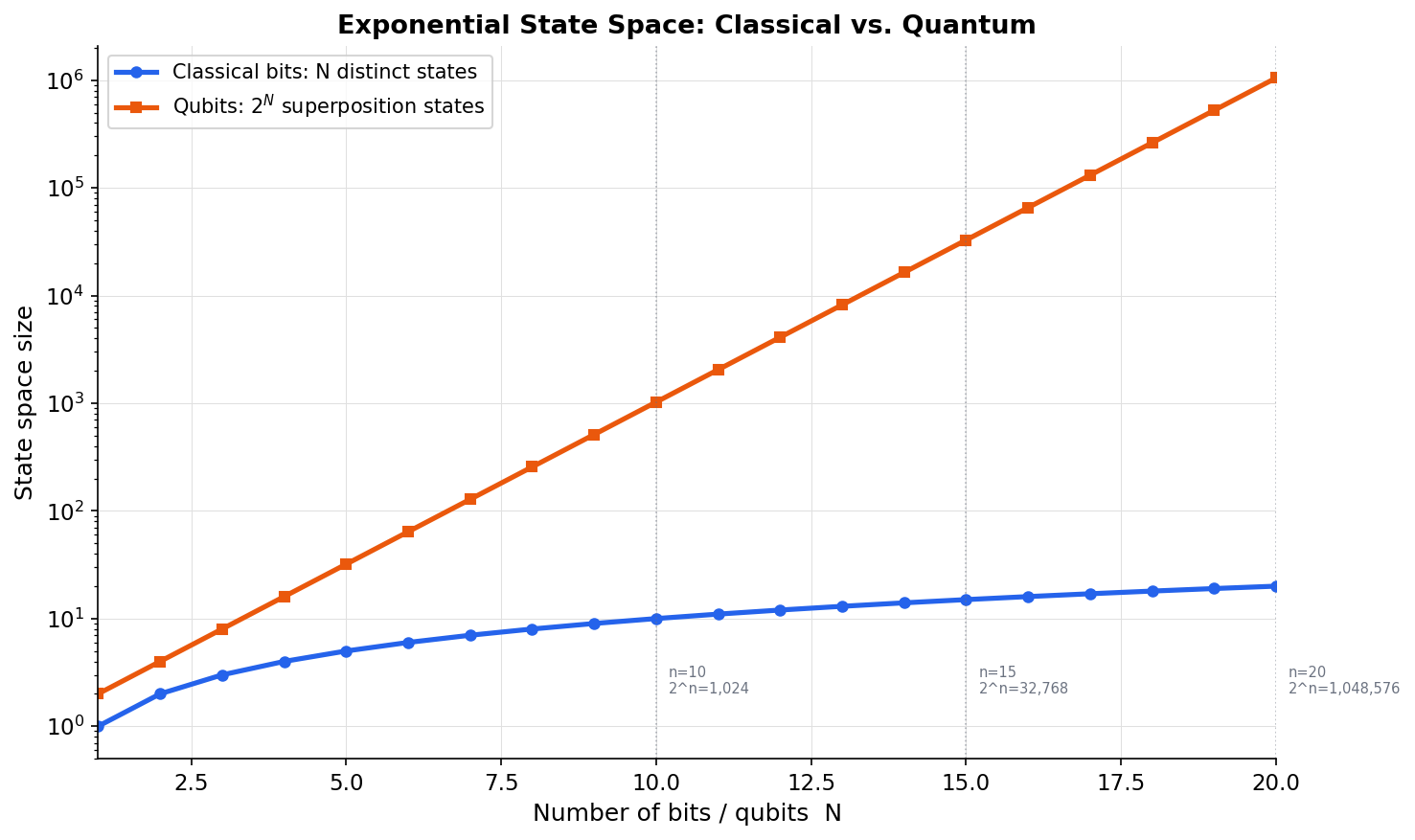
To achieve quantum advantage, a quantum computer must leverage its unique properties: superposition and entanglement. Superposition allows the quantum computer to represent an exponentially vast number of possibilities simultaneously. Entanglement allows these possibilities to interact and be manipulated in a coordinated way, leading to a computational path that is inaccessible to classical machines.
One common way to demonstrate quantum advantage is through a 'random circuit sampling' problem. This involves running a complex, random quantum circuit and then measuring the probabilities of its outputs. While the problem itself might not have immediate practical value, the task of *verifying* these output probabilities is incredibly difficult for classical computers. The quantum computer can generate these probabilities directly, demonstrating its ability to perform computations that are beyond classical reach.
It's important to note that achieving quantum advantage for a specific, often abstract, problem is a scientific milestone. It proves that quantum computers can indeed perform computations that classical computers cannot. The next step, which is still a significant challenge, is to achieve 'useful quantum advantage' – where a quantum computer solves a problem of practical, real-world importance faster than any classical machine. This is the ultimate goal of the field, and it requires more stable, larger-scale quantum computers.