Surface Codes
The surface code uses a 2D checkerboard lattice with local stabilizer measurements and a high fault-tolerance threshold
Source: mortalapps.com- The Surface Code is a 2D topological quantum error-correcting code that requires only local, nearest-neighbor interactions.
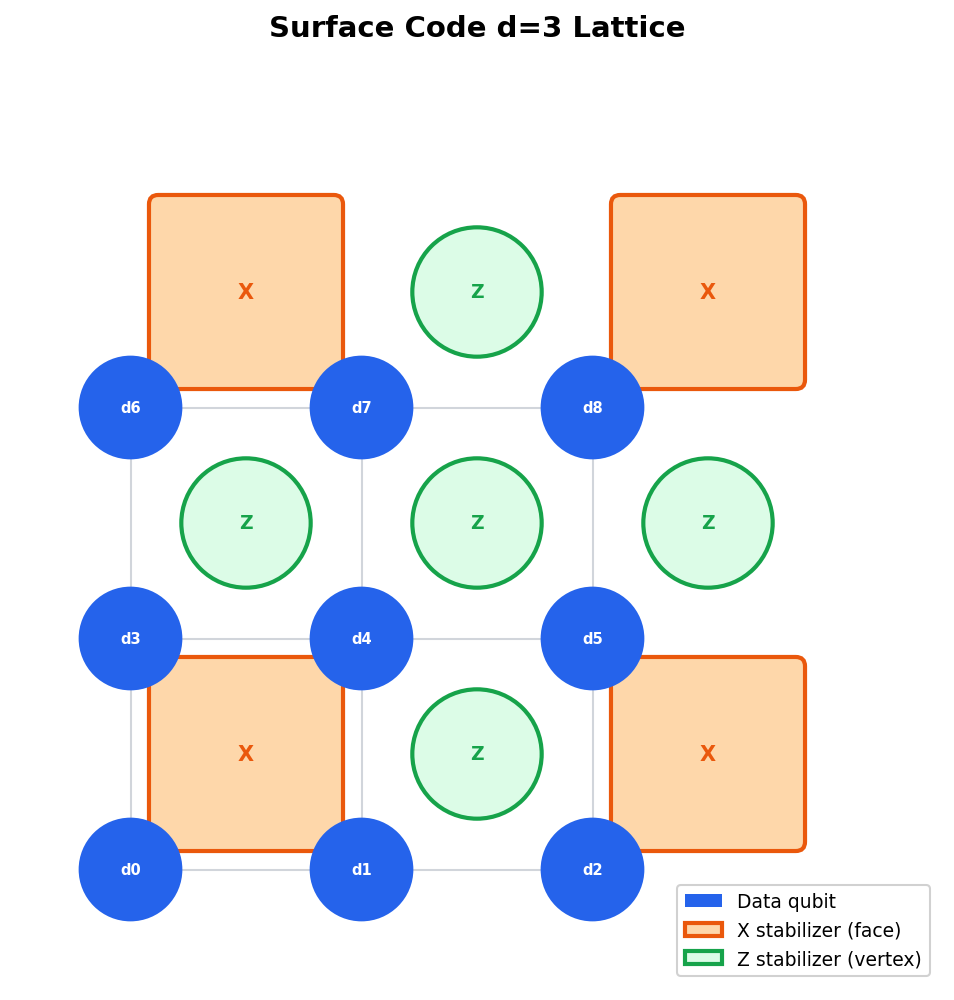
- It consists of a checkerboard lattice of data qubits (storing information) and ancilla qubits (measuring stabilizers).
- Star operators (X-type) detect phase-flip (Z) errors, while Plaquette operators (Z-type) detect bit-flip (X) errors.
- Stabilizers commute with each other, allowing them to be measured simultaneously and continuously.
- Physical errors form chains on the lattice; the endpoints of these chains are detected as -1 stabilizer eigenvalues.
- A classical decoding algorithm must solve a geometric matching problem to identify and correct the physical errors.
- The surface code is highly favored because of its high fault-tolerance threshold (approx. 1%) and planar layout.
Why This Matters
To build a practical quantum computer, we need a code that can protect against both bit-flip ($X$) and phase-flip ($Z$) errors simultaneously, while requiring only local, nearest-neighbor interactions on a physical chip. The leading solution to this challenge is the Surface Code. Arranged in a two-dimensional checkerboard lattice, the surface code is highly prized for its high fault-tolerance threshold and its compatibility with planar semiconductor and superconducting manufacturing processes.
In a surface code, physical qubits are divided into 'data qubits', which store the actual quantum information, and 'ancilla qubits', which are used exclusively to measure stabilizers. By continuously running local stabilizer measurements across the 2D surface, we can detect both $X$ and $Z$ errors as they appear. The errors form topological 'chains' on the lattice, and correcting them becomes a geometric path-finding problem.
This topic will explore the architecture of the surface code. We will analyze the 2D lattice structure, define the star ($X$-type) and plaque ($Z$-type) stabilizers, and explore how the code distance $d$ scales the physical qubit overhead. You will understand why the surface code has become the standard design for almost every major quantum hardware developer.
Core Intuition
Imagine a large checkerboard where white squares represent data qubits and black squares represent measurement zones (ancilla qubits). If a physical error occurs on one of the data qubits, it acts like a broken link in the fabric of the board. We cannot look at the white squares directly, but by constantly checking the boundaries of the black squares, we can see exactly where the fabric has torn.
If a single error occurs, it triggers a warning at the adjacent black squares. If multiple errors occur in a row, they form a 'string' or 'chain' of errors across the board, and only the endpoints of this chain will light up as active syndromes. Correcting the errors is like finding the shortest path to connect these endpoints and stitch the fabric back together. As long as the chains are short, we can easily find the correct path and repair the damage.
This topological approach means that the logical information is not stored in any single physical qubit, but is woven into the global, collective geometry of the entire surface. Just as you cannot destroy the concept of a 'loop' by cutting a single thread of a sweater, you cannot destroy the logical quantum state with a few localized physical errors. This geometric protection is what makes the surface code incredibly robust.
Visualization
Technical Explanation
The surface code is defined on a 2D square lattice. Data qubits are placed on the vertices of the lattice, while ancilla qubits are placed at the centers of the faces (plaquettes) and edges. There are two types of stabilizer generators that are measured continuously:
1. Star Operators ($A_s$) (or $X$-type stabilizers), associated with vertices $s$. They consist of the tensor product of Pauli $X$ operators acting on the four data qubits surrounding the vertex:
$$A_s = \prod_{i \in \text{star}(s)} X_i$$
2. Plaquette Operators ($B_p$) (or $Z$-type stabilizers), associated with faces $p$. They consist of the tensor product of Pauli $Z$ operators acting on the four data qubits surrounding the face:
$$B_p = \prod_{i \in \text{boundary}(p)} Z_i$$
Because these operators commute with each other ($[A_s, B_p] = 0$ for all $s, p$), they can be measured simultaneously. The logical states $|0_L\rangle$ and $|1_L\rangle$ are defined as the joint $+1$ eigenspace of all $A_s$ and $B_p$ operators.
When a physical $Z$ error occurs on a data qubit, it anticommutes with the adjacent $X$-type star operators, flipping their measurement outcomes from $+1$ to $-1$. Similarly, a physical $X$ error flips the adjacent $Z$-type plaquette operators. The set of all $-1$ measurement outcomes forms the error syndrome. A classical algorithm called a 'decoder' (such as the Minimum-Weight Perfect Matching algorithm) processes this syndrome to find the most likely chain of physical errors that caused it, and applies the corresponding correction.