Fault Tolerance
Fault-tolerant design prevents a single physical error from propagating through multi-qubit gates and overwhelming QEC
Source: mortalapps.com- Fault Tolerance is a system-wide design protocol that prevents single physical errors from propagating and multiplying.
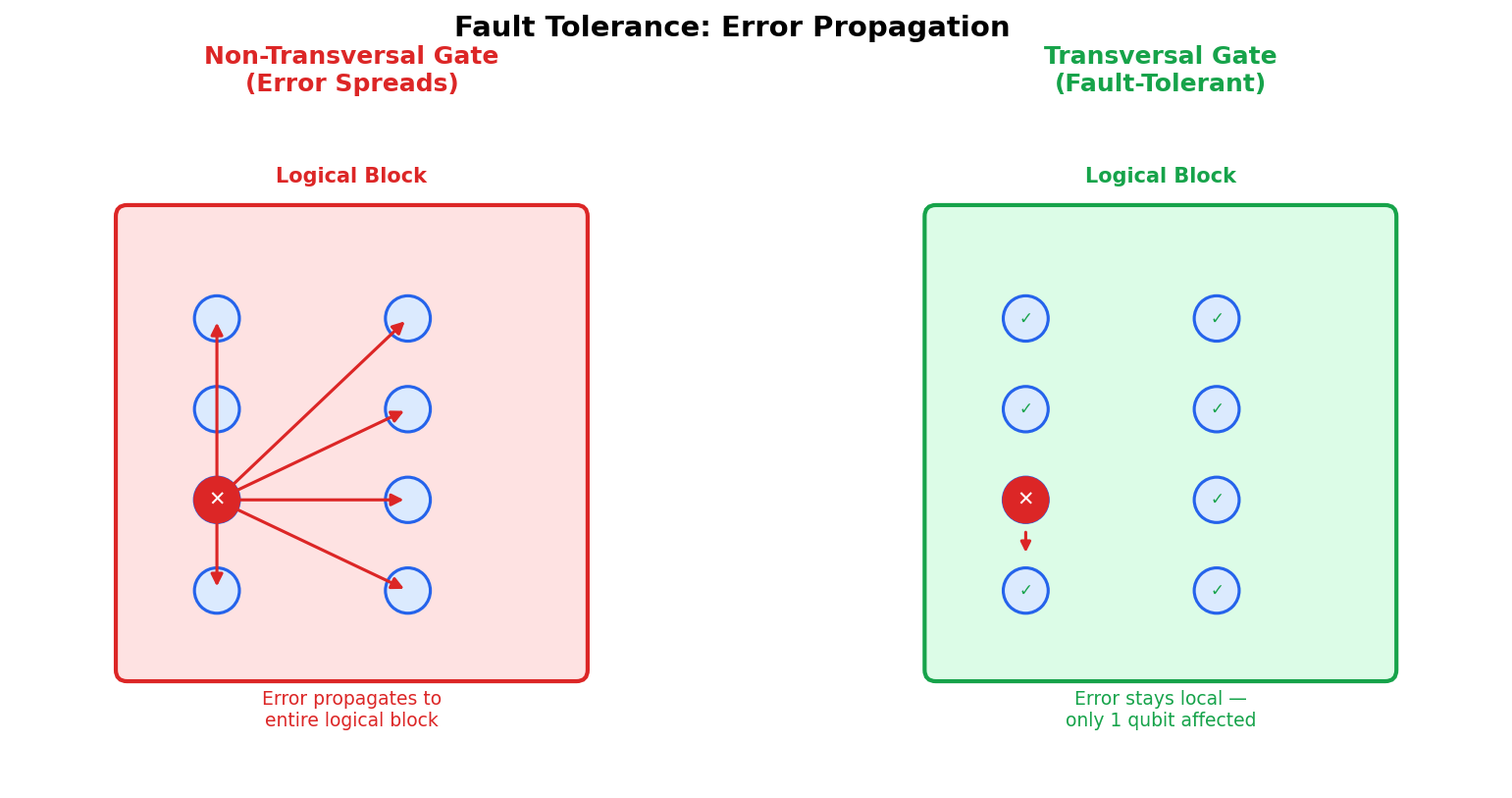
- A logical gate is fault-tolerant if a single physical error during its execution causes at most one physical error per output logical block.
- Transversal gates are the most elegant fault-tolerant operations, implemented by applying physical gates bitwise across blocks.
- The Eastin-Knill Theorem proves that no quantum code can implement a universal gate set using only transversal gates.
- Clifford gates (H, S, CNOT) are transversal on many codes, but non-Clifford gates (like the T gate) are not.
- Universality is achieved by combining transversal Clifford gates with Magic State Distillation to prepare high-fidelity T-states.
- Magic state distillation is highly resource-intensive, often accounting for over 90% of the physical qubit overhead in a fault-tolerant computer.
Why This Matters
Quantum Error Correction gives us a way to protect static quantum states, but a quantum computer is not a museum, it must perform active computations. When we apply quantum gates to logical qubits, we introduce a dangerous new vulnerability. If a single physical qubit inside a logical block has an error, a multi-qubit gate (like a CNOT) can cause that error to propagate and multiply, spreading to other physical qubits and quickly overwhelming the error-correcting code.
To prevent this catastrophic spread of errors, we must design our logical operations according to the strict principles of Fault Tolerance. Fault tolerance is a system-wide engineering protocol. It ensures that if a single error occurs anywhere in the system, whether during a gate, a measurement, or a state preparation, it remains contained and cannot cascade into multiple errors that exceed the code's correction capacity.
In this topic, we will explore the rigorous design of fault-tolerant operations. We will analyze transversal gates, the gold standard of fault tolerance, and examine the Eastin-Knill Theorem, which proves that no single quantum code can implement a universal gate set transversally. Finally, we will explore Magic State Distillation, the highly resource-intensive process used to overcome this limitation and achieve universal fault-tolerant quantum computing.
Core Intuition
To understand fault tolerance, imagine a highly sterile surgical operating room. The entire environment is designed to prevent the spread of contamination. If a surgeon drops a scalpel on the floor, that instrument is contaminated (an error). However, because of strict sterile protocols, the surgeon does not pick it up or use it; they discard it and use a fresh, sterile instrument. The contamination is contained to a single object and does not spread to the patient. This is a fault-tolerant protocol.
Now, contrast this with a non-fault-tolerant design: a water purification plant where all the filtration tanks are connected by a single, open pipe. If a contaminant enters the first tank, it immediately flows through the pipe and contaminates every subsequent tank, rendering the entire system useless. To make it fault-tolerant, we must use isolated, parallel channels with independent valves, ensuring that a leak in one tank can be completely isolated without affecting the others.
In a quantum computer, a logical gate is like that connection between tanks. If we are not careful, a CNOT gate can act as a bridge that takes a single physical error in logical qubit A and copies it to multiple physical qubits in logical qubit B. Fault-tolerant design ensures that our gates only interact in parallel, isolated pathways, preventing any single physical error from cascading into a multi-qubit disaster.
Visualization
Technical Explanation
A logical gate operation $U_L$ acting on a logical state $|\psi_L\rangle$ is defined as fault-tolerant if a single physical error occurring during the execution of the gate can cause at most a single physical error per logical qubit block at the output.
The most elegant way to achieve this is through Transversal Gates. A logical gate is transversal if it can be implemented by applying independent physical gates bitwise across the physical qubits of the code. For example, if we have two logical qubits encoded in a 3-qubit code, a transversal logical CNOT is implemented by applying three independent physical CNOT gates between the corresponding physical qubits:
$$\text{CNOT}_L = \text{CNOT}_{(1,1)} \otimes \text{CNOT}_{(2,2)} \otimes \text{CNOT}_{(3,3)}$$
Because the physical gates only interact pairwise ($1$ with $1$, $2$ with $2$, etc.), an error on physical qubit 1 of the first block can only propagate to physical qubit 1 of the second block. It cannot spread to qubits 2 or 3, keeping the error count within the correctable limit ($t=1$) of both blocks. This is perfectly fault-tolerant.
However, we face a fundamental mathematical barrier: the Eastin-Knill Theorem (1999). This theorem states that no quantum error-correcting code can implement a universal gate set using only transversal gates. For the surface code, Clifford gates (such as $H$, $S$, and CNOT) can be implemented fault-tolerantly, but the non-Clifford $T$ gate ($T = |0\rangle\langle0| + e^{i\pi/4}|1\rangle\langle1|$) cannot. To achieve universality, we must use Magic State Distillation, where multiple noisy, physically prepared auxiliary states (magic states $|T\rangle = \cos(\pi/8)|0\rangle + \sin(\pi/8)|1\rangle$) are fed into a specialized circuit that 'distills' them into a single, highly pure magic state, which is then consumed to execute the $T$ gate.